|
|
| | 1,2,3,4-Tetrachloronaphthalene Basic information |
| Product Name: | 1,2,3,4-Tetrachloronaphthalene | | Synonyms: | PCN-27;1,2,3,4- tetrachloro;Tetrachloronapthalene.;Naphthalene,1,2,3,4-tetrachloro-;1,2,3,4-Tetrachloronaphthalene in isooctane;1,2,3,4-Tetrachloronaphthalene in toluene;1,2,3,4-Tetrachloronaphthalene 100 μg/mL in Cyclohexane;1,2,3,4-Tetrachloronaphthalene 100 μg/mL in Nonane | | CAS: | 20020-02-4 | | MF: | C10H4Cl4 | | MW: | 265.95 | | EINECS: | 622-398-0 | | Product Categories: | Alpha Sort;T-ZAlphabetic;TA - TE;Halogenated;ChloroAnalytical Standards;Chemical Class;NaphthalenesVolatiles/ Semivolatiles | | Mol File: | 20020-02-4.mol | 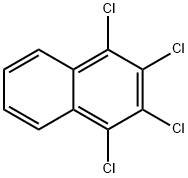 |
| | 1,2,3,4-Tetrachloronaphthalene Chemical Properties |
| Melting point | 196°C | | Boiling point | 362.3±37.0 °C(Predicted) | | density | 1.552±0.06 g/cm3(Predicted) | | Fp | -18 °C | | storage temp. | 2-8°C | | Henry's Law Constant | 4.1×10⁻² mol/(m3Pa) at 25℃, Duchowicz et al. (2020) | | Stability: | Stable. Incompatible with strong oxidizing agents. | | EPA Substance Registry System | 1,2,3,4-Tetrachloronaphthalene (20020-02-4) |
| | 1,2,3,4-Tetrachloronaphthalene Usage And Synthesis |
| Chemical Properties | light brown crystalline solid | | Uses | 1,2,3,4-Tetrachloronaphthalene is a standard for environmental testing and research. Substance for the studies on the pollutant concentration in the placenta: Unborn children are exposed to environmental pollutants via placenta, and there is causal relationship between maternal intake of pollutants and fetal exposure | | General Description | Light-brown crystalline solid. | | Air & Water Reactions | Insoluble in water. | | Reactivity Profile | Simple aromatic halogenated organic compounds, such as 1,2,3,4-TETRACHLORONAPHTHALENE, are very unreactive. Reactivity generally decreases with increased degree of substitution of halogen for hydrogen atoms. Materials in this group may be incompatible with strong oxidizing and reducing agents. Also, they may be incompatible with many amines, nitrides, azo/diazo compounds, alkali metals, and epoxides. | | Fire Hazard | The flash point of 1,2,3,4-TETRACHLORONAPHTHALENE has not been determined, but 1,2,3,4-TETRACHLORONAPHTHALENE is probably combustible. |
| | 1,2,3,4-Tetrachloronaphthalene Preparation Products And Raw materials |
|