- Isophorondiamine
-
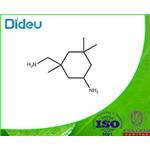
- $1.10
-
2026-08-20
- CAS:2855-13-2
- Min. Order: 1g
- Purity: 99.00%
- Supply Ability: 100 Tons Min
- Isophorondiamine
-

- $10.50
-
2026-05-28
- CAS:2855-13-2
- Min. Order: 1KG
- Purity: 99%
- Supply Ability: 10 ton
|
| | Isophorondiamine Basic information |
| Product Name: | Isophorondiamine | | Synonyms: | 1-AMINO-3-AMINOMETHYL-3,5,5-TRIMETHYLCYCLOHEXANE;Isophorondiamine;5-AMINO-1,3,3-TRIMETHYLCYCLOHEXANEMETHYLAMINE;5-amino-1,3,3-trimethyl-cyclohexanemethanamin;5-amino-1,3,3-trimethyl-Cyclohexanemethanamine;5-amino-1,3,3-trimethyl-cyclohexanemethylamin;aminomethyl-5;aminomethyl-5trimethyl-3,5,5cyclohexylamine | | CAS: | 2855-13-2 | | MF: | C10H22N2 | | MW: | 170.3 | | EINECS: | 220-666-8 | | Product Categories: | Amines;Intermediates & Fine Chemicals;Pharmaceuticals;Organics | | Mol File: | 2855-13-2.mol |  |
| | Isophorondiamine Chemical Properties |
| Melting point | 10 °C(lit.) | | Boiling point | 247 °C(lit.) | | density | 0.924 g/mL at 20 °C(lit.) | | vapor pressure | 0.02 hPa (20 °C) | | refractive index | n20/D 1.490 | | Fp | >230 °F | | storage temp. | Store below +30°C. | | solubility | Chloroform (Slightly), Methanol (Slightly) | | pka | 10.57±0.70(Predicted) | | form | Liquid | | color | Clear | | PH | 11.6 (10g/l, H2O, 20℃) | | explosive limit | 1.2%(V) | | Water Solubility | miscible | | Stability: | Stable. Incompatible with strong oxidizing agents. | | InChI | 1S/C10H22N2/c1-9(2)4-8(12)5-10(3,6-9)7-11/h8H,4-7,11-12H2,1-3H3 | | InChIKey | RNLHGQLZWXBQNY-UHFFFAOYSA-N | | SMILES | CC1(C)CC(N)CC(C)(CN)C1 | | LogP | 0.99 at 23℃ | | CAS DataBase Reference | 2855-13-2(CAS DataBase Reference) | | EPA Substance Registry System | Isophorone diamine (2855-13-2) |
| Hazard Codes | C | | Risk Statements | 21/22-34-43-52/53 | | Safety Statements | 26-36/37/39-45-61 | | RIDADR | UN 2289 | | WGK Germany | 1 | | RTECS | GV5020833 | | F | 10-21-34 | | Autoignition Temperature | 380 °C | | TSCA | TSCA listed | | HS Code | 2921 30 99 | | HazardClass | 8 | | PackingGroup | III | | Storage Class | 8A - Combustible corrosive hazardous materials | | Hazard Classifications | Acute Tox. 4 Dermal
Acute Tox. 4 Oral
Aquatic Chronic 3
Eye Dam. 1
Skin Corr. 1B
Skin Sens. 1A | | Hazardous Substances Data | 2855-13-2(Hazardous Substances Data) | | Toxicity | LD50 orally in Rabbit: 1030 mg/kg |
| | Isophorondiamine Usage And Synthesis |
| Description | Isophorone diamine is widely used as an epoxy-resin
hardener. It is a strong sensitizer and can cause
airborne contact dermatitis. | | Chemical Properties | faintly yellow liquid | | Uses | Isophorone diamine is a common hardener for epoxy resins. | | Uses | Isophorondiamine mainly used as epoxy curing agents, mainly for applications requiring low color, low odor, high flexural strength and excellent chemical resistance of epoxy formulations. Suitable for floor coatings, fillers and paving mixes. | | Uses | One of the three epoxy networks based on diglycidyl ether of bisphenol-A epoxy prepolymer cured with aliphatic amines, namely triethylenetetramine (TETA), 1-(2-aminoethyl) piperazine (AEP) and isophoronediamine (IPD). Allergic contact dermatitis (ACD) ca | | Production Methods | Isophorondiamine is made from isophorone nitrile, ammonia, and hydrogen, which leads to simultaneous imination and hydrogenation of the resulting imine and nitrile groups. Catalysts employed are mainly cobalt or ruthenium.
| | General Description | A clear to light-yellow liquid. Highly soluble though slightly denser than water. May be toxic by inhalation and skin absorption. Corrosive to skin. Used to make other chemicals. | | Air & Water Reactions | Soluble in water. Flash Point 234 F. Melting point 50 F. Reacts with carbon dioxide from the air to form deposits around vents (Roger Patrick, DuPont Engineer). | | Reactivity Profile | ISOPHORONE DIAMINE is an amine. Amines are chemical bases. They neutralize acids to form salts. These acid-base reactions are exothermic. The amount of heat that is evolved per mole of amine in a neutralization is largely independent of the strength of the amine as a base. Amines may be incompatible with isocyanates, halogenated organics, peroxides, phenols (acidic), epoxides, anhydrides, and acid halides (Roger Patrick, DuPont Engineer). Corrodes aluminum and steel in the presence of moisture and carbon dioxide [USCG, 1999]. | | Health Hazard | Inhalation of high concentrations of vapor causes irritation, coughing, and nausea. Eyes: May cause inflammation/burns. Skin: May cause burns. Ingestion: Nausea. | | Fire Hazard | Combustible material: may burn but does not ignite readily. When heated, vapors may form explosive mixtures with air: indoors, outdoors and sewers explosion hazards. Contact with metals may evolve flammable hydrogen gas. Containers may explode when heated. Runoff may pollute waterways. Substance may be transported in a molten form. | | Contact allergens | Isophorone diamine is widely used in urethane and
epoxy coatings for light-stable, weather-resistant prop-
erties. It is used in water proofing and paving concret-
ing, and in the manufacture of diisocyanates and
polyamides as an epoxy resin hardener. It is a strong
sensitizer and can cause airborne contact dermatitis. |
| | Isophorondiamine Preparation Products And Raw materials |
|