Ensartinib dihydrochloride manufacturers
|
| | Ensartinib dihydrochloride Basic information |
| Product Name: | Ensartinib dihydrochloride | | Synonyms: | Ensartinib dihydrochloride;X-396 hydrochloride;Ensartinib hydrochloride ( X396);X-396 dihydrochloride;Ensartinib,X396,Cluster of differentiation 246,X 396,Inhibitor,CD246,Anaplastic lymphoma kinase (ALK),Anaplastic lymphoma kinase,c-Met/HGFR,ALK tyrosine kinase receptor,Ensartinib hydrochloride,inhibit,X-396;Ensartinib 2HCl;Ensartinib (X-396) dihydrochloride;6-Amino-5-((R)-1-(2,6-dichloro-3-fluorophenyl)ethoxy)-N-(4-((3S,5R)-3,5-dimethylpiperazine-1-carbonyl)phenyl)pyridazine-3-carboxamide hydrochloride | | CAS: | 2137030-98-7 | | MF: | C26H28Cl3FN6O3 | | MW: | 597.9 | | EINECS: | | | Product Categories: | APIS | | Mol File: | 2137030-98-7.mol | 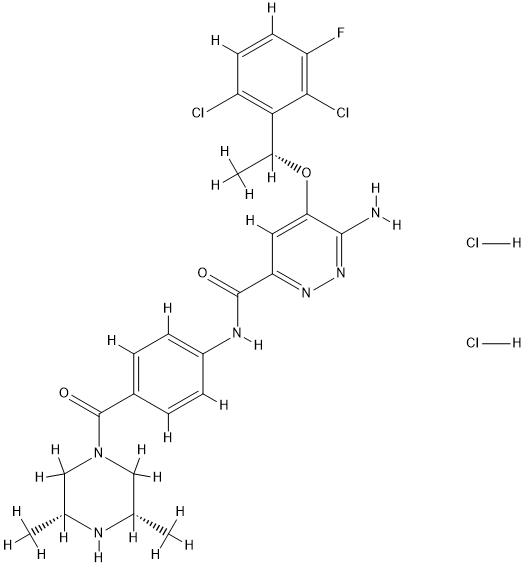 |
| | Ensartinib dihydrochloride Chemical Properties |
| storage temp. | 0 - 4℃ for short term (days to weeks), or -20℃ for long term (months). | | form | solid | | color | white | | Water Solubility | Water : 5 mg/mL (7.88 mM) | | InChIKey | IERUINQRGJAECT-ISUJJMBGSA-N |
| | Ensartinib dihydrochloride Usage And Synthesis |
| Description | Ensartinib
HCl is the salt form of Ensartinib, an orally available small molecule
inhibitor of the receptor tyrosine kinase anaplastic lymphoma kinase
(ALK) with potential antineoplastic activity. Upon oral administration,
X-396 binds to and inhibits ALK kinase, ALK fusion proteins and ALK
point mutation variants. Inhibition of ALK leads to the disruption of
ALK-mediated signaling and eventually inhibits tumor cell growth in
ALK-expressing tumor cells. ALK belongs to the insulin receptor
superfamily and plays an important role in nervous system development. | | Uses | Ensartinib dihydrochloride (X-396 dihydrochloride) is a potent and dual ALK/MET inhibitor with IC50s of <0.4 nM and 0.74 nM, respectively. | | Indications |
Ensartinib dihydrochloride is mainly used to treat patients with ALK-positive non-small cell lung cancer (NSCLC).
| | Synthesis |
The synthesis began with the reaction of dichloropyrazine 248 with ammonia via a SNAr reaction to generate aminopyrazine 249. Aminopyridazine 249 was reacted with bromine under alkaline conditions to give dihalogenated pyridazine building block 250 in 35% yield. First, chiral mixed benzyl alcohol (251) was isolated using N-Boc-D-proline and conventional esterification conditions to give 252 in 51% yield. Exposure of this system to sodium hydride in tetrahydrofuran (THF) gave an unusual substitution reaction with bromide 250. Ether 253 was recovered in 38% yield, and the amine Chemicalbook compound then underwent double Boc protection followed by metal-catalyzed carbonyl insertion in ethanol to give an ester that was subsequently saponified to afford acid 255. Piperazine (piperazine 256) was first reacted with another compound 257 under coupling conditions to form amide 258. Amide 258 then underwent Boc protection. The Boc-protected compound was then subjected to nitro reduction reaction to convert the nitro group to amino group to give aniline 259. Aniline 259 was coupled with the previously synthesized acid 255. Finally, ensartinib dihydrochloride was obtained by treatment with isopropanol hydrochloric acid.

| | in vivo | Ensartinib (X-396) dihydrochloride shows substantial bioavailability and moderate half-lives in vivo. Nude mice harboring H3122 xenografts are treated with Ensartinib dihydrochloride at 25 mg/kg bid. Ensartinib dihydrochloride significantly delays the growth of tumors compared to vehicle alone. In the xenograft experiments, Ensartinib dihydrochloride appears well-tolerated in vivo. Mouse weight is unaffected by Ensartinib dihydrochloride treatment. Drug-treated mice appear healthy and do not display any signs of compound related toxicity. To further assess potential side effects of Ensartinib dihydrochloride, additional systemic toxicity and toxico-kinetic studies are performed in Sprague Dawley (SD) rats. Following 10 days of repeated oral administration of Ensartinib dihydrochloride at 20, 40, 80 mg/kg in SD rats, all animals survive to study termination. The no significant toxicity (NST) levels are determined to be 80 mg/kg for Ensartinib dihydrochloride. At NST levels, Ensartinib dihydrochloride achieves an AUC of 66 μM×hr and a Cmax of 7.19 μM[1]. | | References | [1] Lovly CM, et al. Insights into ALK-driven cancers revealed through development of novel ALK tyrosine kinaseinhibitors. Cancer Res. 2011 Jul 15;71(14):4920-31. DOI:10.1158/0008-5472.CAN-10-3879 |
| | Ensartinib dihydrochloride Preparation Products And Raw materials |
|