| Company Name: |
Energy Chemical |
| Tel: |
400-0056266 |
| Email: |
sales8178@energy-chemical.com |
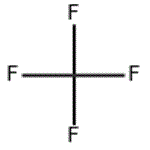
- Carbon tetrafluoride
-
- $1.10
-
2026-05-15
- CAS:75-73-0
- Min. Order: 1g
- Purity: 99.0% Min
- Supply Ability: 100 Tons
|
| | Carbon tetrafluoride Basic information |
| | Carbon tetrafluoride Chemical Properties |
| Melting point | −184 °C(lit.) | | Boiling point | −130 °C(lit.) | | density | (solid, -195°) 1.98; d (liq, -183°) 1.89 | | vapor density | 3.04 (vs air) | | refractive index | 1.1510 | | Water Solubility | mL/100mL in H2O: 0.595 (10°C), 0.490 (20°C), 0.366 (40°C) [LAN05] | | Specific Heat Capacity | Cp(gas): 0.69 J/(g·K), at 25℃ | | Merck | 13,1827 | | Henry's Law Constant | 2.1×10⁻⁶ mol/(m3Pa) at 25℃, Burkholder et al. (2019) | | Stability: | Stable. Incompatible with zinc, alkaline earth metals, Group I metals, aluminium and its alloys. Non-flammable. | | InChI | InChI=1S/CF4/c2-1(3,4)5 | | InChIKey | TXEYQDLBPFQVAA-UHFFFAOYSA-N | | SMILES | C(F)(F)(F)F | | CAS DataBase Reference | 75-73-0(CAS DataBase Reference) | | NIST Chemistry Reference | Carbon tetrafluoride(75-73-0) | | EPA Substance Registry System | Carbon tetrafluoride (75-73-0) |
| Hazard Codes | F | | Safety Statements | 38 | | RIDADR | UN 1982 (TETRAFLUOROMETHANE
(REFRIGERANT GAS R 14)) | | WGK Germany | 3 | | RTECS | FG4920000 | | Hazard Note | Non-flammable | | TSCA | TSCA listed | | DOT Classification | 2.2 (Nonflammable gas) | | HazardClass | 2.2 | | HS Code | 2903392810 | | Hazardous Substances Data | 75-73-0(Hazardous Substances Data) | | Toxicity | LCLo inhalation in rat: 895000ppm/15M |
| | Carbon tetrafluoride Usage And Synthesis |
| Description | Tetrafluoromethane, CF4, also known as carbon tetrafluoride and fluorocarbon 14, is a colorless gas that is slightly soluble in water. | | Chemical Properties | Tetrafluoromethane is a colorless, odorless gas. | | Chemical Properties | colourless gas | | Uses | Low tempereture refrigerant; gaseous insulator. | | Definition | ChEBI: Tetrafluoromethane is a fluorocarbon and a member of fluoromethanes. It has a role as a refrigerant. | | General Description | Tetrafluoromethane is a colorless nonflammable gas. Carbon tetrafluoride is shipped as a liquid under pressure. Carbon tetrafluoride may be narcotic at high concentrations. Under prolonged exposure to fire or heat the containers may rupture violently and rocket. Carbon tetrafluoride is used as a refrigerant. | | Reactivity Profile | The reaction of aluminum with various halogenated hydrocarbons produces a self-sustaining reaction with sufficient heat to melt aluminum pieces, examples of other halogenated hydrocarbons are fluorotrichloromethane, dichlorodifluoromethane, chlorodifluoromethane, tetrafluoromethane. The vigor of the reaction appears to be dependent on the combined degree of fluorination and the vapor pressure [Chem. Eng. News 39(27):44. 1961]. | | Hazard | Toxic by inhalation. | | Health Hazard | Vapors may cause dizziness or asphyxiation without warning. Vapors from liquefied gas are initially heavier than air and spread along ground. Contact with gas or liquefied gas may cause burns, severe injury and/or frostbite. Fire may produce irritating, corrosive and/or toxic gases. | | Fire Hazard | Some may burn but none ignite readily. Containers may explode when heated. Ruptured cylinders may rocket. | | Safety Profile | Mddly toxic by
inhalation. Less chronically toxic than
carbon tetrachloride. Violent reaction with
Al. When heated to decomposition it emits
toxic fumes of F-. See also FLUORIDES. | | Synthesis | At present, the main methods for the industrial preparation of tetrafluoromethane CF4 include direct alkane fluorination, fluorochloromethane fluorination, hydrofluoromethane fluorination and direct fluorocarbon synthesis.
The direct fluorination of alkanes was the earliest method used in the industry to prepare fluorinated alkanes, but the reaction is violently exothermic, difficult to control, and requires the use of special measures.
DuPont (France) company's patent describes a catalyst in the presence of methane and Cl2 and HF in the gaseous state reaction to prepare tetrafluoromethane CF4 method. The reaction formula is as follows: CH4 + 4Cl2 + 4HF --- CF4 + 8HCl.
The reaction is carried out in a catalyst-filled tubular reactor or fluidized bed reactor, and metal oxides or halides pre-activated by HF are used as catalysts, especially Al2O3, Cr2O3 and CoCl2. The amount of Cl2 and HF and the reaction temperature are favorable for CF4 generation, and the reaction temperature is controlled to be in the range of 450-550 , and the contact time of the reactants to be in the range of 0.5-5s.
The advantages of this method are that the process is mature, the operation is simple, and the raw materials are easy to obtain. However, this method also has the disadvantages that the reaction is not easy to control, the product is complicated, the yield is low, etc., and will be eliminated by other processes. | | Potential Exposure | Tetrafluoromethane is used in fire extinguishers and as a low temperature refrigerant. | | Shipping | UN1982 Tetrafluoromethane, compressed or or Refrigerant gas R14, Hazard Class: 2.2; Labels: 2.2Nonflammable gas. Cylinders must be transported in a secure upright position, in a well-ventilated truck. Protect cylinder and labels from physical damage. The owner of the compressed gas cylinder is the only entity allowed by federal law (49CFR) to transport and refill them. It is a violation of transportation regulations to refill compressed gas cylinders without the express written permission of the owner. | | Purification Methods | Purify CF4 by repeated passage over activated charcoal at solid-CO2 temperatures. Traces of air are removed by evacuating while alternately freezing and melting. Alternatively, liquefy CF4 by cooling in liquid air and then fractionally distil it under vacuum. (The chief impurity originally present is probably CF3Cl). Use brass equipment. It is non-flammable. [Beilstein 1 H 59, 1 I 8, 1 II 11, 1 III 35, 1 IV 26.] | | Incompatibilities | Incompatible with oxidizers (chlorates, nitrates, peroxides, permanganates, perchlorates, chlorine, bromine, fluorine, etc.); contact may cause fires or explosions. Keep away from alkaline materials, strong bases, strong acids, oxoacids, epoxides. Forms hydrogen fluoride and fluorides on decomposition with hot surfaces above 125�F/52�C or open flame. Incompatible with powdered metals; including aluminum, zinc, and beryllium. | | Waste Disposal | Return refillable compressed gas cylinders to supplier. Nonrefillable cylinders should be disposed of in accordance with local, state and federalregulations. Allow remaining gas to vent slowly into atmosphere in an unconfined area or exhaust hood. Refillabletype cylinders should be returned to original supplier with any valve caps and outlet plugs secured and valve protection caps in place. |
| | Carbon tetrafluoride Preparation Products And Raw materials |
| Raw materials | Carbon tetrachloride-->Silica gel-->Calcium fluoride-->Silicon carbide-->ChroMiuM hydroxide-->Petroleum coke-->Dichlorodifluoromethane-->Dinitrogen tetrafluoride-->Sulfur, pentafluoro(1,1,2,2,2-pentafluoroethyl)-, (OC-6-21)--->Ethanamine, heptafluoro--->Hexafluoroethane-->Sulfur hexafluoride-->Sulfur tetrafluoride-->2-Penten-3-amine, 1,1,1,4,4,5,5,5-octafluoro-N,N-dimethyl-2-(trifluoromethyl)--->Methane, oxybis[trifluoro--->Carbonyl fluoride |
|