CD1530 manufacturers
- CD 1530
-

-
2026-07-08
- CAS:107430-66-0
- Purity: 98.13%
- Supply Ability: 10g
|
| Product Name: | CD1530 | | Synonyms: | 4-(6-Hydroxy-7-tricyclo[3.3.1.13,7]dec-1-yl-2-naphthalenyl)benzoicacid;Benzoic acid, 4-(6-hydroxy-7-tricyclo[3.3.1.13,7]dec-1-yl-2-naphthalenyl)-;CD1530;CD1530 >=98% (HPLC);4-(7-(Adamantan-1-yl)-6-hydroxynaphthalen-2-yl)benzoic acid | | CAS: | 107430-66-0 | | MF: | C27H26O3 | | MW: | 398.49 | | EINECS: | | | Product Categories: | | | Mol File: | 107430-66-0.mol | 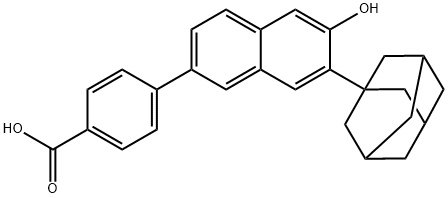 |
| | CD1530 Chemical Properties |
| Boiling point | 610.7±55.0 °C(Predicted) | | density | 1.290±0.06 g/cm3(Predicted) | | storage temp. | Store at +4°C | | solubility | 50 mM in 1 eq. NaOH: Soluble | | form | powder | | pka | 4.13±0.10(Predicted) | | color | white to beige | | InChI | 1S/C27H26O3/c28-25-12-22-6-5-21(19-1-3-20(4-2-19)26(29)30)10-23(22)11-24(25)27-13-16-7-17(14-27)9-18(8-16)15-27/h1-6,10-12,16-18,28H,7-9,13-15H2,(H,29,30) | | InChIKey | VCQGNUWOMLYNNG-UHFFFAOYSA-N | | SMILES | OC1=CC2=C(C=C(C3=CC=C(C(O)=O)C=C3)C=C2)C=C1C4(C[C@H](C5)C6)C[C@H]6C[C@H]5C4 |
| WGK Germany | WGK 3 | | Storage Class | 11 - Combustible Solids | | Hazard Classifications | Eye Irrit. 2
Skin Irrit. 2
STOT SE 3 |
| | CD1530 Usage And Synthesis |
| Uses | CD 1530 is a retinoic acid receptor γ selective agonist. In combination with bexxarotene, they inhibit murine oral-cavity carcinogensis. It is found to inhibit heterotopic ossification and preserve tendon stem cell characteristics. It is also associated with RAR signalling in asthma. | | Biological Activity | Potent and selective RAR γ receptor agonist (K i values are 150, 1500 and 2750 nM for RAR γ , RAR β and RAR α receptors respectively). Activates transcriptional activity (AC 50 = 1.8 nM). | | in vivo | CD1530 (4 mg/kg; p.o.; once every other day) inhibits FOP-like heterotopic ossification in transgenic mice carrying a Cre-inducible constitutively active ALK2Q207D mutation[1].
CD1530 (2.5 mg/100 mL; p.o., in drinking water; frequency not mentioned; 15 weeks) combined with 4-nitroquinoline 1-oxide reduces the number and severity of tongue tumor lesions in mice with oral cancer[3].
CD1530 (10 μg; local injection; 3 times per week; 3 weeks) accelerates tendon healing in mice with Achilles tendon rupture, inhibits cartilage formation, reduces fibrous tissue-like scar formation, and promotes better collagen fiber alignment[4].
CD1530 (4 mg/kg, p.o.; or 1 mM, intramuscular injection; once a day; administration for 4 weeks) can inhibit muscle fat infiltration, reduce the number of intramuscular adipocytes, and reduce the expression of adipogenic marker genes in mice with rotator cuff tear[6].
| Animal Model: | C57BL/6 male mice (weight approximately 23 g, 9 weeks old) + rotator cuff tear model[6] | | Dosage: | 4 mg/kg (orally administered); 1 mM (intramuscular injection, solvent: dimethyl sulfoxide) | | Administration: | Oral administration, once a day, for 4 weeks; Intramuscular injection, once a week, for 4 weeks | | Result: | Significantly suppressed fatty infiltration in the supraspinatus muscle (p.o.).
Reduced the ratio of the fat area to the muscle cross-sectional area and the expression of adipogenic marker genes Pparg and Cebpa (p.o.).
Reduced fatty infiltration in the supraspinatus muscle (intramuscular injection).
|
| | storage | Store at +4°C |
| | CD1530 Preparation Products And Raw materials |
|