- MCPB
-
-
2025-12-24
- CAS:94-81-5
- Min. Order: 1KG
- Purity: 99.0%
- Supply Ability: 1000KG
- MCPB
-
- $1.00
-
2020-01-10
- CAS:94-81-5
- Min. Order: 1g
- Purity: 99.0%
- Supply Ability: 100kg
|
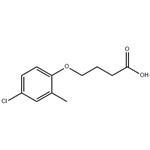
| Product Name: | MCPB | | Synonyms: | (4-chloro-o-tolyloxy)butyricacid;[(4-Chloro-o-tolyl)oxy]butyric acid;2M 4KhM;u46mcpb;2,4-MCPB;4-(2-METHYL-4-CHLOROPHENOXY)-BUTYRIC ACID;4-(4-CHLORO-2-METHYLPHENOXY)BUTANOIC ACID;4-(4-CHLORO-2-METHYLPHENOXY)BUTYRIC ACID | | CAS: | 94-81-5 | | MF: | C11H13ClO3 | | MW: | 228.67 | | EINECS: | 202-365-3 | | Product Categories: | Miscellaneous | | Mol File: | 94-81-5.mol |  |
| Melting point | 101-102℃ (ligroine ) | | Boiling point | 327.31°C (rough estimate) | | density | 1.2076 (rough estimate) | | refractive index | 1.4530 (estimate) | | storage temp. | 0-6°C | | pka | 4.58±0.10(Predicted) | | Water Solubility | 44mg/L(room temperature) | | BRN | 2215202 | | Henry's Law Constant | 3.6×10³ mol/(m3Pa) at 25℃, Duchowicz et al. (2020) | | Major Application | agriculture
environmental | | InChI | InChI=1S/C11H13ClO3/c1-8-7-9(12)4-5-10(8)15-6-2-3-11(13)14/h4-5,7H,2-3,6H2,1H3,(H,13,14) | | InChIKey | LLWADFLAOKUBDR-UHFFFAOYSA-N | | SMILES | C(O)(=O)CCCOC1=CC=C(Cl)C=C1C | | EPA Substance Registry System | MCPB (94-81-5) |
| Hazard Codes | N | | Risk Statements | 50/53 | | Safety Statements | 60-61 | | RIDADR | UN3077 9/PG 3 | | WGK Germany | 2 | | RTECS | ES8575000 | | HS Code | 29189900 | | Storage Class | 11 - Combustible Solids | | Hazard Classifications | Acute Tox. 4 Oral
Aquatic Acute 1
Aquatic Chronic 1 | | Hazardous Substances Data | 94-81-5(Hazardous Substances Data) | | Toxicity | LD50 oral in rat: 680mg/kg |
| Chemical Properties | Colorless crystal; melts at 100 °C (212 °F);practically insoluble in water (44 mg/L at25 °C/77 °F); readily dissolves in most organicsolvents. | | Uses | MCPB is used for research regarding herbicides to control weed in crop field. | | Uses | Herbicide. | | Definition | ChEBI: A monocarboxylic acid that is butyric acid substituted by a 2-methyl-4-chlorophenoxy group at position 4. | | Production Methods | The industrial production of MCPB begins with the chlorination of o-cresol (2-methylphenol) to introduce a chlorine atom at the 4-position, forming 4-chloro-2-methylphenol. This intermediate is then reacted with 1,4-dibromobutane or similar butanoic acid precursors in an etherification step to form the phenoxybutanoic acid structure. The reaction typically involves base catalysis and controlled heating to ensure selective substitution and minimize side reactions. The resulting crude MCPB is purified through solvent extraction and crystallisation to achieve the desired chemical purity. | | Hazard | Toxic by ingestion. | | Health Hazard | MCPB is structurally similar to 2,4-DB,except one methyl group substituting a Clatom in the ring. Toxic properties and thesymptoms are similar to 2,4-DB. It is mod-erately toxic by ingestion and possibly otherroutes of exposure. Skin contact can causeirritation.
LD50 oral (rat): 680 mg/kg
LD50 oral (mouse): 800 mg/kg. | | Agricultural Uses | Herbicide: A metabolite of MCPA (see above). MCPB is a
phenoxy herbicide produced as a sodium salt and an acid.
Herbicide registered for use on peas prior to flowering.
There are no residential uses of MCBP. Target organisms:
post-emergence control of Canadian thistle, buttercup,
mustard, purslane, ragweed, common lambsquarters, pigweed, smartweed, sowthistle, morning glory and other
broad leaf weeds[83]
. | | Trade name | 2 M-4Kh-M; 2M4KhM; 2 M-4XM;
4MCPB; BEXANE; BEXONE; U46 MCPB; LEGUMEX;
PDQ; THITROL; TRIFOLEX; TRITROL; TROTOX | | Mechanism of action | Selective, systemic, absorbed by leaves and roots with translocation. Synthetic auxin. | | Pesticide Type | Herbicide |
| | MCPB Preparation Products And Raw materials |
|