|
|
| | 1,9-Dimethylxanthine Basic information |
| Product Name: | 1,9-Dimethylxanthine | | Synonyms: | 2,6-DIHYDROXY-1,9-DIMETHYLPURINE;3,9-dihydro-1,9-dimethyl-1H-purine-2,6-dione;1,9-Dimethyl-1,2,3,6-tetrahydro-9H-purine-2,6-dione;1,9-Dimethyl-1H-purine-2,6(3H,9H)-dione;1,9-Dimethyl-9H-purine-2,6(1H,3H)-dione;9-Hydro-7-dehydro-1,9-dimethylxanthine;Isoparaxanthine;Isotheophylline | | CAS: | 33073-01-7 | | MF: | C7H8N4O2 | | MW: | 180.16 | | EINECS: | 251-367-0 | | Product Categories: | | | Mol File: | 33073-01-7.mol | 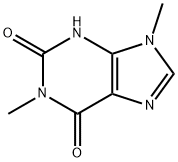 |
| | 1,9-Dimethylxanthine Chemical Properties |
| Melting point | ≥300 °C | | density | 1.60±0.1 g/cm3(Predicted) | | pka | 6.30±0.70(Predicted) |
| | 1,9-Dimethylxanthine Usage And Synthesis |
| Uses | 1,9-Dimethylxanthine is an adenosine receptor antagonist that has the activity of blocking the effects of adenosine on the central nervous system. 1,9-Dimethylxanthine enhances nerve excitability by regulating the adenosine system. 1,9-Dimethylxanthine is used as a pharmacological tool in research to help explore physiological and pathological processes related to adenosine. |
| | 1,9-Dimethylxanthine Preparation Products And Raw materials |
|