| Company Name: |
T&W GROUP |
| Tel: |
021-61551611 13296011611 |
| Email: |
contact@trustwe.com |
- Tebuthiuron
-
-
2026-07-14
- CAS:34014-18-1
- Min. Order: 1kg
- Purity: 95
- Supply Ability: 20tons
|
| | 1-(5-tert-Butyl-1,3,4-thiadiazol-2-yl)-1,3-dimethylurea Basic information |
| Product Name: | 1-(5-tert-Butyl-1,3,4-thiadiazol-2-yl)-1,3-dimethylurea | | Synonyms: | Perflan;Perfmid;Preflan;Prefmid;sha105501;1-(5-tert-butyl-1,3,4-thiadiazol-2-yl)-1,3-dimethylurea/TEBUTHIURON;tebuthiuron (ISO) 1-(5-tert-butyl-1,3,4-thiadiazol-2-yl)-1,3-dimethylurea;tebuthiuron (bsi,iso,ansi,wssa) | | CAS: | 34014-18-1 | | MF: | C9H16N4OS | | MW: | 228.31 | | EINECS: | 251-793-7 | | Product Categories: | Pesticides intermediate;Herbicides;TA - TEPesticides&Metabolites;Urea structure;Alpha sort;Pesticides&Metabolites;Q-ZAlphabetic;Alphabetic | | Mol File: | 34014-18-1.mol | 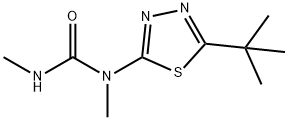 |
| | 1-(5-tert-Butyl-1,3,4-thiadiazol-2-yl)-1,3-dimethylurea Chemical Properties |
| Melting point | 161-164°C | | density | 1.2080 (rough estimate) | | refractive index | 1.6390 (estimate) | | storage temp. | 0-6°C | | form | Solid | | pka | 13.36±0.46(Predicted) | | color | White to Light yellow | | Water Solubility | 2.3g/L(temperature not stated) | | λmax | 255nm(lit.) | | Merck | 14,9095 | | BRN | 527479 | | Henry's Law Constant | 6.9×10⁴ mol/(m3Pa) at 25℃, Keshavarz et al. (2022) | | Exposure limits | LC50 (96-hour) for bluegill sunsh 112 mg/L, rainbow trout 144 mg/L, goldsh
and fathead minnow >160 mg/L (Hartley and Kidd, 1987); acute oral LD50 for rats 644
mg/kg (Ashton and Monaco, 1991). | | Major Application | agriculture
environmental | | InChI | 1S/C9H16N4OS/c1-9(2,3)6-11-12-8(15-6)13(5)7(14)10-4/h1-5H3,(H,10,14) | | InChIKey | HBPDKDSFLXWOAE-UHFFFAOYSA-N | | SMILES | CNC(=O)N(C)c1nnc(s1)C(C)(C)C | | CAS DataBase Reference | 34014-18-1(CAS DataBase Reference) | | NIST Chemistry Reference | Tebuthiuron(34014-18-1) | | EPA Substance Registry System | Tebuthiuron (34014-18-1) |
| Hazard Codes | Xn;N,N,Xn | | Risk Statements | 22-50/53 | | Safety Statements | 37-60-61 | | RIDADR | UN 3077 | | WGK Germany | 3 | | RTECS | YS4250000 | | HazardClass | 9 | | PackingGroup | III | | HS Code | 29349990 | | Storage Class | 11 - Combustible Solids | | Hazard Classifications | Acute Tox. 4 Oral
Aquatic Acute 1
Aquatic Chronic 1 | | Hazardous Substances Data | 34014-18-1(Hazardous Substances Data) | | Toxicity | LD50 in mice, rats, rabbits (mg/kg): 579, 644, 286 orally (Todd) |
| | 1-(5-tert-Butyl-1,3,4-thiadiazol-2-yl)-1,3-dimethylurea Usage And Synthesis |
| Uses | Tebuthiuron is an nonselective broad spectrum herbicide used to control weeds, woody and herbaceous plants. | | Uses | Herbicide. | | Uses | Nonselective herbicide used to control herbaceous and woody plants on noncrop
land. | | Definition | ChEBI: Tebuthiuron is an organonitrogen heterocyclic compound and an organosulfur heterocyclic compound. | | Production Methods | Tebuthiuron is produced commercially through a multi-step chemical synthesis that constructs its urea-based herbicidal structure. The process begins with the preparation of key intermediates such as substituted phenyl isocyanates and methylamines, which are reacted under controlled conditions to form the active tebuthiuron molecule. | | General Description | Colorless odorless crystals. Non corrosive. Used as an herbicide. | | Reactivity Profile | A urea, thiadiazole derivative. | | Agricultural Uses | Herbicide: Tebuthiuron is a broad-spectrum herbicide that is
used to control weeds in non-cropland areas, range lands,
rights-of-way and industrial sites. In grasslands and sugar
cane it controls woody and herbaceous plants and weeds
such as alfalfa, bluegrasses, chickweed, clover, dock,
goldenrod and mullein. Not approved for use in EU countries[
115]. Registered for use in the U.S. | | Trade name | BRULAN®; BRUSH-BULLET®; E-103®;
GRASLAN®; HERBEC®; HERBIC®; PERFLAN®;
RECLAIM; SHA-105501®; SPIKE®; SPRAKIL®;
TEBULAN®; TIUROLAN® | | Mechanism of action | Systemic, low selectivity, absorbed by roots and translocated. Inhibits photosynthesis (photosystem II). | | Environmental Fate | Soil. In microbially active soils, tebuthiuron is degraded via demethylation. The average
half-life in soil 12–15 months in areas receiving 60 inches of rainfall a year (Humburg et
al., 1989).
When tebuthiuron was applied to a rangeland at a rate of 0.84 kg/ha, 38% remained
after 21 months (Emmerich et al., 1984).
Groundwater . According to the U.S. EPA (1986) tebuthiuron has a high potential to
leach to groundwater .
Plant. Degrades in plants via N-demethylation and hydroxylation of the t-butyl
sidechain (Hartley and Kidd, 1987; Humburg et al., 1989). | | Pesticide Type | Herbicide |
| | 1-(5-tert-Butyl-1,3,4-thiadiazol-2-yl)-1,3-dimethylurea Preparation Products And Raw materials |
|