1-(4-ethylphenyl)-3-(1H-indol-3-yl)urea manufacturers
- H-151
-

- $30.00
-
2026-08-08
- CAS:941987-60-6
- Purity: 99.80%
- Supply Ability: 10g
|
| | 1-(4-ethylphenyl)-3-(1H-indol-3-yl)urea Basic information |
| Product Name: | 1-(4-ethylphenyl)-3-(1H-indol-3-yl)urea | | Synonyms: | 1-(4-ethylphenyl)-3-(1H-indol-3-yl)urea;H151;H-151;H-151;H-151;STING ANTAGONIST;STING antagonist;N-(4-Ethylphenyl)-N'-1H-indol-3-yl-urea;H 151 NEW;Urea, N-(4-ethylphenyl)-N'-1H-indol-3-yl-;STING inhibitor;H 151 (H-151) | | CAS: | 941987-60-6 | | MF: | C17H17N3O | | MW: | 279.34 | | EINECS: | | | Product Categories: | | | Mol File: | 941987-60-6.mol | 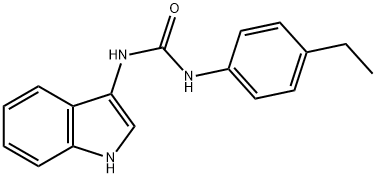 |
| | 1-(4-ethylphenyl)-3-(1H-indol-3-yl)urea Chemical Properties |
| Boiling point | 399.9±25.0 °C(Predicted) | | density | 1.298±0.06 g/cm3(Predicted) | | storage temp. | Sealed in dry,Room Temperature | | solubility | Soluble in DMSO (25 mg/ml) | | pka | 14.96±0.70(Predicted) | | form | solid | | color | Off-white | | Stability: | Stable for 2 years from date of purchase as supplied. Solutions in DMSO may be stored at -20°C for up to 3 months. | | InChI | InChI=1S/C17H17N3O/c1-2-12-7-9-13(10-8-12)19-17(21)20-16-11-18-15-6-4-3-5-14(15)16/h3-11,18H,2H2,1H3,(H2,19,20,21) | | InChIKey | UJZDIKVQFMCLBE-UHFFFAOYSA-N | | SMILES | N(C1=CC=C(CC)C=C1)C(NC1C2=C(NC=1)C=CC=C2)=O |
| WGK Germany | WGK 3 | | Storage Class | 11 - Combustible Solids |
| | 1-(4-ethylphenyl)-3-(1H-indol-3-yl)urea Usage And Synthesis |
| Description | H-151 (941987-60-6) is an inhibitor of the signaling molecule STING in mouse and human cells. It covalently binds to Cys91 of STING preventing activation via blockade of palmitoylation at Cys91. It reduced systemic cytokine response in mice treated with the STING agonist 10-carboxymethyl-9-acridanone and showed efficacy in Trex-/- mice. | | Uses | 1-(4-ethylphenyl)-3-(1H-indol-3-yl)urea (cas# 941987-60-6) is a useful research chemical. It is used in biological studies in the enhancement of transgene expression by beta-catenin inhibitor iCRT14. | | in vivo | H-151 (750 nmol per mouse; a single i.p.) markedly reduces systemic cytokine responses in CMA-treated mice[1].
H-151 (750 nmol per mouse; i.p. daily for 7 d) exhibits notable efficacy in Trex1 / mice that expressed a bioluminescent IFNβ reporter[1].
H-151 (750 nmol per mouse; i.p.) reaches effective systemic levels, displays a short half-life in the serum and forms an adduct to mmSTING in wild-type mice[1]. | | storage | Store at +4°C | | References | [1] SIMONE M. HAAG. Targeting STING with covalent small-molecule inhibitors[J]. Nature, 2018, 559 7713: 269-273. DOI:10.1038/s41586-018-0287-8
[2] JOEL LEE K C M Ghonime. STING Restricts oHSV Replication and Spread in Resistant MPNSTs but Is Dispensable for Basal IFN-Stimulated Gene Upregulation[J]. Molecular Therapy Oncolytics, 2019, 22 1: 91-100. DOI:10.1016/j.omto.2019.09.001 |
| | 1-(4-ethylphenyl)-3-(1H-indol-3-yl)urea Preparation Products And Raw materials |
|