|
|
| | Tetrahydroamentoflavone Basic information |
| Product Name: | Tetrahydroamentoflavone | | Synonyms: | Tetrahydroamentoflavone;Amentoflavanone;4H-1-Benzopyran-4-one, 8-[5-[(2S)-3,4-dihydro-5,7-dihydroxy-4-oxo-2H-1-benzopyran-2-yl]-2-hydroxyphenyl]-2,3-dihydro-5,7-dihydroxy-2-(4-hydroxyphenyl)-, (2S)-;(2S)-8-{5-[(2S)-5,7-Dihydroxy-4-oxo-3,4-dihydro-2H-chromen-2-yl]-2-hydroxyphenyl}-5,7-dihydroxy-2-(4-hydroxyphenyl)-2,3-dihydro-4H-chromen-4-one | | CAS: | 48236-96-0 | | MF: | C30H22O10 | | MW: | 542.49 | | EINECS: | | | Product Categories: | | | Mol File: | 48236-96-0.mol | 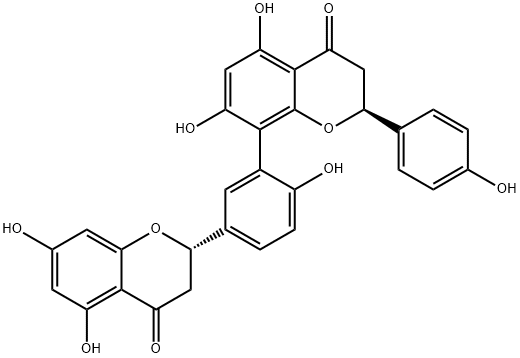 |
| | Tetrahydroamentoflavone Chemical Properties |
| Boiling point | 932.8±65.0 °C(Predicted) | | density | 1.584±0.06 g/cm3(Predicted) | | pka | 6.87±0.40(Predicted) |
| | Tetrahydroamentoflavone Usage And Synthesis |
| Uses | Tetrahydroamentoflavone (Amentoflavanone) is a potent xanthine oxidase (XO) inhibitor. Tetrahydroamentoflavone has inhibitory activity for XO with IC50 and Ki values of 92 nM and 0.982 μM, respectively. Tetrahydroamentoflavone can be used for the research of inflammatory disorders and gout[1]. | | References | [1] Ranjith Arimboor, et al. Tetrahydroamentoflavone (THA) from Semecarpus anacardium as a potent inhibitor of xanthine oxidase. J Ethnopharmacol. 2011 Feb 16;133(3):1117-20. DOI:10.1016/j.jep.2010.10.027 |
| | Tetrahydroamentoflavone Preparation Products And Raw materials |
|