CYCLURON manufacturers
- CYCLURON
-
-
2023-12-04
- CAS:2163-69-1
- Purity: 98%+
- Supply Ability: 100kg
|
| | CYCLURON Basic information |
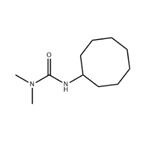
| Product Name: | CYCLURON | | Synonyms: | 3-cyclooctyl-1,1-dimethylharnstoff;3-cyclooctyl-1,1-dimethyl-ure;cyclouron;hs61;n-cyclooctyl-n’,n’-dimethylurea;omu;CYCLURON PESTANAL (3-CYCLOOCTYL- 1,1-DIM;Alipur-O | | CAS: | 2163-69-1 | | MF: | C11H22N2O | | MW: | 198.31 | | EINECS: | 218-493-8 | | Product Categories: | | | Mol File: | 2163-69-1.mol |  |
| | CYCLURON Chemical Properties |
| Melting point | 138℃ | | Boiling point | 335.64°C (rough estimate) | | density | 0.97 | | refractive index | 1.4620 (estimate) | | Fp | >100 °C | | pka | 13.97±0.20(Predicted) | | Water Solubility | 0.15g/L(20 ºC) | | BRN | 2209526 | | Henry's Law Constant | 8.2×10² mol/(m3Pa) at 25℃, HSDB (2015) | | EPA Substance Registry System | Cycluron (2163-69-1) |
| | CYCLURON Usage And Synthesis |
| Description | Cycluron is an obsolete urea herbicide. Data is limited. It is highly soluble in water and moderately volatile. It is moderately toxic to mammals if ingested. | | Uses | Cycluron is a pesticide. | | Definition | ChEBI: Cycluron is a member of ureas. | | Production Methods | Cycluron is commercially synthesised through a reaction involving cyclooctylamine and dimethylcarbamoyl chloride. In this process, cyclooctylamine acts as the nucleophile, reacting with dimethylcarbamoyl chloride in the presence of a base such as triethylamine to form N'-cyclooctyl-N,N-dimethylurea, the active compound known as cycluron. The reaction typically occurs in an organic solvent under controlled temperature conditions to ensure optimal yield and purity. | | Mechanism of action | Works by inhibiting photosynthesis in target plants, effectively suppressing weed growth while minimising harm to cultivated crops. Absorbed by roots and has a strong residual activity. | | Pesticide Type | Herbicide |
| | CYCLURON Preparation Products And Raw materials |
|