|
|
| | IMiquiMod (hydrochloride) Basic information |
| Product Name: | IMiquiMod (hydrochloride) | | Synonyms: | IMiquiMod (hydrochloride);Imiquimod hydrochloride (R 837 hydrochloride);1-Isobutyl-1H-imidazo[4,5-c]quinolin-4-amine hydrochloride;1-Isobutyl-1H-imidazo[4,5-c]quinolin-4-amine hydrochloride , Imiquimod HCl;Imiquimod HCl | | CAS: | 99011-78-6 | | MF: | C14H17ClN4 | | MW: | 276.76458 | | EINECS: | | | Product Categories: | | | Mol File: | 99011-78-6.mol | 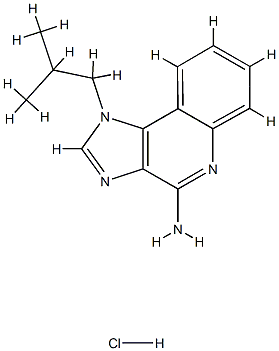 |
| | IMiquiMod (hydrochloride) Chemical Properties |
| Melting point | >300 °C | | storage temp. | Keep in dark place,Sealed in dry,Room Temperature | | solubility | ≥3.59 mg/mL in EtOH with ultrasonic; ≥5.54 mg/mL in DMSO with gentle warming and ultrasonic; ≥7.34 mg/mL in H2O with ultrasonic | | form | solid | | color | White to off-white |
| | IMiquiMod (hydrochloride) Usage And Synthesis |
| Uses | Imiquimod hydrochloride (R 837 hydrochloride), an immune response modifier, is a selective toll like receptor 7 (TLR7) agonist. Imiquimod hydrochloride exhibits antiviral and antitumor effects in vivo. Imiquimod hydrochloride can be used for the research of external genital, perianal warts, cancer and COVID-19[1][2]. | | Biological Activity | imiquimod hydrochloride is an immune response modifier that acts as a toll-like receptor 7 agonist and is commonly used topically to treat warts on the skin of the genital and anal areas. | | in vivo | In animal models, Imiquimod hydrochloride stimulates the innate immune response by increasing NK cell activity, activating macrophages to secretecytokines and nitric oxide, and inducing proliferation and differentiation of B lymphocytes. Imiquimod hydrochloride stimulates the innate immune response through induction, synthesis, and release of cytokines, including interferon-a (IFN-α), interleukin (IL)-6, and tumor necrosis factor (TNF)-α.
| | target | | | IC 50 | TLR7; HSV-1 | | References | [1] Athina Angelopoulou, et al. Imiquimod - A toll like receptor 7 agonist - Is an ideal option for management of COVID 19. Environ Res. 2020 Sep; 188: 109858. DOI:10.1016/j.envres.2020.109858
[2] Yuji Kan, et al. Imiquimod suppresses propagation of herpes simplex virus 1 by upregulation of cystatin A via the adenosine receptor A1 pathway. J Virol. 2012 Oct;86(19):10338-46. DOI:10.1128/JVI.01196-12
[3] Aditya K Gupta, et al. Imiquimod: a review. J Cutan Med Surg. Nov-Dec 2002;6(6):554-60. DOI:10.1007/s10227-001-0134-6
[4] Michael P Schn, et al. The small antitumoral immune response modifier imiquimod interacts with adenosine receptor signaling in a TLR7- and TLR8-independent fashion. J Invest Dermatol. 2006 Jun;126(6):1338-47. DOI:10.1038/sj.jid.5700286 |
| | IMiquiMod (hydrochloride) Preparation Products And Raw materials |
|