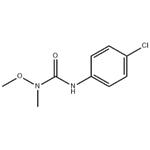
- Monolinuron
-
- $8.00
-
2026-09-02
- CAS:1746-81-2
- Min. Order: 1KG
- Purity: 99%
- MONOLINURON
-

- $1.00
-
2023-04-12
- CAS:1746-81-2
- Min. Order: 1kg/bag
- Purity: 99.9%
- Supply Ability: 3000
- MONOLINURON
-

- $1.00
-
2020-01-01
- CAS: 1746-81-2
- Min. Order: 1KG
- Purity: 95-99%
- Supply Ability: 1ton
|
| | Monolinuron Basic information |
| | Monolinuron Chemical Properties |
| Melting point | 81.5℃ | | density | 1.3575 (rough estimate) | | refractive index | 1.5790 (estimate) | | Fp | 100 °C | | storage temp. | Sealed in dry,Room Temperature | | pka | 12.80±0.70(Predicted) | | form | solid | | color | White to Light yellow to Light orange | | Water Solubility | 0.58g/L(room temperature) | | BRN | 2212523 | | Henry's Law Constant | 2.1×10² mol/(m3Pa) at 25℃, HSDB (2015) | | InChI | InChI=1S/C9H11ClN2O2/c1-12(14-2)9(13)11-8-5-3-7(10)4-6-8/h3-6H,1-2H3,(H,11,13) | | InChIKey | LKJPSUCKSLORMF-UHFFFAOYSA-N | | SMILES | N(OC)(C)C(NC1=CC=C(Cl)C=C1)=O | | EPA Substance Registry System | Monolinuron (1746-81-2) |
| Hazard Codes | Xn,N | | Risk Statements | 22-48/22-50/53 | | Safety Statements | 22-60-61 | | RIDADR | UN 3077 9/PG 3 | | WGK Germany | 3 | | RTECS | YS6425000 | | TSCA | TSCA listed | | HS Code | 29280000 | | Storage Class | 11 - Combustible Solids | | Hazard Classifications | Acute Tox. 4 Oral
Aquatic Acute 1
Aquatic Chronic 1
STOT RE 2 | | Hazardous Substances Data | 1746-81-2(Hazardous Substances Data) |
| | Monolinuron Usage And Synthesis |
| Description | Monolinuron is a herbicide that is not widely approved for use in the developed world. It has a low to moderate mammalian oral toxicity. It is moderately soluble in water and many organic solvents, and is volatile. Monolinuron has a high leaching potential and studies suggest that it is moderately persistent in soils. It is moderately toxic to birds, fish, aquatic invertebrates, aquatic plants and earthworms. It is relatively less toxic to honeybees. | | Uses | The certified reference material (CRM) is intended to be used as a calibrant for chromatography and other analytical techniques.
Monolinuron CRM may also be used as given below:
- Determination of 252 pesticides extracted from surface water samples by solid-phase extraction (SPE) using liquid chromatography quadrupole-orbitrap high-resolution tandem mass spectrometry
- Extraction of 13 pesticides from four groundwater and three river water samples using silica-based MSU-1 mesoporous solid as a sorbent for their solid-phase extraction (SPE) followed by ultra-performance liquid chromatography-triple quadrupole-mass spectrometric (UHPLC- QqQ-MS/MS) determination
- Development and validation of a UHPLC-diode array detection (DAD) method for simultaneous determination of urea and tebuthiuron herbicides in four fresh vegetable samples
- Multi-residue analysis of 50 herbicides in 51 grain samples of soybean, corn, and whe at by ultra-performance liquid chromatography-electrospray ionization-mass spectrometry (UPLC-ESI-MS)
- Extraction of 109 pesticide residues from different chemical classes from 345 tomato samples by modified QuEChERS method and their determination using liquid chromatography-tandem mass spectrometry (LC-MS/MS)
- Simultaneous analysis of 238 pesticides and 78 veterinary drugs in 80 bovine milk samples using ultra-fast liquid chromatography-tandem mass spectrometry (UFLC-MS/MS) and gas chromatography-tandem mass spectrometry (GC-MS/MS)
| | Definition | ChEBI: Monolinuron is a member of ureas. | | Production Methods | The industrial synthesis of monolinuron begins with the preparation of 4-chloroaniline, which serves as the aromatic base. This compound undergoes a condensation reaction with methyl isocyanate or dimethylcarbamoyl chloride to form the substituted urea backbone. The methoxy group is introduced via methylation using agents such as dimethyl sulphate or methyl iodide. These reactions are typically carried out in organic solvents like acetone or toluene under controlled temperature and pH conditions to ensure high yield and purity. After synthesis, the crude product is purified through crystallisation or solvent extraction. | | Reactions |
Nitrite or nitrate induced-photolysis of monolinuron (a phenyl urea herbicide) using the 300–450 nm light excitation gives rise to various photo-products. The direct photolysis of monolinuron proceeds via two main pathways yielding, respectively, 3-(4-chlorophenyl)-1-methylurea, which results from demethoxylation of the N-terminus substituted functional group and 3-(4-hydroxyphenyl)-1-methoxy-1- methylurea obtained by photohydrolysis of the C-Cl bond[1].
Degradation pathways of monolinuron by direct and nitrite (or nitrate) induced photolysis. Specific photoproducts: circled numbers (direct); underlined numbers (induced):

| | Mechanism of action | Selective, systemic absorbed by roots and leaves and translocated. Inhibition of photosynthesis at photosystem II | | Safety Profile | Moderately toxic by
ingestion. Experimental teratogenic and
reproductive effects. When heated to
decomposition it emits very toxic fumes of
Cland NOx. | | References |
[1] S. Nélieu. “Nitrite and nitrate induced photodegradation of monolinuron in aqueous solution.” Environmental Chemistry Letters 2 2 (2004): 83–87.
| | Pesticide Type | Herbicide |
| | Monolinuron Preparation Products And Raw materials |
|