|
|
| | Chlorthion Basic information |
| Product Name: | Chlorthion | | Synonyms: | ent18,861;ent18,861[qr];Methyl chlorothion;methylchlorothion;methylchlorothion[qr];O-(3-Chloor-4-nitro-fenyl)-O,O-dimethyl-monothiofosfaat;o-(3-chloor-4-nitro-fenyl)-o,o-dimethyl-monothiofosfaat[dutch][qr];O-(3-Chlor-4-nitro-phenyl)-O,O-dimethyl-monothiophosphat | | CAS: | 500-28-7 | | MF: | C8H9ClNO5PS | | MW: | 297.65 | | EINECS: | 207-902-5 | | Product Categories: | Alpha sort;C;CAlphabetic;CH;Pesticides&Metabolites | | Mol File: | 500-28-7.mol | 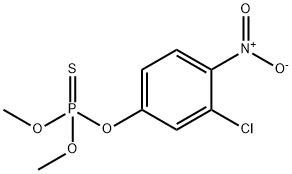 |
| | Chlorthion Chemical Properties |
| Melting point | 21° | | Boiling point | bp0.1 125° | | density | d420 1.437 | | refractive index | nD20 1.5661 | | storage temp. | 2-8°C | | solubility | Chloroform (Slightly), Methanol (Slightly) | | form | liquid | | Water Solubility | 40mg/L(20 ºC) | | BRN | 2292513 | | Henry's Law Constant | 2.5×10² mol/(m3Pa) at 25℃, HSDB (2015) | | Major Application | agriculture
environmental | | InChI | 1S/C8H9ClNO5PS/c1-13-16(17,14-2)15-6-3-4-8(10(11)12)7(9)5-6/h3-5H,1-2H3 | | InChIKey | NZNRRXXETLSZRO-UHFFFAOYSA-N | | SMILES | COP(=S)(OC)Oc1ccc(c(Cl)c1)[N+]([O-])=O | | EPA Substance Registry System | Chlorthion (500-28-7) |
| Hazard Codes | Xn,N | | Risk Statements | 20/21/22-50/53 | | Safety Statements | 13-60-61 | | RIDADR | UN2811 6.1/PG 3 | | WGK Germany | 3 | | RTECS | TE8050000 | | Storage Class | 6.1C - Combustible acute toxic Cat.3
toxic compounds or compounds which causing chronic effects | | Hazard Classifications | Acute Tox. 3 Oral
Acute Tox. 4 Dermal
Acute Tox. 4 Inhalation
Aquatic Acute 1
Aquatic Chronic 1 | | Hazardous Substances Data | 500-28-7(Hazardous Substances Data) | | Toxicity | LD50 in male, female rats (mg/kg): 880, 980 orally (Gaines) |
| | Chlorthion Usage And Synthesis |
| Description | Chlorthion is an organophosphate insecticide. It has a moderate aqueous solubility and not considered to be volatile. Chlorthion is not persistent in soil systems and, based on its physico-chemical properties, it is only slightly mobile and not expected to leach to groundwater. It is moderately toxic to most biodiversity but there may be a higher risk for bees. It has a moderate mammalian toxicity, is a cholinesterase inhibitor and a neurotoxin. | | Uses | Insecticide. | | Definition | ChEBI: Chlorthion is an organic thiophosphate that is O,O-dimethyl O-phenyl phosphorothioate substituted by a chloro group at position 3 and a nitro group at position 4. It is a potent cholinesterase inhibitor and used as an insecticide for the control of a wide range of insects. It has a role as an EC 3.1.1.8 (cholinesterase) inhibitor and an agrochemical. It is a C-nitro compound, an organic thiophosphate, a member of monochlorobenzenes and an organothiophosphate insecticide. | | Production Methods | Chlorthion is commercially synthesised through the esterification of dimethyl phosphorothioic acid with 3-chloro-4-nitrophenol under controlled conditions. This process involves reacting O,O-dimethyl phosphorothioic acid chloride with 3-chloro-4-nitrophenol in the presence of a base such as pyridine or triethylamine, typically in an organic solvent like toluene or dichloromethane. The reaction is conducted at moderate temperatures to ensure selectivity and minimise byproducts. | | Mechanism of action | Broad-spectrum with contact, stomach and respiratory action. Acetylcholinesterase (AchE) inhibitor. | | Pesticide Type | Insecticide; Larvicide |
| | Chlorthion Preparation Products And Raw materials |
|