|
|
| | Zeaxanthin dipalmitate Basic information |
| Product Name: | Zeaxanthin dipalmitate | | Synonyms: | (3R,3R')-beta,beta-carotene-3,3'-diyl dipalmitate;PHYSALIEN(ST);PHYSALIEN WITH TLC;β,β-Carotene-3β,3'β-diol dipalmitate;PHYSALIEN(RG);Zeaxanthin Impurity 1;β,β-Carotene-3,3'-diol, 3,3'-dihexadecanoate, (3R,3'R)-;(3R,3R')-?,?-carotene-3,3'-diyl dipalmitate | | CAS: | 144-67-2 | | MF: | C72H116O4 | | MW: | 1045.69 | | EINECS: | 205-635-9 | | Product Categories: | Carotenoids | | Mol File: | 144-67-2.mol | 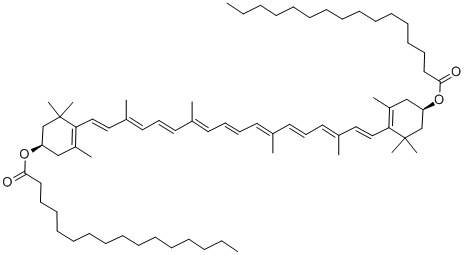 |
| | Zeaxanthin dipalmitate Chemical Properties |
| Melting point | 98~100℃ | | Boiling point | 956.4±65.0 °C(Predicted) | | density | 0.96±0.1 g/cm3(Predicted) | | storage temp. | Store at -20℃,protected from light | | solubility | Ethanol: slightly soluble | | form | A crystalline solid | | color | Brown to reddish brown | | LogP | 26.908 (est) |
| | Zeaxanthin dipalmitate Usage And Synthesis |
| Uses | Zeaxanthin dipalmitate is an antioxidant carotenoid compound, and is the main carotenoid in Lycium barbarum and Lycium chinense fruits. Zeaxanthin dipalmitate from Lycium chinense has been shown to reduce experimentally induced hepatic fibrosis in rats. | | Definition | ChEBI: Physalien is a xanthophyll. | | in vivo | Zeaxanthin dipalmitate (10 mg/kg; p.o.; daily for 2 weeks) reduces the serum ALT and AST levels increased by long-term ethanol challenge in at AFLD Model[1].
Zeaxanthin dipalmitate (10 mg/kg; p.o.; daily for 2 weeks) effectively attenuates the histological injury[1].
Zeaxanthin dipalmitate (10 mg/kg; p.o.; daily for 2 weeks) attenuates the AFLD-induced hepatic apoptosis (reveal by caspase-3/7 activity) and inflammation (TNF-α) in rat[1].
Zeaxanthin dipalmitate (approximately 4 μM; intravitreal injection for once) improves the visual behavior of rd10 mice and delays the degeneration of retinal photoreceptors[2].
Zeaxanthin dipalmitate (approximately 4 μM; intravitreal injection for once) improves the light responses of photoreceptors, bipolar cells and retinal ganglion cells[2].
Zeaxanthin dipalmitate (approximately 4 μM; intravitreal injection for once) reduces the expression of genes that are involved in inflammation, apoptosis and oxidative stress in rd10 mice[2].
| | Purification Methods | Purify it by chromatography on water-deactivated alumina, using hexane/diethyl ether (19:1) to develop the column. It crystallises |
| | Zeaxanthin dipalmitate Preparation Products And Raw materials |
|