- Diclofop
-

-
2026-09-11
- CAS:40843-25-2
- Min. Order: 25kg
- Purity: 99%
- Supply Ability: 100 T/Month
- (±)-Diclofop
-
- $2500.00
-
2026-05-11
- CAS:40843-25-2
- Purity:
- Supply Ability: 10g
- diclofop
-

- $1.00
-
2020-02-17
- CAS:40843-25-2
- Min. Order: 1KG
- Purity: 98% HPLC
- Supply Ability: 10 tons
|
| | Diclofop Basic information |
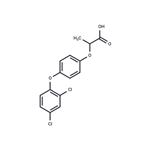
| Product Name: | Diclofop | | Synonyms: | 2-(4-(2,4-dichlorophenoxy)pheenoxy)propanoic acid;(RS)-2-[4-(2,4-Dichlorophenoxy)phenoxy]propionic acid;2-(4-(2,4-dichlorophenoxy)phenoxy)-propanoicaci;dichlorfopacid;2-(4-(2,4-dichlorophenoxy)phenoxy)propanoic acid;hoe-021079;DICLOFOP;diclofop (bsi,iso,ansi,wssa) | | CAS: | 40843-25-2 | | MF: | C15H12Cl2O4 | | MW: | 327.16 | | EINECS: | 609-871-7 | | Product Categories: | | | Mol File: | 40843-25-2.mol |  |
| | Diclofop Chemical Properties |
| Melting point | 107°C | | Boiling point | 440.5±45.0 °C(Predicted) | | density | 1.386±0.06 g/cm3(Predicted) | | storage temp. | -20°C Freezer | | solubility | DMSO (Slightly), Methanol (Slightly) | | pka | 3.19±0.10(Predicted) | | color | White | | BRN | 2338390 | | Henry's Law Constant | 9.2×10⁵ mol/(m3Pa) at 25℃, Ebert et al. (2023) | | Major Application | agriculture
environmental | | InChI | 1S/C15H12Cl2O4/c1-9(15(18)19)20-11-3-5-12(6-4-11)21-14-7-2-10(16)8-13(14)17/h2-9H,1H3,(H,18,19) | | InChIKey | OOLBCHYXZDXLDS-UHFFFAOYSA-N | | SMILES | CC(Oc1ccc(Oc2ccc(Cl)cc2Cl)cc1)C(O)=O | | LogP | 4.580 | | NIST Chemistry Reference | Diclofop(40843-25-2) | | EPA Substance Registry System | Diclofop (40843-25-2) |
| Hazard Codes | Xn | | Risk Statements | 36/37/38-22 | | Safety Statements | 26-36/37/39 | | RIDADR | UN3077(solid) | | WGK Germany | 3 | | Storage Class | 11 - Combustible Solids | | Hazard Classifications | Acute Tox. 4 Oral |
| | Diclofop Usage And Synthesis |
| Description | Diclofop is a grass herbicide which is usually used as the methyl variant. It is highly soluble in water and is not considered to be volatile. It is not normally environmentally persistent. Diclofop is moderately toxic to mammals via the oral route. Its toxicity to biodiversity tends to be moderate to low. | | Uses | (±)-Diclofop is an Acetyl-CoA carboxylase (ACCase) inhibiting herbicide. | | Definition | ChEBI: 2-[4-(2,4-dichlorophenoxy)phenoxy]propanoic acid is an aromatic ether that is 2-(4-hydroxyphenoxy)propanoic acid in which the hydrogen of the hydroxy group at position 4 has been substituted by a 2,4-dichlorophenyl group. It is an aromatic ether, a dichlorobenzene, a monocarboxylic acid and a diether. | | Production Methods | The commercial production of dichlofop, typically marketed as its methyl ester dichlofop-methyl, involves a multi-step synthesis starting from 2,4-dichlorophenol. This compound undergoes etherification with phenol derivatives to form the key intermediate 2-(2,4-dichlorophenoxy)phenol. The intermediate is then esterified with methyl 2-hydroxypropionate or a similar propionic acid derivative under acidic or catalytic conditions to yield dichlofop-methyl. The reaction is carefully controlled to ensure high purity and minimise side products, followed by purification steps such as crystallisation or distillation. | | Trade name | HOE-021079 | | Mechanism of action | Selective, absorbed by leaves and inhibits fatty acid synthesis. Acetyl CoA carboxylase inhibitor (ACCase) - distrupts fatty acid biosynthesis and lipid formation. | | Pesticide Type | Herbicide; Metabolite |
| | Diclofop Preparation Products And Raw materials |
|