| Identification | More | [Name]
3-Bromo-4-fluorophenol | [CAS]
27407-11-0 | [Synonyms]
3-BROMO-4-FLUOROPHENOL | [EINECS(EC#)]
807-954-4 | [Molecular Formula]
C6H4BrFO | [MDL Number]
MFCD03425884 | [Molecular Weight]
191 | [MOL File]
27407-11-0.mol |
| Questions And Answer | Back Directory | [Synthesis]
Under ice-water bath conditions (0°C), a solution of tetrabutylammonium fluoride in THF (80 mL, 80 mmol) was added to a solution of 3-bromo-4-fluorophenol (24.4 g, 80 mmol) protected by dimethyl tert-butylsilane in THF (160 mL). The mixture was stirred at 0°C for 0.5 hours. The mixture was concentrated to remove tetrahydrofuran solvent and unreacted tetrabutylammonium fluoride. The mixture was diluted with ethyl acetate/n-hexane (1:1), then washed with water (3x) and brine to separate the organic layer. The organic layer was dried with anhydrous sodium sulfate, and the anhydrous sodium sulfate solid was filtered off. The filtrate was concentrated, and the crude product was dissolved in n-hexane (if insoluble, it can be dissolved by heating). The residue was purified by column chromatography (eluting with a gradient of 0 to 50% ethyl acetate/hexane) to obtain the target product (12.5 g, 65.4 mmol). (mmol, 82% yield). 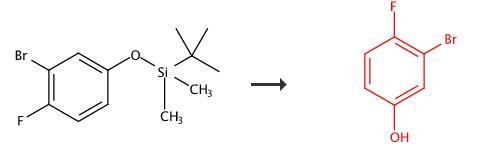 | [Uses]
3-Bromo-4-fluorophenol is commonly used as a synthetic intermediate for pharmaceutical molecules and bioactive substances, and it has wide applications in the preparation of bactericides and preservatives. Synthetic transformations mainly revolve around the bromine unit in its structure; the bromine atom can be linked to aryl, alkyl, etc., via the Suzuki coupling reaction. Furthermore, the phenolic hydroxyl group undergoes alkylation under basic conditions to yield ether compounds. |
| Chemical Properties | Back Directory | [Boiling point ]
78°C/0.5mmHg(lit.) | [density ]
1.764±0.06 g/cm3(Predicted) | [storage temp. ]
Inert atmosphere,2-8°C | [solubility ]
soluble in Methanol | [form ]
Crystalline | [pka]
9.01±0.18(Predicted) | [color ]
Yellow-green | [InChI]
InChI=1S/C6H4BrFO/c7-5-3-4(9)1-2-6(5)8/h1-3,9H | [InChIKey]
QWTULQLVGNZMLF-UHFFFAOYSA-N | [SMILES]
C1(O)=CC=C(F)C(Br)=C1 | [CAS DataBase Reference]
27407-11-0(CAS DataBase Reference) |
|
| Company Name: |
J & K SCIENTIFIC LTD.
|
| Telephone: |
18210857532 18210857532 |
| Website: |
https://www.jkchemical.com |
| Company Name: |
Alfa Aesar
|
| Telephone: |
400-6106006 |
| Website: |
http://chemicals.thermofisher.cn |
| Company Name: |
Energy Chemical
|
| Telephone: |
400-0056266 18918157536; |
| Website: |
http://www.energy-chemical.com |
| Company Name: |
Jia Xing Isenchem Co.,Ltd
|
| Telephone: |
0573-85285100 18627885956 |
| Website: |
https://www.chemicalbook.com/ShowSupplierProductsList14265/0_EN.htm |
|