


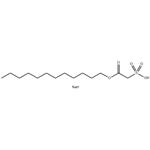
Sodium lauryl sulfoacetate

- CAS No.
- 1847-58-1
- Chemical Name:
- Sodium lauryl sulfoacetate
- Synonyms
- Dodecyl sodium sulfoacetate;Sodium 2-(dodecyloxy)-2-oxoethanesulfonate;foacetate;JACS-1847-58-1;Houttuynia oil;Sodium houttuynia;New Houttuynia Sodium;Lactic acid impurity 76;SodiuM Lauryl Sulfoactate;Houttuynia cordata sodium
- CBNumber:
- CB02131186
- Molecular Formula:
- C14H29NaO5S
- Molecular Weight:
- 331.43
- MDL Number:
- MOL File:
- 1847-58-1.mol
- MSDS File:
- SDS
- TDS File:
- TDS
| Melting point | >142°C (dec.) |
|---|---|
| storage temp. | Inert atmosphere,Room Temperature |
| solubility | DMSO (Slightly), Methanol (Slightly, Heated) |
| form | Solid |
| color | White to Off-White |
| Stability | Hygroscopic |
| Cosmetics Ingredients Functions |
FOAMING CLEANSING SURFACTANT - CLEANSING |
| InChI | InChI=1S/C14H28O5S.Na.H/c1-2-3-4-5-6-7-8-9-10-11-12-19-14(15)13-20(16,17)18;;/h2-13H2,1H3,(H,16,17,18);; |
| InChIKey | BCMBLJOFYNHIGL-UHFFFAOYSA-N |
| SMILES | O(C(=O)CS(O)(=O)=O)CCCCCCCCCCCC.[NaH] |
| LogP | 4.054 (est) |
| CAS DataBase Reference | 1847-58-1 |
| EWG's Food Scores | 1 |
| FDA UNII | D0Y70F2B9J |
| ATC code | A06AG11 |
| EPA Substance Registry System | Acetic acid, sulfo-, 1-dodecyl ester, sodium salt (1847-58-1) |
SAFETY
Risk and Safety Statements
| Symbol(GHS) |  GHS07 |
|---|---|
| Signal word | Warning |
| Hazard statements | H315-H319 |
| Precautionary statements | P264-P280-P302+P352-P337+P313-P305+P351+P338-P362+P364-P332+P313 |
| TSCA | TSCA listed |
| Hazardous Substances Data | 1847-58-1(Hazardous Substances Data) |
Sodium lauryl sulfoacetate price More Price(29)
| Manufacturer | Product number | Product description | CAS number | Packaging | Price | Updated | Buy |
|---|---|---|---|---|---|---|---|
| Cayman Chemical | 29906 | Sodium Lauryl Sulfoacetate ≥95% | 1847-58-1 | 50mg | $107 | 2026-04-30 | Buy |
| Cayman Chemical | 29906 | Sodium Lauryl Sulfoacetate ≥95% | 1847-58-1 | 100mg | $193 | 2026-04-30 | Buy |
| Cayman Chemical | 29906 | Sodium Lauryl Sulfoacetate ≥95% | 1847-58-1 | 250mg | $424 | 2026-04-30 | Buy |
| Cayman Chemical | 29906 | Sodium Lauryl Sulfoacetate ≥95% | 1847-58-1 | 500mg | $740 | 2026-04-30 | Buy |
| Usbiological | 289330 | Sodium Lauryl Sulfoacetate ≥95% | 1847-58-1 | 50mg | $347 | 2026-06-03 | Buy |
Sodium lauryl sulfoacetate Chemical Properties, Uses, Production
Preparation
(1) Take 3500g of coconut oil and place it in an enamel container. Add 750g of sodium hydroxide and 250g of sulfuric acid respectively. After saponification and acidification, place it in a vacuum fractionation apparatus and fractionate it under reduced pressure at 150℃ and 120mmHg to obtain dodecanoic acid;
(2) Preparation of calcium salt
Take 1800g of sieved lime and add 2500ml of water to make a paste. Separately, heat 500g of dodecanoic acid in a 10,000ml porcelain bucket to completely dissolve it. Mix it evenly with 2500g of glacial acetic acid and pour it into the lime paste. Stir continuously to obtain calcium salt. Let it stand overnight (preparation of calcium salt);
(3) Preparation of mixed ketones:
Put the obtained calcium salt into a pyrolysis tank and heat it directly for 10 hours to obtain about 750ml of mixed ketones;
(4) Preparation of tridecone-2 (fractionation)
Take 1000ml of mixed ketones and pour it into a round-bottom flask. Add 2-3 glass beads to prevent boiling. Connect the fractionation apparatus and then heat (temperature controlled at 150℃, pressure controlled at 120mmHg) and distill under reduced pressure. Collect the fraction within this range and weigh it to obtain tridecanoyl-2;
(5) Preparation of sodium dodecanoyl acetaldehyde:
Take 200g of tridecanoyl-2, 750g of ethyl formate, and 1000ml of anhydrous benzene and mix them in a 5000ml Erlenmeyer flask. Then take 125g of metallic sodium, chop it, and add it to the mixture in portions. Shake it thoroughly. Cool the Erlenmeyer flask with ice water and keep the reaction solution at 25℃. Let it stand at room temperature to obtain sodium dodecanoyl acetaldehyde;
(6) Addition of sodium dodecanoyl acetaldehyde bisulfite
The above reactants were extracted with water four times: 2000 ml × 2, 1000 ml × 2. The four extracts were combined. Separately, 750 g of NaHSO3 was dissolved in 1500 ml of water and mixed with 250 ml of glacial acetic acid. The above water extract was added, and a large amount of white precipitate was immediately formed. The mixture was stirred evenly, allowed to stand, filtered, dried, and allowed to stand again. The precipitate was poured into a porcelain container and heated to boiling in a water bath with 8000 ml of 50% ethanol. After filtration, the filtrate was heated to boiling again in a water bath and allowed to stand overnight for recrystallization. The filtrate was then filtered to dryness, washed several times with about 1500 ml of diethyl ether, then washed with water, and then washed with diethyl ether until white. The filtrate was then dried at 80°C to obtain Sodium lauryl sulfoacetate.
Antiviral?Activities
Description
Sodium Lauryl Sulfoacetate is derived from coconut and palm oils; a safe, skin-friendly surfactant (foaming agent) for both skin and hair. This mild plant-derived surfactant creates a rich, luxurious lather that effectively removes surface oil, dirt, and bacteria without stripping or drying sensitive skin or hair.
Description
Sodium lauryl sulfoacetate is an anionic surfactant. It increases proliferation of isolated chicken peripheral blood mononuclear cells (PBMCs) when used at concentrations ranging from 62.5 to 500 μg/ml. Sodium lauryl sulfoacetate (1, 2, and 4 mg/kg) increases the blood CD4+ to CD8+ T cell ratio induced by a Newcastle disease virus vaccine in chickens. Formulations containing sodium lauryl sulfoacetate have been used as surfactants in the manufacture of cosmetics.
Chemical Properties
Sodium lauryl sulfate may be derived from either petroleum based or vegetable based sources. The SLS Tom’s of Maine uses is entirely derived from the vegetable sources of coconut and/or palm kernel oil. The oils can be split into glycerin and the component fatty acids, one of which is lauric acid. The lauric acid is isolated and then hydrogenated to form the lauryl alcohol. Alternately, the whole oil can be esterified and then hydrogenated to form the fatty alcohols of which lauryl alcohol would be isolated by fractionation. The lauryl alcohol is then combined with sulfur which then forms the salt, sodium lauryl sulfate.
Uses
Sodium Lauryl Sulfoacetate,can be used in the preparation of new surfactants of sodium cocoyl threoninate and sodium cocoyl glutamate that offer outstanding mildness, moisturization properties, and good foaming ability.
Application
Sodium lauryl sulfate is frequently used as a surfactant, or foaming agent. It may also serve as an emulsifier, helping oil based and water based ingredients to stay mixed. In many of our toothpastes SLS is used as a surfactant and helps to properly disperse the ingredients during brushing, and ensures easy rinsing and removal of debris (i.e. food particles).
benefits
Personal Care Products
SLS has been an ingredient in shampoos since the 1930s. It works as a surfactant, trapping oil and dirt in hair so it can rinse away with water. An effective foaming agent, SLS can help create a rich lather in products like body and hand wash, facial cleansers and bubble. Likewise, SLS helps create the foaming action in toothpaste and also helps remove food particles from teeth.
Cleaning Products
SLS is an effective surfactant used in household cleaning products to help remove oily stains and residues, such as food stains in carpets. Because of its ability to break down oil and grease, SLS also is an ingredient in many industrial cleaning products, such as engine degreasers and industrial strength detergents.
Food Additive
As a food additive, SLS is used as an emulsifier or thickener. For example, SLS helps make marshmallows and dried egg products light and fluffy. SLS also helps acids mix better with liquids, for example in fruit juices and punches.
Hazard
Depending on manufacturing processes, sodium laureth sulfate may be contaminated with measurable amounts of ethylene oxide and 1,4-dioxane. The International Agency for Research on Cancer ethylene oxide as a known human carcinogen and 1,4-dioxane as a possible human carcinogen. Ethylene oxide can also harm the nervous system iiand the California Environmental Protection Agency has classified it as a possible developmental toxicant based on evidence that it may interfere with human development. 1,4-dioxane is also persistent. In other words, it doesn’t easily degrade and can remain in the environment long after it is rinsed down the shower drain. 1,4-dioxane can be removed from cosmetics during the manufacturing process by vacuum stripping, but there is no easy way for consumers to know whether products containing sodium laureth sulfate have undergone this process.
References
[1] E. GAD E A M M El Sukkary. Surface and thermodynamic properties of octyl, dodecyl, and cetyl sulfoacetates[J]. Monatshefte für Chemie - Chemical Monthly, 1997, 25 1: 1085-1092. DOI: 10.1007/bf00807558
[2] DARONG CHENG Huaichang S Shanyuan Zhu. The immune enhancement of sodium lauryl sulfoacetate in chickens.[J]. Veterinary Medicine International, 2010, 2010: 485060. DOI: 10.4061/2010/485060
Sodium lauryl sulfoacetate Preparation Products And Raw materials
Raw materials
Preparation Products
| Supplier | Tel | Country | ProdList | Advantage | |
|---|---|---|---|---|---|
| Shanghai Aladdin Biochemical Technology Co.,Ltd. | 6206333 13167063860 | anhua.mao@aladdin-e.com | China | 43586 | 58 |
| Wuhan Luyi New Material Co., Ltd. | 027-81360608 13971310049 | 109321999@qq.com | China | 80 | 58 |
| HUNEI MEIBEI NEW MATERIAL Co., Ltd. | 18271819653 | 1483755123@qq.com | China | 4735 | 58 |
| Chembest Research Laboratories Limited | 021-20908456 | sales@BioChemBest.com | China | 5996 | 61 |
| Adamas Reagent, Ltd. | 400-6009262 15618770481 | yhx@titansci.com | China | 14098 | 59 |
| XiaoGan ShenYuan ChemPharm co,ltd | 15527621225; 15527621225 | 1791901229@qq.com | China | 6740 | 52 |
| Beijing HuaMeiHuLiBiological Chemical | 010-56205725 | waley188@sohu.com | China | 12323 | 58 |
| UHN Shanghai Research & Development Co., Ltd. | 021-58958002 18930822973 | sales@uhnshanghai.com | China | 997 | 58 |
| TargetMol Chemicals Inc. | 021-021-33632979 15002134094 | marketing@targetmol.com | China | 7993 | 58 |
| Quality Control Solutions Ltd. | 0755-66853366 13670046396 | orders@qcsrm.com | China | 18188 | 56 |
Related articles
- What is Sodium new houttuyfonate?
- Sodium new houttuyfonate (SNH), is an addition product of active ingredient houttuynin which could inhibit a variety of bacter....
- Feb 11,2020
View Latest Price from Sodium lauryl sulfoacetate manufacturers
| Image | Update time | Product | Price | Min. Order | Purity | Supply Ability | Manufacturer | |
|---|---|---|---|---|---|---|---|---|
 |
2026-09-18 | Sodium lauryl sulfoacetate
1847-58-1
|
1kg/bag | ≥98% | 50 T/Month | Hebei Qujie Technology Co., Ltd. | ||
 |
2026-09-18 | Sodium new houttuyfonate
1847-58-1
|
1KG | 98%min;CP | 100KG | WUHAN FORTUNA CHEMICAL CO., LTD | ||
 |
2026-09-02 | Sodium lauryl sulfoacetate
1847-58-1
|
$1.00-50.00 | 1KG | 99% | Henan Fengda Chemical Co., Ltd |
-
- Sodium lauryl sulfoacetate
1847-58-1
- $0.00
- ≥98%
- Hebei Qujie Technology Co., Ltd.
-
- Sodium new houttuyfonate
1847-58-1
- 98%min;CP
- WUHAN FORTUNA CHEMICAL CO., LTD
-
- Sodium lauryl sulfoacetate
1847-58-1
- $1.00-50.00
- 99%
- Henan Fengda Chemical Co., Ltd
