


Iron(III) citrate
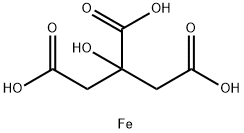
- CAS No.
- 3522-50-7
- Chemical Name:
- Iron(III) citrate
- Synonyms
- FERRIC CITRATE;IRON CITRATE;Fe(II)max5%;Fe(II) max 5%;EFRRIC CITRATE;Ferric Cltrate;Iron(Ⅲ) citrate;Citric acid iron;Einecs 222-536-6;ron(III) citrate
- CBNumber:
- CB1273092
- Molecular Formula:
- C6H8FeO7
- Molecular Weight:
- 247.97
- MDL Number:
- MFCD00013098
- MOL File:
- 3522-50-7.mol
- MSDS File:
- SDS
- TDS File:
- TDS
| Melting point | >300°C |
|---|---|
| storage temp. | room temp |
| solubility | soluble in H2O; insoluble in ethanol |
| form | red-brown crystals |
| color | Dark Orange to Very Dark Orange |
| biological source | synthetic (organic) |
| Water Solubility | hot water: 0.01g/mL, clear, orange-yellow |
| Stability | Stable. Incompatible with strong oxidizing agents. |
| Cosmetics Ingredients Functions | SKIN CONDITIONING |
| Cosmetic Ingredient Review (CIR) | Iron(III) citrate (3522-50-7) |
| InChI | InChI=1S/C6H8O7.Fe/c7-3(8)1-6(13,5(11)12)2-4(9)10;/h13H,1-2H2,(H,7,8)(H,9,10)(H,11,12); |
| InChIKey | NPFOYSMITVOQOS-UHFFFAOYSA-K |
| SMILES | C(O)(C(=O)O)(CC(=O)O)CC(=O)O.[Fe] |
| CAS DataBase Reference | 3522-50-7(CAS DataBase Reference) |
| FDA UNII | 63G354M39Z |
| UNSPSC Code | 12352302 |
| NACRES | NA.75 |
SAFETY
Risk and Safety Statements
| Symbol(GHS) |  GHS07 |
|---|---|
| Signal word | Warning |
| Hazard statements | H315-H335-H319 |
| Precautionary statements | P264-P280-P305+P351+P338-P337+P313P-P264-P280-P302+P352-P321-P332+P313-P362 |
| PPE | Eyeshields, Gloves, type N95 (US) |
| WGK Germany | 3 |
| F | 8 |
| Storage Class | 11 - Combustible Solids |
Iron(III) citrate price More Price(37)
| Manufacturer | Product number | Product description | CAS number | Packaging | Price | Updated | Buy |
|---|---|---|---|---|---|---|---|
| Sigma-Aldrich | F3388 | Ferric citrate BioReagent, suitable for cell culture | 3522-50-7 | 250g | $85.9 | 2026-04-30 | Buy |
| Sigma-Aldrich | F3388 | Ferric citrate BioReagent, suitable for cell culture | 3522-50-7 | 1kg | $291 | 2026-04-30 | Buy |
| Usbiological | 276888 | Ferric citrate | 3522-50-7 | 50g | $319 | 2026-06-03 | Buy |
| Usbiological | 276888 | Ferric citrate | 3522-50-7 | 100g | $432 | 2026-06-03 | Buy |
| Usbiological | 276888 | Ferric citrate | 3522-50-7 | 250g | $573 | 2026-06-03 | Buy |
Iron(III) citrate Chemical Properties, Uses, Production
Phosphate binding agents
Each available phosphate-binding agent effectively binds phosphorus but each has its disadvantages. This has led to continued research seeking alternative agents that ideally would bind phosphorus only and have no negative systemic consequences. Ferric compounds were initially noted to cause hypophosphatemia in the 1940s[4,5]. During the course of observing several pregnant patients to characterize calcium, phosphate and vitamin D balance, the investigators treated one patient for anemia with ferric ammonium citrate. Her anemia did not respond to therapy, but the authors noted an adverse effect on calcium and phosphorus balance (hypophosphatemia) that subsequently resolved upon discontinuation of the ferric compound[4]. On the basis of this observation, ferric ammonium citrate was used successfully in the early 1940s by the same group to treat the hyperphosphatemia of CKD in two subjects for several months. At that time, the only side effect reported was occasional diarrhea[5]. Given the need for alternative agents, ferric compounds are now being revisited as potential phosphate-binding agents.
Chemistry and mechanism of action
Ferric citrate reduces intestinal phosphate absorption by precipitating phosphate in the intestine in a mechanism analogous to the currently used salts of aluminum, calcium and lanthanum. Ferric citrate is water-soluble and thus easily dissociates into ferric iron and citrate in the intestinal lumen. Dietary phosphorus is then precipitated as either ferric or ferrous phosphate and subsequently excreted in the feces. Soluble inorganic free-iron absorption (Fe2+ or Fe3+) is very tightly regulated in the intestine. Iron is actively transported across the mucosa of the small intestine primarily in the duodenum that serves as the primary site of iron absorption. Any ferric (Fe3+) iron in the duodenum must first be reduced to ferrous (Fe2+) iron by ferric reductase (duodenal cytochrome b) on the mucosal surface of the enterocyte to be absorbed by the mucosal cell. Much of the iron entering the mucosal cells is not transferred to the plasma but remains trapped in the cell and is ultimately excreted when the mucosal cell is shed into the intestinal lumen. The potential for iron overload via this route of absorption is extremely low due to tight regulation mediated by iron regulatory proteins intracellularly and hepcidin extracellularly[6]. The citrate moiety can also be absorbed systemically in the intestine. Once absorbed it is metabolized by the liver to bicarbonate and subsequently enters the bicarbonate buffer system that in part regulates systemic acid–base status.
Phase III Clinical efficacy
The Phase III clinical program has two trials, a 4-week dose-ranging and efficacy trial (ClinicalTrials.gov identifier: NCT01074125)[8] and a long-term efficacy and safety trial (ClinicalTrials.gov identifier: NCT01191255)[9]. The objective of the short-term trial was to determine the dose–response relationship and the efficacy of a fixed dose of 1, 6 and 8 g/day of ferric citrate[7]. The study was a multicenter, randomized, open-label trial with a 2-week washout period, immediately followed by a 4-week treatment period in 154 subjects. Preliminary results from this trial showed that serum phosphorus decreased by 23 and 27% from randomization in the 6 and 8 g/day groups, respectively. The primary efficacy variable was the change in serum phosphorus from baseline to the end of the treatment period. The dose–response relationship for the change in serum phosphorous from baseline was confirmed by regression analysis (p < 0.001). An increase of 0.1, 1.6 and 1.5 mEq/l of the serum bicarbonate level was noted in the 1, 6 and 8 g/day groups, respectively. A modest increase in the ferritin level was noted with no changes in serum iron or TSAT levels. Thus, ferric citrate appears to be an efficacious phosphate binder, in a dose-dependent manner.
Safety and tolerability
Ferric citrate has been generally well tolerated in clinical studies to date. Most patients experience a dark discoloration of their stool, which is expected, as iron in the gastrointestinal tract is known to darken stool color. Interestingly, not all subjects recognize this, although it is believed that all subjects experience it. In the first clinical trial performed in Taiwan, all of the adverse events were minor and primarily related to the gastrointestinal system (e.g., diarrhea, bloating or constipation)[10]. None of these events were serious in nature. These same profiles of adverse events were noted in the second clinical study in 28 subjects and were similar to the control (calcium acetate) group. The Phase II study (ClinicalTrials.gov identifier: NCT00648167) also demonstrated tolerability comparable to other phosphate-binding agents with primarily gastrointestinal adverse events and change in stool color[11]. Ferric citrate appears to be well tolerated, on par with other phosphate-binding agents[12–14].
Many ESRD patients require iron-replacement therapy and therefore often receive intravenous iron[15]. The daily use of an iron-containing phosphate-binding medication could lead to systemic absorption but is unlikely to result in an iron overload state, given the tight regulation of iron absorption at the enterocyte (see the section on ‘Chemistry & mechanism of action’). In the preliminary studies to date, small increases in the biochemical parameters used to assess iron status (serum iron, TSAT and ferritin) have been noted. In the largest clinical trial to date in 55 subjects (ClinicalTrials. gov identifier: NCT00648167)[8], small but statistically significant increases were seen in serum iron, TSAT and ferritin. These, however, remained well within recommended limits for ESRD patients[16,17]. Thus, it is felt that iron overload is unlikely to occur with ferric citrate. The pivotal safety study with an enrollment of 441 subjects is presently ongoing.
References
- Harmon B. Abrahamson, Ahmad B. Rezvani, J. George Brushmiller (1994): "Photochemical and spectroscopic studies of complexes of iron (III) with citric acid and other carboxylic acids". Inorganica Chimica Acta, volume 226, pages 117-127.
- Kidney Disease Outcomes Quality Initiative. K/DOQI clinical practice guidelines for bone metabolism and disease in chronic kidney disease. Am. J. Kidney Dis. 42(4 Suppl. 3), S1–S201 (2003).
- Kidney Disease Improving Global Outcomes. KDIGO clinical practice guideline for the diagnosis, evaluation, prevention, and treatment of chronic kidney disease-mineral and bone disorder (CKD-MBD). Kidney Int. Suppl. 113, S1–S130 (2009).
- Liu SH, Chu HI, Hsu HC, Chao HC, Cheu SH. Calcium and phosphorus metabolism in osteomalacia. XI. the pathogenetic role of pregnancy and relative importance of calcium and vitamin D supply. J. Clin. invest. 20(3), 255–271 (1941).
- Liu SH, Chu HI. Studies of calcium and phosphorus metabolism with special reference to pathogenesis and effects of dihydrotachysterol (A.T. 10) and iron. Medicine (Baltimore) 22, 103–161 (1943).
- Fleming RE, Ponka P. Iron overload in human disease. N. Engl. J. Med. 366(4), 348–359 (2012).
- Sika M, Smith M, Schulman G, Kaplan M, Lewis JB. A dose-ranging and efficacy Phase 3 trial of ferric citrate (FC) as a phosphate binder in dialysis patients. Am. J. Kid. Dis. (2011) (Abstract 292).
- A safety and tolerability study of Zerenex (ferric citrate) in patients with end-stage renal disease (ESRD) (2008).
- A 4-week dose-ranging and efficacy trial of KRX-0502 (ferric citrate) in patients with end-stage renal disease (2010).
- Yang WC, Yang CS, Hou CC, Wu TH, Young EW, Hsu CH. An open-label, crossover study of a new phosphate-binding agent in haemodialysis patients: ferric citrate. Nephrol. Dial. Transplant. 17(2), 265–270 (2002).
- Sinsakul MV, Korbet S, Greene T et al. The safety and tolerability of higher doses of ferric citrate in controlling serum phosphorus in ESRD patients. Poster Presented at: National Kidney Foundation Meetings. Orlando, FL, USA (2010).
- Finn WF; SPD 405-307 Lanthanum Study Group. Lanthanum carbonate versus standard therapy for the treatment of hyperphosphatemia: safety and efficacy in chronic maintenance hemodialysis patients. Clin. Nephrol. 65(3), 191–202 (2006).
- Joy MS, Finn WF; LAM-302 Study Group. Randomized, double-blind, placebo-controlled, dose-titration, Phase III study assessing the efficacy and tolerability of lanthanum carbonate: a new phosphate binder for the treatment of hyperphosphatemia. Am. J. Kidney Dis. 42(1), 96–107 (2003).
- Slatopolsky EA, Burke SK, Dillon MA. RenaGel, a nonabsorbed calciumand aluminum-free phosphate binder, lowers serum phosphorus and parathyroid hormone. The RenaGel Study Group. Kidney Int. 55(1), 299–307 (1999).
- Van Wyck DB. Iron deficiency in patients with dialysis-associated anemia during erythropoietin replacement therapy: strategies for assessment and management. Semin. Nephrol. 9(1 Suppl. 2), 21–24 (1989).
- II. Clinical practice guidelines and clinical practice recommendations for anemia in chronic kidney disease in adults. Am. J. Kidney Dis. 47(5 Suppl. 3), S16–S85 (2006).
- Kidney Disease Outcomes Quality Initiative. KDOQI clinical practice guideline and clinical practice recommendations for anemia in chronic kidney disease: 2007 update of hemoglobin target. Am. J. Kidney Dis. 50(3), 471–530 (2007).
Description
Ferric citrate (iron (III) citrate) is prepared from reaction of citric acid with ferric hydroxide. It is a compound of indefinite ratio of citric acid and iron. Ferric citrate is slowly soluble in cold water, readily soluble in hot water, and practically insoluble in alcohol.
Chemical Properties
solid
Uses
Iron(III) Citrate is an integral part of the structural basis of gating by the outer membrane receptor FecA from Escherichia coli. Binding of ferric citrate triggers a conformational change of the extracellular loops that close the external pocket of FecA.
Biochem/physiol Actions
Ferric citrate is used as a component of protein-free medium. It is used as a substitute for transferrin in mouse hybridomas culture. Ferric citrate enhances IgM production. It indirectly stimulates the mitogen-activated protein kinase (MAPK) by favoring high amphiregulin oncoprotein levels in colon cancer. Ferric citrate is effective in binding to phosphate in patients with dialysis-dependent chronic kidney disease.
Iron(III) citrate Preparation Products And Raw materials
Raw materials
Preparation Products
| Supplier | Tel | Country | ProdList | Advantage | |
|---|---|---|---|---|---|
| Nanjing songguan Biotechnology Co., Ltd. | 13584088977 | 2714748392@qq.com | China | 609 | 58 |
| Hubei Zhonglong Kangsheng fine chemical Co.,Ltd | 027-83850125 15927542930 | 3321236220@qq.com | China | 996 | 58 |
| Beijing HwrkChemical Technology Co., Ltd | 89508211 18501085097 | sales.bj@hwrkchemical.com | China | 9407 | 55 |
| Energy Chemical | 400-0056266 | sales8178@energy-chemical.com | China | 44850 | 61 |
| JinYan Chemicals(ShangHai) Co.,Ltd. | 13817811078 | sales@jingyan-chemical.com | China | 9963 | 60 |
| Shandong Xiya Chemical Co., Ltd | 13355009207 13355009207 | 3007715519@qq.com | China | 18722 | 57 |
| Syntechem Co.,Ltd | info@syntechem.com | China | 12973 | 57 | |
| Tianjin heowns Biochemical Technology Co., Ltd. | 400 638 7771 | sales@heowns.com | China | 14412 | 57 |
| Hunan Hui Bai Shi Biotechnology Co., Ltd. | 0731-85526065 13308475853 | ivy@hnhbsj.com | China | 7236 | 62 |
| Wuhan Fortuna Chemical Co., Ltd | 027-59207852 13308628970 | buy@fortunachem.com | China | 2684 | 58 |
Related articles
- Iron(III) citrate: a generalist from plant photosynthesis to blood iron metabolism
- This article takes you through the photochemical behavior, synthesis methods, detection technology and physiological significa....
- Aug 10,2026
View Latest Price from Iron(III) citrate manufacturers
| Image | Update time | Product | Price | Min. Order | Purity | Supply Ability | Manufacturer | |
|---|---|---|---|---|---|---|---|---|
 |
2026-03-22 | Ferric citrate
3522-50-7
|
$10.00 | 25KG | 99% | 200 | Jiangsu Kolod Food Ingredients Co.,Ltd. | |
 |
2026-03-20 | Iron(III) citrate
3522-50-7
|
$1.00 | 1KG | 99% | 10mt | Hebei Chuanghai Biotechnology Co., Ltd | |
 |
2025-11-04 | Ferric Citrate
3522-50-7
|
$1100.00-1200.00 | 1ton | 99% | 1000T/M | Lianyungang Kaiyu Environmental Tech Co., Ltd. |
-
- Ferric citrate
3522-50-7
- $10.00
- 99%
- Jiangsu Kolod Food Ingredients Co.,Ltd.
-
- Iron(III) citrate
3522-50-7
- $1.00
- 99%
- Hebei Chuanghai Biotechnology Co., Ltd
-
- Ferric Citrate
3522-50-7
- $1100.00-1200.00
- 99%
- Lianyungang Kaiyu Environmental Tech Co., Ltd.
