


CADUSAFOS
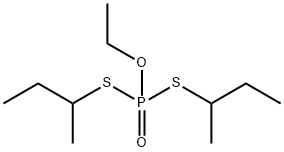
- CAS No.
- 95465-99-9
- Chemical Name:
- CADUSAFOS
- Synonyms
- RUGBY;ebufos;APACHE;Toredan;taredan;fmc67825;codusafos;Hsdb 7139;PMC 67825;CADUSAFOS
- CBNumber:
- CB3728824
- Molecular Formula:
- C10H23O2PS2
- Molecular Weight:
- 270.39
- MDL Number:
- MFCD00072511
- MOL File:
- 95465-99-9.mol
- MSDS File:
- SDS
| Melting point | <25 °C |
|---|---|
| Boiling point | 167°C |
| Density | 1.069±0.06 g/cm3(Predicted) |
| vapor pressure | 0.12 Pa (25 °C) |
| Flash point | 129℃ |
| storage temp. | 2-8°C |
| Water Solubility | 248 mg l-1 |
| Specific Gravity | 1.05 |
| BRN | 8140049 |
| Henry's Law Constant | 7.6×100 mol/(m3Pa) at 25℃, HSDB (2015) |
| Major Application |
agriculture environmental |
| InChI | 1S/C10H23O2PS2/c1-6-9(4)14-13(11,12-8-3)15-10(5)7-2/h9-10H,6-8H2,1-5H3 |
| InChIKey | KXRPCFINVWWFHQ-UHFFFAOYSA-N |
| SMILES | CCOP(=O)(SC(C)CC)SC(C)CC |
| FDA UNII | 8JBJ4VO75K |
| Pesticides Freedom of Information Act (FOIA) | Ebufos |
| EPA Substance Registry System | Cadusafos (95465-99-9) |
| UNSPSC Code | 41116107 |
| NACRES | NA.24 |
SAFETY
Risk and Safety Statements
| Symbol(GHS) |   GHS06,GHS09 |
|---|---|
| Signal word | Danger |
| Hazard statements | H300+H310+H330-H400 |
| Precautionary statements | P262-P273-P280-P301+P310+P330-P302+P352+P310-P304+P340+P310 |
| PPE | Eyeshields, Faceshields, Gloves, type ABEK (EN14387) respirator filter |
| Hazard Codes | T+ |
| Risk Statements | 25-26-27-50/53 |
| Safety Statements | 28-36/37-45-60-61 |
| RIDADR | 3018 |
| WGK Germany | 3 |
| HazardClass | 6.1(a) |
| PackingGroup | II |
| HS Code | 29309090 |
| Storage Class | 6.1A - Combustible acute toxic Cat. 1 and 2 very toxic hazardous materials |
| Hazard Classifications | Acute Tox. 1 Dermal Acute Tox. 1 Inhalation Acute Tox. 2 Oral Aquatic Acute 1 Aquatic Chronic 1 |
| Hazardous Substances Data | 95465-99-9(Hazardous Substances Data) |
CADUSAFOS price More Price(13)
| Manufacturer | Product number | Product description | CAS number | Packaging | Price | Updated | Buy |
|---|---|---|---|---|---|---|---|
| Sigma-Aldrich | 32505 | Cadusafos PESTANAL | 95465-99-9 | 50mg | $164 | 2026-04-30 | Buy |
| AHH | MT-48880 | Cadusafos 97% | 1g | $480 | 2026-05-26 | Buy | |
| TRC | C060000 | Cadusafos | 95465-99-9 | 2.5mg | $195 | 2021-12-16 | Buy |
| Biosynth | FC19624 | Cadusafos | 95465-99-9 | 2mg | $40 | 2021-12-16 | Buy |
| Biosynth | FC19624 | Cadusafos | 95465-99-9 | 5mg | $60 | 2021-12-16 | Buy |
CADUSAFOS Chemical Properties, Uses, Production
Description
This nonsystemic organophosphate not registered for U.S. usage is used to control nematodes and soil insects on bananas and other crops in several countries. The U.S. EPA has granted tolerances for cadusafos in imported bananas, where it provides excellent control of the burrowing nematode, Radopholus similis (22). Cadusafos reportedly possesses reduced risk for contaminating groundwater and provided good control of the citrus nematode, Tylenchulus semipenetrans (23). Cadusafos is commercially available in granular and microencapsulated formulations.
Uses
CADUSAFOS is used in the agriculture industry
Uses
Insecticide; nematocide.
Uses
Cadusafos is used to control nematodes, cutworms and soil insects in bananas, citrus, maize, potatoes, tobacco, sugar cane and vegetables.
Definition
ChEBI: Cadusafos is an organic thiophosphate and an organothiophosphate insecticide. It has a role as an EC 3.1.1.7 (acetylcholinesterase) inhibitor, a nematicide and an agrochemical.
Production Methods
Cadusafos, a synthetic organothiophosphate nematicide, is produced through a multi-step chemical synthesis involving the formation of its key phosphorodithioate structure. The process typically begins with the reaction of phosphorus compounds, such as phosphorus oxychloride or phosphorus pentasulfide, with alcohols and thiols to form the phosphorodithioate backbone. In the case of cadusafos, this includes the incorporation of sec-butyl mercaptan and ethyl alcohol to yield S,S-di-sec-butyl O-ethyl phosphorodithioate.
General Description
Cadusafos is a nematicide used in controlling nematodes, soil insects and cutworms in a variety of fruits and vegetables. Its mode of action involves the inhibition of acetylcholinesterase.
Mechanism of action
Broad-spectrum activity with contact and stomach action. Acetylcholinesterase (AchE) inhibitor.
Metabolic pathway
There is little published information on the metabolism of cadusafos. What has been published suggests that the main route of metabolism in animals is via hydrolysis to give 1-methyl-1-propanethiol which is then thiooxidised.
Metabolism
The acute oral LD50 values for rats and mice are 37.1 and 71.4 mg/kg, respectively. Inhalation LC50 (4 h) for rats is 0.026 mg/L air. NOEL (2 yr) for rats is 1 mg/kg diet (0.05 mg/kg/d) and ADI is 0.3 μg/kg. In mammals, it is readily metabolized and is eliminated in the urine and feces. The major metabolic route is hydrolysis to give 1-methyl-1-propanothiol, followed by oxidation. The halflife in soils is 11–55 d.
Pesticide Type
Insecticide; Nematicide
CADUSAFOS Preparation Products And Raw materials
95465-99-9 (CADUSAFOS) Related Search:
1of4
