


5-Aminolevulinic acid

- CAS No.
- 106-60-5
- Chemical Name:
- 5-Aminolevulinic acid
- Synonyms
- 5-AMINOLEVULINATE;5-AMINOLAEVULINIC ACID;5-amino-4-oxovaleric acid;5-AMinelevulic acid (5-ALA);4-Oxo-5-aminopentanoic acid;Kerastick;Aminolevulinate;aminolevulinicacid;5-aminolevulinicaci;5-Aminobutyric acid
- CBNumber:
- CB5265495
- Molecular Formula:
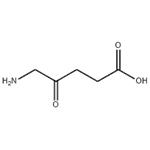
- C5H9NO3
- Molecular Weight:
- 131.13
- MDL Number:
- MFCD00044485
- MOL File:
- 106-60-5.mol
- MSDS File:
- SDS
- TDS File:
- TDS
| Melting point | 118-119 °C |
|---|---|
| Boiling point | 242.42°C (rough estimate) |
| Density | 1.3121 (rough estimate) |
| refractive index | 1.4300 (estimate) |
| storage temp. | 2-8°C(protect from light) |
| solubility | Soluble in DMSO |
| pka | 4.05(at 25℃) |
| InChI | InChI=1S/C5H9NO3/c6-3-4(7)1-2-5(8)9/h1-3,6H2,(H,8,9) |
| InChIKey | ZGXJTSGNIOSYLO-UHFFFAOYSA-N |
| SMILES | C(O)(=O)CCC(=O)CN |
| CAS DataBase Reference | 106-60-5(CAS DataBase Reference) |
| EWG's Food Scores | 1 |
| FDA UNII | 88755TAZ87 |
| NCI Drug Dictionary | aminolevulinic acid |
| ATC code | L01XD04 |
| EPA Substance Registry System | Pentanoic acid, 5-amino-4-oxo- (106-60-5) |
SAFETY
Risk and Safety Statements
| Symbol(GHS) |  GHS07 |
|---|---|
| Signal word | Warning |
| Hazard statements | H302 |
| Precautionary statements | P261-P280-P305+P351+P338-P304+P340 |
| TSCA | TSCA listed |
| HS Code | 29225090 |
5-Aminolevulinic acid price More Price(16)
| Manufacturer | Product number | Product description | CAS number | Packaging | Price | Updated | Buy |
|---|---|---|---|---|---|---|---|
| ChemScene | CS-W000450 | 5-Aminolevulinic acid ≥98% | 106-60-5 | 10mg | $135 | 2026-06-04 | Buy |
| ChemScene | CS-W000450 | 5-Aminolevulinic acid ≥98% | 106-60-5 | 25mg | $195 | 2026-06-04 | Buy |
| ChemScene | CS-W000450 | 5-Aminolevulinic acid ≥98% | 106-60-5 | 50mg | $271 | 2026-06-04 | Buy |
| ChemScene | CS-W000450 | 5-Aminolevulinic acid ≥98% | 106-60-5 | 100mg | $433 | 2026-06-04 | Buy |
| aablocks | AA00HANV | 5-Amino-4-oxopentanoic acid >98% | 106-60-5 | 10mg | $174 | 2026-05-28 | Buy |
5-Aminolevulinic acid Chemical Properties, Uses, Production
Description
5-aminolevulinic acid is the simplest delta-amino acid in which the hydrogens at the gamma position are replaced by an oxo group. It is metabolised to protoporphyrin IX, a photoactive compound which accumulates in the skin. Used (in the form of the hydrochloride salt)in combination with blue light illumination for the treatment of minimally to moderately thick actinic keratosis of the face or scalp. It has a role as a photosensitizing agent, an antineoplastic agent, a dermatologic drug, a prodrug, a plant metabolite, a human metabolite, a Saccharomyces cerevisiae metabolite, an Escherichia coli metabolite and a mouse metabolite. It is a delta-amino acid and a 4-oxo monocarboxylic acid. It derives from a 4-oxopentanoic acid. It is a conjugate base of a 5-ammoniolevulinic acid. It is a conjugate acid of a 5-aminolevulinate. It is a tautomer of a 5-ammoniolevulinate.
Originator
Levulan Kerastick,DUSA Pharmaceuticals Inc.
Uses
5-Aminolevulinic acid (ALA), a nonprotein amino acid involved in tetrapyrrole synthesis, has been widely applied in agriculture, medicine, and food production.
5-Aminolevulinic acid (5-ALA) is an intermediate in heme biosynthesis and is useful in cancer treatment. It is a non-protein amino acid. 5-ALA also has applications in the field of agriculture. It is being studied as an inducing reagent for protoporphyrin IX (PPIX) dependent fluorescence diagnosis of metastatic lymph nodes. 5-ALA is used for photodynamic therapy of diseases, such as Paget′s disease and HPV infection-associated cervical condylomata acuminata.
Intermediate in heme biosynthesis.
Definition
ChEBI: 5-aminolevulinic acid is the simplest delta-amino acid in which the hydrogens at the gamma position are replaced by an oxo group. It is metabolised to protoporphyrin IX, a photoactive compound which accumulates in the skin. Used (in the form of the hydrochloride salt)in combination with blue light illumination for the treatment of minimally to moderately thick actinic keratosis of the face or scalp. It has a role as a photosensitizing agent, an antineoplastic agent, a dermatologic drug, a prodrug, a plant metabolite, a human metabolite, a Saccharomyces cerevisiae metabolite, an Escherichia coli metabolite and a mouse metabolite. It is a delta-amino acid and a 4-oxo monocarboxylic acid. It is functionally related to a 4-oxopentanoic acid. It is a conjugate base of a 5-ammoniolevulinic acid. It is a conjugate acid of a 5-aminolevulinate. It is a tautomer of a 5-ammoniolevulinate.
Indications
Aminolevulinic acid (ALA HCl, Levulan Kerastick) is indicated for the treatment of nonhyperkeratotic actinic keratosis of the face and scalp. It has two components, an alcohol solution vehicle and ALA HCl as a dry solid. The two are mixed prior to application to the skin. When applied to human skin, ALA is metabolized to protoporphyrin, which accumulates and on exposure to visible light produces a photodynamic reaction that generates reactive oxygen species (ROS).The ROS produce cytotoxic effects that may explain therapeutic efficacy. Local burning and stinging of treated areas of skin due to photosensitization can occur.
Manufacturing Process
1) Oxidation Step
2.27 g (10.0 mmol) of N-furfurylphthalimide was charged into a three-necked
glass flask equipped with an oxygen feed tube, a thermometer, and a reflux
condenser, and dissolved in 100 ml of anhydrous pyridine. After the addition
of 7.0 mg of Rose Bengal, oxygen gas was fed at a rate of 20 ml/min at 10°-
20°C under irradiation by light. A 27 W white fluorescent lamp was used as a
light source and the radiation was performed from the outside of the flask.
After 7 hours, the irradiation was terminated and the pyridine was evaporated
under reduced pressure to obtain 2.47 g of a light brown, semi-crystalline
product.
2) Reduction Step (Hydrogenation)
2.00 g of the semi-crystalline solid obtained in (1) was dissolved in 40 ml of
methanol and stirred at 50°C in a hydrogen atmosphere under atmospheric
pressure in the presence of 200 mg of 5% palladium-on-carbon catalyst.
After five hours, the reaction was terminated and the mixture was allowed to
cool to room temperature. The catalyst was removed by filtration and
methanol was evaporated to obtain 2.11 g of white crystals.
The crystals were identified to be 5-phthalimidolevulinic acid by NMR analysis.
The yield was 97%.
3) Hydrolysis Step
100 ml of 6 N hydrochloric acid was added to 2.11 g of the white crystals (2),
and the mixture was heated under reflux for 5 hours.
After evaporating the hydrochloric acid under reduced pressure, a brown solid
product was obtained and dissolved in ethanol. Acetone was added to the
solution and the crystals produced were collected by filtration to obtain 0.689
g of 5-aminolevulinic acid hydrochloride. The yield based on Nfurfurylphthalimide
was 51%.
NMR spectrum data conformed to 5-aminolevulinic acid hydrochloride
Therapeutic Function
Photosensitizer
Biosynthesis
5-ALA was confirmed as the common precursor of tetrapyrrole compounds and was found in many organisms. Two natural 5-ALA biosynthesis pathways are known to date. One is the C4 pathway (Shemin pathway), which Shemin and Russell first reported. It exists in animals, yeast, some protozoa, and purple non-sulfur photosynthetic bacteria. In this pathway, glycine and succinyl-CoA are condensed to 5-ALA under the catalysis of 5-aminolevulinic acid synthase (ALAS), with pyridoxal 5′-phosphate (PLP) as the cofactor. Succinyl-CoA is synthesized by methylmalonyl-CoA mutase, which utilizes vitamin B12 as an essential cofactor (38). The other is the C5 pathway (Beale pathway), which starts from the discovery of 5-ALA in Chlorella vulgaris by Beale. Glutamate produced via the TCA cycle acts as the substrate of the C5 pathway. The C5 pathway is mainly present in higher plants, algae, and many bacteria. The pathway starts with ligating tRNA and glutamate to generate L-glutamyl–tRNA, catalyzed by glutamyl–tRNA synthetase (GluTS). The NADPH-dependent glutamyl-tRNA reductase (GluTR) reduces the carboxyl group of Glu–tRNA to a formyl group, which enables the conversion of L-Glu–tRNA into L-glutamic acid 1-semialdehyde (GSA). In the last step, 5-ALA is created through transamination by glutamate-1-semialdehyde aminotransferase (GSA-AM). The enzymes involved in this pathway, GluTS, GluTR, and GSA-AM, are encoded by gltX, hemA (homonymic with the ALAS gene of the C4 pathway), and hemL, respectively. However, a few microorganisms have C4 and C5 pathways, Euglena gracilis being a well-known example[1].
Biological Activity
5-Aminolevulinic acid (5-ALA) is a precursor in the biosynthesis of porphyrins, including heme. The conversion of 5-ALA to protoporphyrins within tissues produces a photosensitive target that produces reactive oxygen species upon exposure to light.1 In this way, it is used in photodynamic therapy for a range of dermatological conditions, cancers, and other diseases. Also, oral administration of 5-ALA leads to the preferential accumulation of the fluorescent molecule protoporphyrin IX within certain types of cancer cells. This allows fluorescence-based identification of tumor tissue for accurate resection of diseased tissue.
Enzyme inhibitor
This key metabolic precursor (FW = 131.13 g/mol; CAS 106-60-5; pKa values = 4.05 and 8.90 at 25°C; Symbol: ALA), also known as daminolevulinic acid, is essential for the biosynthesis of metal ion-binding tetrapyrrole ring systems (porphyrins, chlorophylls, and cobalamins). In non-photosynthetic eukaryotes (animals, insects, fungi, protozoa, and alphaproteobacteria), d-aminolevulinic acid is produced by the enzyme ALA synthase, using glycine and succinyl CoA as substrates. In plants, algae, bacteria, and archaea, it is produced from glutamyl-tRNA and glutamate-1-semialdehyde. 5-Aminolevulinic acid inhibits (R)-3-amino-2- methylpropionate:pyruvate aminotransferase. ALA Phototherapy: Protoporphyrin IX, the immediate heme precursor is a highly effective tissue photosensitizer that is synthesized in four steps from 5- aminolevulinic acid. ALA synthesis is regulated via a feedback inhibition and gene repression mechanism linked to the concentration of free heme. In certain cell and tissue types, addition of exogenous ALA bypasses these regulation mechanisms, inducing uptake and synthesis of photosensitizing concentrations of Protoporphyrin IX, or PpIX. Topical application of ALA to certain malignant and non-malignant skin lesions, for example, can induce a clinically useful degree of lesion-specific photosensitization (e.g., superficial basal cell carcinomas show high response rate (~79%) after a single phototherapy treatment). ALA also induces localized tissue-specific photosensitization, when injected intradermally. In this sense, ALA and its methyl ester (methyl aminolevulinate, or MAL; trade name: Metvix) are prodrugs that increase the amounts of the active drug (PpIX).
References
[1] Meiru Jiang. “Natural 5-Aminolevulinic Acid: Sources, Biosynthesis, Detection and Applications.” Frontiers in Bioengineering and Biotechnology (2022): 841443.
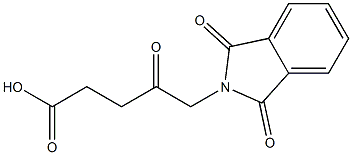

5-Aminolevulinic acid Preparation Products And Raw materials
Raw materials
Preparation Products
| Supplier | Tel | Country | ProdList | Advantage | |
|---|---|---|---|---|---|
| Cell-Free Biopharma (Shanghai) Co. , Ltd | 021-36696129 18916053988 | info@cell-freebiopharma.com | China | 17 | 58 |
| Shenzhen Hygieia Biotechnology Co., Ltd | 0755-0755-27208059 18898723287 | chloe@hygieia.com.cn | China | 64 | 58 |
| Suzhou NMT Biotech Co., Ltd. | 0512-62388427 18012730781 | longchengnmt@gmail.com | China | 42 | 58 |
| Shaanxi Haochen Biotechnology Co., Ltd | 18710685966 18710685966 | 511325867@qq.com | China | 319 | 58 |
| Wuxi Jingyao Bio-Technology Co., Ltd. | 88770633 13961738808 | jingyaobiotech@126.com | China | 389 | 55 |
| JinYan Chemicals(ShangHai) Co.,Ltd. | 13817811078 | sales@jingyan-chemical.com | China | 9963 | 60 |
| Jia Xing Isenchem Co.,Ltd | 0573-85285100 18627885956 | isenchem@163.com | China | 9389 | 66 |
| Nanjing Chemlin Chemical Co., Ltd | 025-83697070 13770331960 | info@chemlin.com.cn | China | 16305 | 64 |
| Shanghai Xianhui Pharmaceutical Co., Ltd. | 13564796979; 13564796979 | shxh2006@outlook.com | China | 32 | 62 |
| Sichuan Kulinan Technology Co., Ltd | 400-1166-196 18981987031 | cdhxsj@163.com | China | 11674 | 57 |
View Latest Price from 5-Aminolevulinic acid manufacturers
| Image | Update time | Product | Price | Min. Order | Purity | Supply Ability | Manufacturer | |
|---|---|---|---|---|---|---|---|---|
 |
2026-09-15 | Pentanoic acid,5-amino-4-oxo-
106-60-5
|
0.99 | RongNa Biotechnology Co.,Ltd | ||||
 |
2026-09-14 | 5-Aminolevulinic acid(ALA)
106-60-5
|
1KG | 0.98 | 10000 KG | Nanjing pathgene biotech co .,ltd | ||
 |
2026-09-01 | 5-Aminolevulinic acid
106-60-5
|
1kg | 99% | 10000kg | Shaanxi TNJONE Pharmaceutical Co., Ltd |
-
- Pentanoic acid,5-amino-4-oxo-
106-60-5
- 0.99
- RongNa Biotechnology Co.,Ltd
-
- 5-Aminolevulinic acid(ALA)
106-60-5
- 0.98
- Nanjing pathgene biotech co .,ltd
-
- 5-Aminolevulinic acid
106-60-5
- $0.00
- 99%
- Shaanxi TNJONE Pharmaceutical Co., Ltd
