


Amiloride hydrochloride
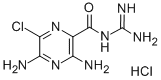
- CAS No.
- 2016-88-8
- Chemical Name:
- Amiloride hydrochloride
- Synonyms
- AMILORIDE HCL;Arumil;AMipraMizi;AMIPRAMIDIN;amiprazidine;AMipraMidine;AMIPRAMIZIDE;GUANAMPRAZINE;amiloridechloride;HCL AMILORIDE HCL
- CBNumber:
- CB5290772
- Molecular Formula:
- C6H8ClN7O.ClH
- Molecular Weight:
- 266.09
- MDL Number:
- MFCD03703482
- MOL File:
- 2016-88-8.mol
- MSDS File:
- SDS
- TDS File:
- TDS
| Product description | Number | Pack Size | Price |
| Amiloride hydrochloride hydrate ≥98% (HPLC), powder | A7410 | 1g | $83.9 |
| Amiloride, Hydrochloride An inhibitor of angiogenesis. | 129876 | 100mg | $94 |
| Amiloride (hydrochloride) ≥98% | 26295 | 1mg | $49 |
| Amiloride (hydrochloride) ≥98% | 26295 | 5mg | $120 |
| Amiloride (hydrochloride) (hydrate) ≥98% | 14409 | 1g | $44 |
| More product size | |||
| Melting point | 293-294°C |
|---|---|
| storage temp. | Store at RT |
| solubility | H2O: 50 mg/mL, clear, yellow-green |
| form | powder |
| color | yellow |
| Water Solubility | <0.1 g/100 mL at 19.5 ºC |
| BCS Class | 1 |
| InChI | InChI=1S/C6H8ClN7O.ClH/c7-2-4(9)13-3(8)1(12-2)5(15)14-6(10)11;/h(H4,8,9,13)(H4,10,11,14,15);1H |
| InChIKey | ACHKKGDWZVCSNH-UHFFFAOYSA-N |
| SMILES | C1(N=C(C(N)=NC=1N)Cl)C(=O)NC(=N)N.Cl |
| CAS DataBase Reference | 2016-88-8(CAS DataBase Reference) |
| FDA UNII | 7M458Q65S3 |
| EPA Substance Registry System | Amiloride hydrochloride (2016-88-8) |
| UNSPSC Code | 12352200 |
| NACRES | NA.77 |
SAFETY
Risk and Safety Statements
| Symbol(GHS) |  GHS06 |
|||||||||
|---|---|---|---|---|---|---|---|---|---|---|
| Signal word | Danger | |||||||||
| Hazard statements | H301 | |||||||||
| Precautionary statements | P264-P270-P301+P310-P405-P501 | |||||||||
| PPE | Eyeshields, Faceshields, Gloves, type P2 (EN 143) respirator cartridges | |||||||||
| Hazard Codes | T,Xi | |||||||||
| Risk Statements | 25-36/37/38 | |||||||||
| Safety Statements | 36-45-26 | |||||||||
| RIDADR | UN 2811 6.1/PG 3 | |||||||||
| WGK Germany | 3 | |||||||||
| RTECS | UQ2275500 | |||||||||
| HazardClass | 6.1(a) | |||||||||
| PackingGroup | II | |||||||||
| HS Code | 29339980 | |||||||||
| Storage Class | 6.1C - Combustible acute toxic Cat.3 toxic compounds or compounds which causing chronic effects |
|||||||||
| Hazard Classifications | Acute Tox. 3 Oral | |||||||||
| NFPA 704 |
|
Amiloride hydrochloride price More Price(49)
| Manufacturer | Product number | Product description | CAS number | Packaging | Price | Updated | Buy |
|---|---|---|---|---|---|---|---|
| Sigma-Aldrich | A7410 | Amiloride hydrochloride hydrate ≥98% (HPLC), powder | 2016-88-8 | 1g | $83.9 | 2026-04-30 | Buy |
| Sigma-Aldrich | 129876 | Amiloride, Hydrochloride An inhibitor of angiogenesis. | 2016-88-8 | 100mg | $94 | 2026-04-30 | Buy |
| Cayman Chemical | 26295 | Amiloride (hydrochloride) ≥98% | 2016-88-8 | 1mg | $49 | 2026-04-30 | Buy |
| Cayman Chemical | 26295 | Amiloride (hydrochloride) ≥98% | 2016-88-8 | 5mg | $120 | 2026-04-30 | Buy |
| Cayman Chemical | 14409 | Amiloride (hydrochloride) (hydrate) ≥98% | 1g | $44 | 2026-04-30 | Buy |
Amiloride hydrochloride Chemical Properties,Uses,Production
Chemical Properties
Pale yellow solid. Soluble in water; almost odorless. Amchlorpyrimidine [2609-46-3]; melting point: 240.5–241.5 °C.
Originator
Midamor,Merck,UK,1971
Uses
Na+ channel inhibitor, diuretic
Uses
A calcium channel andsodium channel protein inhibitor
Definition
ChEBI: Amiloride hydrochloride is a hydrochloride obtained by combining amiloride with one molar equivalent of hydrochloric acid. It has a role as a diuretic and a sodium channel blocker. It contains an amiloride(1+).
Manufacturing Process
Step A: Preparation of methyl 3-amino-5,6-dichloropyrazinoare: Methyl 3-
aminopyrazinoate (765 g, 5 mols) is suspended in 5 liters of dry benzene.
While stirring under anhydrous conditions sulfuryl chloride (1.99 liters, 3.318
g, 24.58 mols) is added over a period of 30 minutes and stirring is continued
for 1 hour. During this period, the temperature rises to about 50°C and then
begins to drop. The mixture is heated cautiously to reflux (60°C), refluxed for
5 hours and then stirred overnight at room temperature. The excess sulfuryl
chloride is distilled off at atmospheric pressure (distillation is stopped when
vapor temperature reaches 78%). The dark red mixture is chilled to 6°C. The
crystals are filtered off, washed by displacement with two 100 ml portions of
cold (8°C) benzene, then washed with 300 ml petroleum ether and dried in
vacuum at room temperature, yielding 888 g (80%) of methyl 3-amino-5,6-
dichloropyrazinoate in the form of red crystals, MP 228-230°C. The crude
product is dissolved in 56 liters of boiling acetonitrile and passed through a
heated (70-80°C) column of decolorizing charcoal (444 g). The column is
washed with 25 liters of hot acetonitrile, the combined eluate concentrated in
vacuum to about 6 liters and chilled to 5°C. The crystals that form are
filtered, washed three times with cold acetonitrile, and air dried to constant
weight, yielding 724 g (82% recovery, 66% overall) of methyl 3-amino-5,6-
dichloropyrazinoate in the form of yellow crystals, MP 230-234°C. After
additional recrystallizations from acetonitrile the product melts at 233-234°C.
Step B: Preparation of methyl-3,5diamino-6-chloropyrazinoete: In a 2-liter, 3-necked flask fitted with a a mechanical stirrer, thermometer and gas inlet tube
is placed dry dimethyl sulfoxide (1 liter). Methyl 3-amino-5,6-
dichloropyrazinoate (100 g, 0.45 mol) is added and the mixture stirred and
heated at 65°C on a steam bath until solution is effected. A stream of dry
ammonia gas is admitted to the solution with continuous stirring, over a
period of 45 minutes while the temperature is maintained at 65-70°C. The
solution is cooled to about 10°C with continuous stirring and ammonia gas is
admitted for an additional 1 1/4 hours. The yellow reaction mixture is poured,
with stirring, into cold water (2 liters) and the light yellow solid that separates
is removed by filtration, thoroughly washed with water, and dried in a vacuum
desiccator to give 82.5 g (91%) of methyl 3,5-diamino-6-chloropyrazinoate,
MP 210-212°C. Recrystallization from acetonitrile gives material melting at
212-213°C.
Step C: Preparation of the base: A 300 ml one-necked, round-bottomed flask,
equipped with a water-cooled condenser, calcium chloride tube and magnetic
stirrer is charged with anhydrous methanol (150 ml) and sodium metal (5.75
g, 0.25 g atom). When the reaction is complete, the solution is treated with
dry guanidine hydrochloride (26.3 g, 0.275 mol) and stirred for 10 minutes.
The sodium chloride that forms is removed by filtration. The solution is
concentrated in vacuum to a volume of 30 ml and the residue treated with the
product of Step B, heated one minute on a steam bath and kept at 25°C for 1
hour. The product is filtered, washed well with water, dissolved in dilute
hydrochloric acid and the free base precipitated by addition of sodium
hydroxide to give the amiloride product base, a solid which melts at 240.5-
241.5°C.
To produce the hydrochloride, the base is suspended in water (70 ml) and
treated with sufficient 6 N hydrochloric acid to dissolve the free base. The
solution is filtered and treated with concentrated hydrochloric acid (5 ml). The
hydrochloride salt (22 g, 97%) separates and is recrystallized from water (50
ml) containing concentrated hydrochloric acid (3 ml).
brand name
Midamor (Merck).
Therapeutic Function
Diuretic
General Description
Crystalline solid or very light yellow powder.
Air & Water Reactions
Insoluble in water.
Reactivity Profile
A halogenated amine and amide, acidic salt. In aqueous solution, behaves as a weak acid. Amines are chemical bases. They neutralize acids to form salts plus water. These acid-base reactions are exothermic. The amount of heat that is evolved per mole of amine in a neutralization is largely independent of the strength of the amine as a base. Amines may be incompatible with isocyanates, halogenated organics, peroxides, phenols (acidic), epoxides, anhydrides, and acid halides. Flammable gaseous hydrogen is generated by amines in combination with strong reducing agents, such as hydrides. Organic amides/imides react with azo and diazo compounds to generate toxic gases. Flammable gases are formed by the reaction of organic amides/imides with strong reducing agents. Amides are very weak bases (weaker than water). Imides are less basic yet and in fact react with strong bases to form salts. That is, they can react as acids. Mixing amides with dehydrating agents such as P2O5 or SOCl2 generates the corresponding nitrile. The combustion of these compounds generates mixed oxides of nitrogen (NOx).
Health Hazard
SYMPTOMS: Symptoms of exposure to Amiloride hydrochloride include headache, weakness, fatigue, back, chest, neck, shoulder or extremity pain; nausea, anorexia, vomiting, abdominal pain, hyperkalemia, paresthesias, shock, dizziness, coughing, shortness of breath, depression, nervousness, flaccid paralysis of the extremities, bradycardia, flatulence, skin rash, gas pain, constipation and dyspnea.
Fire Hazard
Flash point data for Amiloride hydrochloride are not available; however, Amiloride hydrochloride is probably combustible.
Biological Activity
Na + channel blocker. Defines the I 2A -amiloride sensitive and I 2B -amiloride insensitive imidazoline binding sites. Also inhibits TRPP3 channels.
Biochem/physiol Actions
Selective T-type calcium channel blocker and blocker of epithelial sodium channel. Selective inhibitor of urokinase plasminogen activator (uPA).
Clinical Use
Oedema
Potassium conservation with thiazide and loop
diuretics
Drug interactions
Potentially hazardous interactions with other drugs
ACE inhibitor and angiotensin-II antagonists:
increased risk of hyperkalaemia and hypotension.
Antibacterials: avoid concomitant use with
lymecycline.
Antidepressants: increased risk of postural
hypotension with tricyclics; enhanced hypotensive
effect with MAOIs.
Antihypertensives: enhanced hypotensive effect.
Ciclosporin: increased risk of hyperkalaemia and
nephrotoxicity.
Cytotoxics: increased risk of nephrotoxicity and
ototoxicity with platinum compounds.
Lithium excretion reduced
NSAIDS: increased risk of hyperkalaemia; increased
risk of nephrotoxicity; antagonism of diuretic effect.
Potassium salts: increased risk of hyperkalaemia.
Tacrolimus: increased risk of hyperkalaemia.
Metabolism
Amiloride is excreted unchanged in the urine. In two studies in which single doses of 14C-Amiloride were used, approximately 50% was recovered in urine and 40% in the faeces within 72 hours.
storage
Room temperature
Amiloride hydrochloride Preparation Products And Raw materials
Raw materials
1of2
Preparation Products
| Supplier | Tel | Country | ProdList | Advantage | |
|---|---|---|---|---|---|
| career henan chemical co | +86-0371-86658258 +8613203830695 | sales@coreychem.com | China | 29812 | 58 |
| CONIER CHEM AND PHARMA LIMITED | +8618523575427 | sales@conier.com | China | 49979 | 58 |
| Shaanxi Dideu Medichem Co. Ltd | +86-29-81139210 17389186172 | 1077@dideu.com | China | 3801 | 58 |
| TargetMol Chemicals Inc. | +1-781-999-5354; +17819995354 | marketing@targetmol.com | United States | 32466 | 58 |
| Hefei TNJ Chemical Industry Co.,Ltd. | +86-0551-65418671 +8618949823763 | sales@tnjchem.com | China | 34563 | 58 |
| Dideu Industries Group Limited | +86-86-15536356810 +8617392712697 | 1022@dideu.com | China | 28755 | 58 |
| AFINE CHEMICALS LIMITED | +86-571-85134551 | info@afinechem.com | China | 15080 | 58 |
| BOC Sciences | 16314854226; +16314854226 | inquiry@bocsci.com | United States | 19853 | 58 |
| Hong Kong Tiansheng New Material Trading Co., Ltd | +8617320695765 | zxx@hktiansheng.com | China | 973 | 58 |
| Guangzhou TongYi biochemistry technology Co.,LTD | +8613073028829 | tongyibiochem@163.com | China | 2995 | 58 |
View Lastest Price from Amiloride hydrochloride manufacturers
| Image | Update time | Product | Price | Min. Order | Purity | Supply Ability | Manufacturer | |
|---|---|---|---|---|---|---|---|---|
 |
2025-11-18 | Amiloride hydrochloride USP/EP/BP
2016-88-8
|
$1.10 | 1g | 99.9% | 100 Tons Min | Dideu Industries Group Limited | |
 |
2022-02-25 | Amiloride hydrochloride
2016-88-8
|
$88.00 | 1KG | 99% | 1 ton | Hong Kong Tiansheng New Material Trading Co., Ltd | |
 |
2022-02-25 | Amiloride hydrochloride
2016-88-8
|
$19.00 | 1Kg/Bag | 99% | 20tons | Hong Kong Tiansheng New Material Trading Co., Ltd |
-
- Amiloride hydrochloride USP/EP/BP
2016-88-8
- $1.10
- 99.9%
- Dideu Industries Group Limited
-
- Amiloride hydrochloride
2016-88-8
- $88.00
- 99%
- Hong Kong Tiansheng New Material Trading Co., Ltd
-
- Amiloride hydrochloride
2016-88-8
- $19.00
- 99%
- Hong Kong Tiansheng New Material Trading Co., Ltd
2016-88-8(Amiloride hydrochloride)Related Search:
1of4
