


Decoquinate
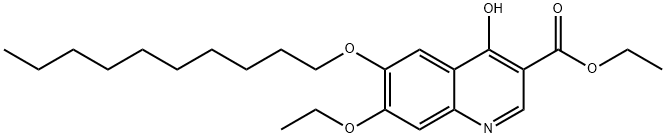
- CAS No.
- 18507-89-6
- Chemical Name:
- Decoquinate
- Synonyms
- deccox;e 756;Decox;Decoxy;HC-1528;Nsc339057;Aids106129;Ketoxifene;M & B 15497;DECOQUINATE
- CBNumber:
- CB6837673
- Molecular Formula:
- C24H35NO5
- Molecular Weight:
- 417.54
- MDL Number:
- MFCD00673686
- MOL File:
- 18507-89-6.mol
- MSDS File:
- SDS
- TDS File:
- TDS
| Melting point | 241.0 to 245.0 °C |
|---|---|
| Boiling point | 517.9±45.0 °C(Predicted) |
| Density | 1.091±0.06 g/cm3(Predicted) |
| storage temp. | Inert atmosphere,Room Temperature |
| solubility | Chloroform (Slightly, Heated), Methanol (Slightly, Heated, Sonicated) |
| pka | 2.60±0.50(Predicted) |
| form | Solid |
| color | Off-White to Pale Beige |
| Merck | 14,2854 |
| Major Application |
forensics and toxicology pharmaceutical (small molecule) |
| InChI | InChI=1S/C24H35NO5/c1-4-7-8-9-10-11-12-13-14-30-21-15-18-20(16-22(21)28-5-2)25-17-19(23(18)26)24(27)29-6-3/h15-17H,4-14H2,1-3H3,(H,25,26) |
| InChIKey | JHAYEQICABJSTP-UHFFFAOYSA-N |
| SMILES | N1C2C(=CC(OCCCCCCCCCC)=C(OCC)C=2)C(O)=C(C(OCC)=O)C=1 |
| LogP | 8.740 (est) |
| CAS DataBase Reference | 18507-89-6(CAS DataBase Reference) |
| FDA 21 CFR | 556.170; 558.195; 558.4 |
| EWG's Food Scores | 1 |
| FDA UNII | 534I52PVWH |
| EPA Substance Registry System | Decoquinate (18507-89-6) |
| UNSPSC Code | 41116107 |
| NACRES | NA.24 |

Decoquinate price More Price(56)
| Manufacturer | Product number | Product description | CAS number | Packaging | Price | Updated | Buy |
|---|---|---|---|---|---|---|---|
| Sigma-Aldrich | 33823 | Decoquinate VETRANAL?, analytical standard | 18507-89-6 | 100mg | $235 | 2026-04-30 | Buy |
| Sigma-Aldrich | 1165408 | Decoquinate United States Pharmacopeia (USP) Reference Standard | 18507-89-6 | 200mg | $413 | 2026-04-30 | Buy |
| TCI Chemical | D4192 | Decoquinate >97.0%(HPLC)(N) | 18507-89-6 | 1g | $97 | 2026-04-30 | Buy |
| Biosynth | FD20875 | Decoquinate | 18507-89-6 | 0.5kg | $900 | 2026-06-04 | Buy |
| Biosynth | FD20875 | Decoquinate | 18507-89-6 | 0.25kg | $900 | 2026-06-04 | Buy |
Decoquinate Chemical Properties, Uses, Production
Highly Effective Anti-coccidiosis for Livestock and Poultry
Decoquinate is a new type highly-efficienct quinolones anti-coccidiosis for livestock and poultry, commonly known as quinoxetine, decanoquinolate, paclitaxel, to quinolate, benzoquinone. The active compound is white or slightly yellow crystalline powder, rarely soluble in chloroform or ether, insoluble in water or ethanol. It has a unique anti-coccidial activity stronger than Maduramicin, nicarbazine + Ethanamidobenzylate, methyl salicin. Studies have shown that decanoquinolines are effective in combating the resistance from coccidium and are clinically used to control the most harmful poultry coccidiosis caused by E.tenella, E.maxima, E.acerVulina, E.necatrix, E.brunetti, E.mivati). it can also effect in the precaution of neosporosis in livestocks of cattle and sheep. It can improve the weight growth rate and milk yield of young goat.
Decoquinate plays a role in the asexual reproduction of coccidia, and after entering the sporozoite cell, it prevents its development by interfering with DNA synthesis. It begins to function in the early stages of life history of coccidia, effectively prevents the coccidia caused by intestinal damage. Addition of decoquinate in the fodder does not affect the digestion of the fodder and the absorption of nutrients.
This product has no incompatibility except that it can not be used in the feed containing bentonite.
Quinoline anticoccidial drugs are easy to be resisted. It is recommended continuous use of up to no more than 4 weeks be applied only in the peak period of coccidia,.
Since the 1970s, decanoquinolines have been widely used in the control of coccidiosis in poultry in many countries, but have not been used in China.
In 2006, the Alpharma (U.S.) first introduced quinoline into China market, which had aroused wide attention. Its first use in China had presented no drug resistance, its use as ideal alternative, killing effect on coccidia, promoting effect on growth, improvement effect on the color, excellent anticoccidial effect and growth performance in the early life; it starts to play a role in the early stages of life history of coccidia with the longest effect duration and a wide anticoccidial spectrum. It has extermination effect on the most harmful 6 avian coccidia with an excellent stability. It can keep stable quality for 4 years at proper temperature and humidity.
At present, Healthy (Hangzhou) Husbandry Sci-tech Co., Ltd, Shandong Sinder Technology Co., Ltd produce and market decoquinate APIs.
Chemical and Physical Properties
Light yellow crystalline powder;
Melting point at 86-87 DEG C;
Slightly soluble in chloroform, ether, almost insoluble in water;
Odorless.
Toxicological Information
Decoquinate is well tolerated with low toxicity and dosage 80 times of the recommended is still safe.
Poultry: addition of 800ppm in fodder (26 times the normal dosage) with continuous feeding for 127 days caused no poisoning;
Pigs: 800ppm continuous feeding for 10 days caused no poisoning.
Pharmacokinetics
Decoquinate is fast absorpted. It reaches the effective concentration within 1 hour and its peak level 3 days after.
On the 5th days and 7th days after the administration of unlabeled qecoquinate on the cattle and sheep, a single dose of this product labeled with 14C was intravenously injected into the cattle, sheep and the plasma radiation reaches the peak 1.5 hours after.
Decoquinate is partially metabolized in the rat body, resulting in three kinds of metabolites, but the structure cannot be determined.
Only two of its metabolites are identified in ruminants, and the proportion is lower than that of rats. Its main excretion in ruminants is manure, followed by urine. In sheep, urine excreted 36% of the total dose and 35% is discharged within 24 hours; qecoquinate and its metabolites in urinary is completely discharged in 3 days.
Applications
Quinoline coccidia;
Used as a feed additive (27.2g in 1t feed) to prevent broiler coccidiosis. This product of low toxicity and good tolerance has a wide dosage range of safety. Its rapid metabolism entitles it a withdrawal in 3 days with the residual drug concentration in each tissue is less than 1ppm.
Drug Combination
In order to improve the anti-coccidia effect and reduce drug resistance, you can take a combination of drugs. In the early stages of coccidiosis (coccidiosis asexual breeding period) using decanoquinate + diclazuril, calcitonizumole or deccox + maduramicin, deccox + chloropyridine and other combination therapy to perform a synergistic effect of drugs to enhance the killing effect, while the use of each drug can reduce 1/2. In the fully outbreak period of coccidiosis, the use of deccox +sodium sulfaquinoxaline, deccox + SPZ and other combination therapy can inhibit and kill coccidium in asexual breeding and sexual reproduction.
Synthesis Method
3,4-dihydroxy nitrobenzene reacts with bromodecane in DMF medium to produce 3-hydroxy-4-decyloxy nitrobenzene. And the product is then ethoxylated and reduced to produce 3-ethoxy-4-decyloxyaniline. Then, 3-ethoxy-4-decyloxyaniline is condensed with diethyl ethoxymethylenemalonate to produce 3-ethoxy-4-decyloxyanilide methylidene malonate ester, which is finally transformed into finished product through heat condensation with dowtherm A.
Chemical Properties
Off-White to Pale Yellow Solid
Uses
Decoquinate is a quinolone coccidiostat used in veterinary medicine, in particular as animal feed for poultry.
Uses
monoxycarbolic acid antibiotic
Uses
antiviral
Veterinary Drugs and Treatments
Decoquinate is labeled for use in cattle for the prevention of coccidiosis
in either ruminating or non-ruminating calves, cattle or young
goats caused by the species E. christenseni or E. ninakohlyakimoviae.
It is used for prevention of coccidiosis in broilers caused by E. tenella,
E. necatrix, E. acervulina, E. mivati, E. maxima or E. burnetti.
It may be useful in dogs as prophylactic treatment for coccidiosis
and hepatozoonosis relapse.
IC 50
Plasmodium; Coccidia
References
[1] Synthetic Communications, 2010, vol. 40, # 7, p. 992 - 997
[2] Patent: CN107382855, 2017, A. Location in patent: Paragraph 0018; 0026; 0032
[3] Patent: CN105254560, 2016, A. Location in patent: Paragraph 0032
[4] Synthetic Communications, 2008, vol. 38, # 18, p. 3088 - 3106


Decoquinate Preparation Products And Raw materials
Raw materials
Preparation Products
| Supplier | Tel | Country | ProdList | Advantage | |
|---|---|---|---|---|---|
| Wuhan Wsem Biological Co., Ltd. | 027-83778876; 13667159345 | 13667159345@163.com | China | 1904 | 55 |
| Wuhan Yuqing Jiaheng Pharmaceutical Co., Ltd | 027-83850128 18207128853 | 3860188266@qq.com | China | 998 | 58 |
| J & K SCIENTIFIC LTD. | 18210857532 18210857532 | jkinfo@jkchemical.com | China | 96815 | 76 |
| TCI (Shanghai) Development Co., Ltd. | 021-67121386 | Sales-CN@TCIchemicals.com | China | 24512 | 81 |
| Energy Chemical | 400-0056266 | sales8178@energy-chemical.com | China | 45000 | 61 |
| Capot Chemical Co., Ltd | +86 (0) 571 85 58 67 18 | China | 18187 | 66 | |
| Adamas Reagent, Ltd. | 4006009262 13023226327 | hmj@titansci.com | China | 14098 | 59 |
| LGM Pharma | 1-(800)-881-8210 | inquiries@lgmpharma.com | United States | 2110 | 70 |
| Chemsky(shanghai)International Co.,Ltd. | 021-50135380 | shchemsky@sina.com | China | 32273 | 50 |
| Zhejiang Genebest Pharmaceutical Co.,Ltd. | 86-571-63348198 | genebest@163.com sales@genebest.com | China | 18 | 60 |
View Latest Price from Decoquinate manufacturers
| Image | Update time | Product | Price | Min. Order | Purity | Supply Ability | Manufacturer | |
|---|---|---|---|---|---|---|---|---|
 |
2026-10-14 | Decoquinate
18507-89-6
|
1KG | 99.0% | 100kg/month | WUHAN FORTUNA CHEMICAL CO., LTD | ||
 |
2026-08-25 | Decoquinate
18507-89-6
|
1kg | 98% | 1000 | Xi an Biohorlden Industry Trade Co Ltd | ||
 |
2026-08-20 | Decoquinate USP/EP/BP
18507-89-6
|
$1.10 | 1g | 99.9% | 100 Tons min | Dideu Industries Group Limited |
-
- Decoquinate
18507-89-6
- $0.00
- 99.0%
- WUHAN FORTUNA CHEMICAL CO., LTD
-
- Decoquinate
18507-89-6
- $0.00
- 98%
- Xi an Biohorlden Industry Trade Co Ltd
-
- Decoquinate USP/EP/BP
18507-89-6
- $1.10
- 99.9%
- Dideu Industries Group Limited
