


Sucralose
- CAS No.
- 56038-13-2
- Chemical Name:
- Sucralose
- Synonyms
- TGS;ctopyranoside;loro-4-deoxy-;TRICHLOROSUCROSE;Sucralose 0.1;Sucralose CRS;Sucralose in stock GMP Factory;4,1’,6’-trichloro-4,1’,6’-trideoxy-galacto-sucrose;E955;ucralose
- CBNumber:
- CB9363034
- Molecular Formula:
- C12H19Cl3O8
- Molecular Weight:
- 397.63
- MDL Number:
- MFCD03648615
- MOL File:
- 56038-13-2.mol
- MSDS File:
- SDS
- TDS File:
- TDS
| Melting point | 115-1018°C |
|---|---|
| Boiling point | 104-107 C |
| alpha | D +68.2° (c = 1.1 in ethanol) |
| Density | 1.375 g/cm |
| vapor pressure | 0Pa at 25℃ |
| refractive index | 1.604 |
| storage temp. | 2-8°C |
| solubility |
DMF: 30 mg/ml DMSO: 30 mg/mlPBS (pH 7.2): 1 mg/ml |
| form | Powder |
| pka | 12.52±0.70(Predicted) |
| color | White |
| PH | 6-8 (100g/l, H2O, 20°C) |
| Odor | wh. cryst. powd., odorless, sweet taste |
| optical activity | [α]/D 86.0±2.0°, c = 1 in H2O |
| Water Solubility | Soluble in Water. |
| Merck | 14,8880 |
| BRN | 3654410 |
| Henry's Law Constant | 2.5×10¹³ mol/(m3Pa) at 25℃, HSDB (2015) |
| Stability | Hygroscopic |
| Major Application |
cleaning products cosmetics food and beverages personal care |
| Cosmetics Ingredients Functions | SKIN CONDITIONING |
| InChI | 1S/C12H19Cl3O8/c13-1-4-7(17)10(20)12(3-14,22-4)23-11-9(19)8(18)6(15)5(2-16)21-11/h4-11,16-20H,1-3H2/t4-,5-,6+,7-,8+,9-,10+,11-,12+/m1/s1 |
| InChIKey | BAQAVOSOZGMPRM-QBMZZYIRSA-N |
| SMILES | OC[C@H]1O[C@H](O[C@]2(CCl)O[C@H](CCl)[C@@H](O)[C@@H]2O)[C@H](O)[C@@H](O)[C@H]1Cl |
| LogP | -0.51 at 20℃ |
| CAS DataBase Reference | 56038-13-2(CAS DataBase Reference) |
| Substances Added to Food (formerly EAFUS) | SUCRALOSE |
| FDA 21 CFR | 101.80; 172.831 |
| EWG's Food Scores | 1 |
| FDA UNII | 96K6UQ3ZD4 |
| EPA Substance Registry System | .alpha.-D-Galactopyranoside, 1,6-dichloro-1,6-dideoxy-.beta.-D-fructofuranosyl 4-chloro-4-deoxy- (56038-13-2) |
| UNSPSC Code | 85151701 |
| NACRES | NA.25 |
SAFETY
Risk and Safety Statements
| Symbol(GHS) |  GHS07 |
|---|---|
| Signal word | Warning |
| Hazard statements | H302-H315-H319-H335 |
| Precautionary statements | P261-P301+P312-P302+P352-P304+P340-P305+P351+P338 |
| Hazard Codes | Xi |
| Risk Statements | 36/37/38 |
| Safety Statements | 26-37/39-24/25 |
| WGK Germany | 3 |
| RTECS | LW5440140 |
| HS Code | 2932 14 00 |
| Storage Class | 11 - Combustible Solids |
| Hazardous Substances Data | 56038-13-2(Hazardous Substances Data) |
| Toxicity | LD50 orally in Rabbit: > 10000 mg/kg |
| REACH Registrations | Active |
Sucralose price More Price(83)
| Manufacturer | Product number | Product description | CAS number | Packaging | Price | Updated | Buy |
|---|---|---|---|---|---|---|---|
| Sigma-Aldrich | Y0001344 | Sucralose European Pharmacopoeia (EP) Reference Standard | 56038-13-2 | 550 mg | $254 | 2026-04-30 | Buy |
| Sigma-Aldrich | 1.00895 | Sucralose granular EMPROVE?ESSENTIALPhEur,NF,JPE | 56038-13-2 | 10g | $34.6 | 2026-04-30 | Buy |
| Sigma-Aldrich | 69293 | Sucralose ≥98.0% (HPLC) | 56038-13-2 | 100g | $183 | 2026-04-30 | Buy |
| Sigma-Aldrich | 1623626 | Sucralose United States Pharmacopeia (USP) Reference Standard | 56038-13-2 | 400mg | $489 | 2026-04-30 | Buy |
| Sigma-Aldrich | 1.00895 | Sucralose granular EMPROVE?ESSENTIALPhEur,NF,JPE | 56038-13-2 | 1kg | $522 | 2026-04-30 | Buy |
Sucralose Chemical Properties, Uses, Production
Description
Sucralose is the only non-caloric sweetener made from sugar. It is in fact the latest non nutritive sweetener to have been approved by US FDA and other regulatory bodies and have hit the markets .
Sucralose is derived from sugar through a multi-step patented manufacturing process that selectively substitutes three atoms of chlorine for three hydroxyl groups on the sugar molecule. This change produces a sweetener that has no calories, yet is 600 times sweeter than sucrose, making it roughly twice as sweet as saccharin and four times as sweet as aspartame.
Chemical Properties
Sucralose is a white to off-white colored, free-flowing, crystalline powder.
History
In 1975, sucralose was discovered by scientists from Tate & Lyle, working with researchers Leslie Hough and Shashikant Phadnis at Queen Elizabeth College (now part of King's College London). While looking for ways to use sucrose as a chemical intermediate, mixing sulfuryl chloride with sugar, Phadnis was told to "test" a chlorinated sugar compound. According to an anecdotal account, Phadnis thought Hough asked him to "taste" it, so he did and found the compound to be exceptionally sweet.
Sucralose was first approved for use in Canada in 1991. Subsequent approvals came in Australia in 1993, in New Zealand in 1996, in the United States in 1998, and in the European Union in 2004. By 2008, it had been approved in over 80 countries, including Mexico, Brazil, China, India, and Japan. In 2006, the FDA amended the regulations for foods to include sucralose as a "non-nutritive sweetener" in food.
Uses
High intensity sweetener manufactured by replacing three hydroxyl groups on the sucrose molecule with three chlorine atoms. The results are a sweetener of 0 cal that is not digested. It is 600 times as sweet as sugar with a similar flavor profile. It is heat stable, readily soluble, and maintains its stability at elevated temperatures. It has been approved for use in specific categories that include baked products, beverages, confectioneries, and certain desserts and toppings.
Uses
A low-calorie artificial sweetener
Uses
antiprotozoal
Uses
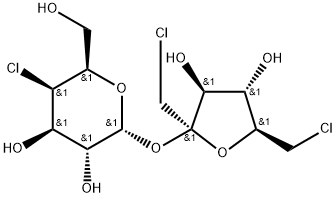
Sucralose (1,6-dichloro-1,6-dideoxy-p-fructofuranosyl-4-chloro-oc-
D-galactopyra- noside) is a nonnutritive sweetener based on sucrose. It
is selectively chlorinated and the glycoside link between the two rings
is resistant to hydrolysis by acid or enzymes, so it is not metabolized. It
has 400 to 800 times the sweetness of sucrose, is very soluble in water,
and is stable in heat. It can be used in food products that are baked or
fried.
Sucralose is produced by the selective chlorination of the sucrose molecule
using a patented process by Tate and LyIe that replaces the three
hydroxyl groups (OH) with three chlorine (Cl) atoms.
This modified sugar is minimally absorbed by the body and passes out
unchanged. It was approved for use in foods and beverages in 1999 in
the United States.
Production Methods
Sucralose may be prepared by a variety of methods that involve the selective substitution of three sucrose hydroxyl groups by chlorine. Sucralose can also be synthesized by the reaction of sucrose (or an acetate) with thionyl chloride.
Definition
ChEBI: A disaccharide derivative consisting of 4-chloro-4-deoxy-alpha-D-galactopyranose and 1,6-dichloro-1,6-dideoxy-beta-D-fructofuranose units linked by a glycosidic bond.
General Description
Certified pharmaceutical secondary standards for application in quality control provide pharma laboratories and manufacturers with a convenient and cost-effective alternative to pharmacopeia primary standards.
Sucralose is a polar, chlorinated sugar synthesized from saccharose precursor. It is widely used as a sweetener in a number of food and beverage products.
Pharmaceutical Applications
Sucralose is used as a sweetening agent in beverages, foods, and pharmaceutical applications. It has a sweetening power approximately 300–1000 times that of sucrose and has no aftertaste. It has no nutritional value, is noncariogenic, does not promote dental caries, and produces no glycemic response.
Biochem/physiol Actions
A synthetic sweet tastant detectable by humans. Activates T1R2/T1R3 sweet taste receptors on enteroendocrine cells and elicits increased hormonal secretion of glucagon-like peptide-1 and glucose-dependent insulinotrophic peptide.
Safety
Sucralose is generally regarded as a nontoxic and nonirritant
material and is approved, in a number of countries, for use in food
products. Following oral consumption, sucralose is mainly unabsorbed
and is excreted in the feces.
The WHO has set an acceptable daily intake for sucralose of up
to 15 mg/kg body-weight.
LD50 (mouse, oral): > 16 g/kg
LD50 (rat, oral): > 10 g/kg
storage
Sucralose is a relatively stable material. In aqueous solution, at
highly acidic conditions (pH < 3), and at high temperatures
(≤35℃), it is hydrolyzed to a limited extent, producing 4-chloro-4-
deoxygalactose and 1,6-dichloro-1,6-dideoxyfructose. In food
products, sucralose remains stable throughout extended storage
periods, even at low pH. However, it is most stable at pH 5–6.
Sucralose should be stored in a well-closed container in a cool,
dry place, at a temperature not exceeding 21℃. Sucralose, when
heated at elevated temperatures, may break down with the release
of carbon dioxide, carbon monoxide, and minor amounts of
hydrogen chloride.
Regulatory Status
The FDA, in April 1998, approved sucralose for use as a tabletop sweetener and as an additive in a variety of food products. In the UK, sucralose was fully authorized for use in food products in 2005. It is also accepted for use in many other countries worldwide. Included in the Canadian List of Acceptable Nonmedicinal Ingredients.
References
[1] SUSAN S SCHIFFMAN K I R. Sucralose, a synthetic organochlorine sweetener: overview of biological issues.[J]. Journal of Toxicology and Environmental Health-Part B-Critical Reviews, 2013, 16 7: 399-451. DOI: 10.1080/10937404.2013.842523
[2] KNUT ERIK TOLLEFSEN Duane B H Luca Nizzetto. Presence, fate and effects of the intense sweetener sucralose in the aquatic environment[J]. Science of the Total Environment, 2012, 438: Pages 510-516. DOI: 10.1016/j.scitotenv.2012.08.060


Sucralose Preparation Products And Raw materials
Raw materials
1of2
Preparation Products
| Supplier | Tel | Country | ProdList | Advantage | |
|---|---|---|---|---|---|
| NANJING SUNSHINE BIOTECH CO.,LTD | 025-86189919,025-86189929 13814179829 | market@sunshine-bio.com | China | 48 | 58 |
| Jiangsu Duoyang Bioengineering Technology Co., Ltd | 15161148838 | 2234255617@qq.com | China | 1056 | 58 |
| Shanghai Aladdin Bio-Chem Technology Co.,LTD | 400-6206333 13167063860 | anhua.mao@aladdin-e.com | China | 29977 | 65 |
| Xi'an Jinxiang Pharmaceutical Accessories Co., Ltd. | 029-19991803015 19991803015 | 1309520151@qq.com | China | 438 | 58 |
| Shandong flying Chemical Co., Ltd | 18954855616 | 920481088@qq.com | China | 33 | 58 |
| Hebei Qiansheng Biotechnology Co., Ltd | 13068769255 13068769255 | 3865144208@qq.com | China | 756 | 58 |
| caiwei | 13338976321 | 864355939@qq.com | China | 2435 | 58 |
| Guangdong Mingtong Biotechnology Co., Ltd | 13112222280 | 3406958264@qq.com | China | 2487 | 58 |
| J & K SCIENTIFIC LTD. | 18210857532 18210857532 | jkinfo@jkchemical.com | China | 96815 | 76 |
| Meryer (Shanghai) Chemical Technology Co., Ltd. | 4006356688 18621169109 | market03@meryer.com | China | 40202 | 62 |
Related articles
- Sucralose: A Comprehensive Overview of Its Composition, Synthesis, and Applications
- Sucralose, a zero-calorie artificial sweetener, has revolutionized the food and beverage industry since its approval.
- Nov 7,2024
- Sucralose vs Aspartame
- Sucralose and aspartame are both artificial, high-intensity sweeteners with different properties.
- Oct 11,2023
- Is sucralose safe?
- Sucralose is a zero calorie artificial sweetener. Sucralose is made from sugar in a multistep chemical process in which three ....
- Mar 22,2022
Related Questions
Ask a questionView Latest Price from Sucralose manufacturers
| Image | Update time | Product | Price | Min. Order | Purity | Supply Ability | Manufacturer | |
|---|---|---|---|---|---|---|---|---|
 |
2026-09-20 | Sucralose
56038-13-2
|
0.99 | RongNa Biotechnology Co.,Ltd | ||||
 |
2026-09-20 | Sucralose
56038-13-2
|
1kg | 98% | 100 T/Month | Hebei Qujie Technology Co., Ltd. | ||
 |
2026-09-20 | Sucralose
56038-13-2
|
1kg | >99% HPLC | 1000kg | Changsha Staherb Natural Ingredients Co., Ltd. |
