|
|
| | ATRIAL NATRIURETIC PEPTIDE (126-149) (RAT) Basic information |
| Product Name: | ATRIAL NATRIURETIC PEPTIDE (126-149) (RAT) | | Synonyms: | H-ARG-SER-SER-CYS-PHE-GLY-GLY-ARG-ILE-ASP-ARG-ILE-GLY-ALA-GLN-SER-GLY-LEU-GLY-CYS-ASN-SER-PHE-ARG-OH;AURICULIN A, RAT;ATRIAL NATRIURETIC PEPTIDE (126-149) (RAT);ATRIAL NATRIURETIC PEPTIDE (4-27), RAT;atrialnatriureticfactor(8-33;atrial natriuretic peptide*fragment 4-27 rat;Auriculin A;ANP (126-149) (RAT) | | CAS: | 91421-87-3 | | MF: | C104H168N38O33S2 | | MW: | 2542.81 | | EINECS: | | | Product Categories: | Peptide | | Mol File: | 91421-87-3.mol | 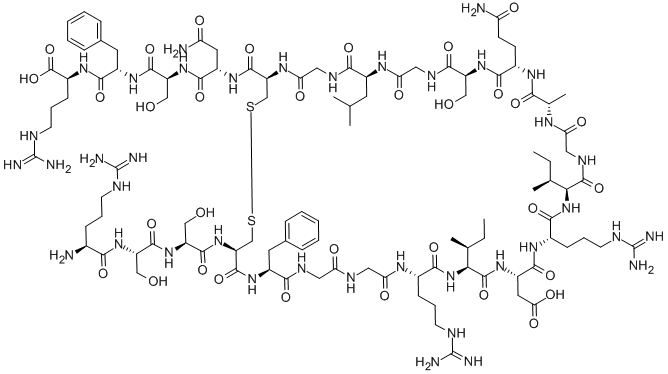 |
| | ATRIAL NATRIURETIC PEPTIDE (126-149) (RAT) Chemical Properties |
| density | 1.56 | | storage temp. | -15°C |
| | ATRIAL NATRIURETIC PEPTIDE (126-149) (RAT) Usage And Synthesis |
| Uses | Auriculin A is a synthetic atrialnatriureticfactor(ANF) with hemodynamic effect. Auriculin A antagonizes renal vasoconstriction in the dog, and influences on arterial baroreflex control of heart rate, systemic blood pressure, and perfusion pressure in the hind limb (perfused at constant flow) in rabbits[1][2]. | | in vivo | Auriculin A (0.3 μg/min/kg; i.v.; for 30 min) antagonizes renal vasoconstriction in the dog[1].
Auriculin A (2 μg/kg prime, 0.2 μg/kg/min; i.v.; for 45 min) influences on arterial baroreflex control of heart rate, systemic blood pressure, and perfusion pressure in the hind limb (perfused at constant flow) in rabbits[2].
| Animal Model: | Female mongrel dogs used in early clamp experiments (15-20 kg, anesthetized with 30 mg/kg pentobarbital sodium i.v.)[1] | | Dosage: | 0.3 μg/min/kg | | Administration: | Intravenous injection; last for 30 min | | Result: | Increased glomerular filtration rate (GFR) 16±4% and Na excretion (UNa V) 261±63%, whereas it decreased urine osmolality (Uosm) 36±7% without changing free water clearance.
Also increased diuresis (V) and kaliuresis (UKV). |
| Animal Model: | New Zealand white male rabbits (3-3.5 kg, anesthetized with 50 mg/kg Chloralose (HY-B1020) and 500 mg/kg Urethane (HY-B1207) i.v.)[2] | | Dosage: | 0.5 μg/kg prime, 0.05 μg/kg/min; 2 μg/kg prime, 0.2 μg/kg/min; 4 μg/kg prime, 0.4 μg/kg/min; 8 μg/kg prime, 0.8 μg/kg/min | | Administration: | Intravenous injection; last for 30-60 min | | Result: | Significantly reduced mean blood pressure and increased mean perfusion pressure at 4 μg/kg prime, 0.4 μg/kg/min dose, while heart rate did not change. |
| | References | [1] Sosa RE, et al. Relationship between renal hemodynamic and natriuretic effects of atrial natriuretic factor. Am J Physiol. 1986 Mar;250(3 Pt 2):F520-4. DOI:10.1152/ajprenal.1986.250.3.F520
[2] Volpe M, et al. Vagal mediation of the effects of atrial natriuretic factor on blood pressure and arterial baroreflexes in the rabbit. Circ Res. 1987 May;60(5):747-55. DOI:10.1161/01.res.60.5.747 |
| | ATRIAL NATRIURETIC PEPTIDE (126-149) (RAT) Preparation Products And Raw materials |
|