|
|
| | SUBSTANCE P (6-11) Basic information |
| Product Name: | SUBSTANCE P (6-11) | | Synonyms: | GLY-LEU-MET-NH2: GLM-NH2;SUBSTANCE P (6-11);SUBSTANCE P FRAGMENT 6-11);HEXA-SUBSTANCE P;GLN-PHE-PHE-GLY-LEU-MET-NH2;H-GLN-PHE-PHE-GLY-LEU-MET-NH2;SUBSTANCE-P-(-6-11) HEXA-SUBSTANCE P;[Gln6]substance P(6-11) | | CAS: | 51165-07-2 | | MF: | C36H52N8O7S | | MW: | 740.91 | | EINECS: | | | Product Categories: | | | Mol File: | 51165-07-2.mol | 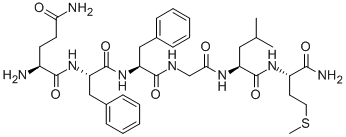 |
| | SUBSTANCE P (6-11) Chemical Properties |
| Boiling point | 1198.894±65.00 °C(Press: 760.00 Torr)(predicted) | | density | 1.240±0.06 g/cm3(Temp: 25 °C; Press: 760 Torr)(predicted) | | storage temp. | -15°C | | pka | 13.332±0.46(predicted) |
| | SUBSTANCE P (6-11) Usage And Synthesis |
| Uses | Substance P (6-11) is the C-terminal hexapeptideamide of Substance P (Substance P (HY-P0201)). Substance P (6-11) binds to NK-1 tachykinin receptor. Substance P (6-11) shows depolarization of motoneurons and a hypotensive effect[1][2]. | | in vivo | Substance P (6-11) (0.1-10 nM) inhibits insulin and glucagon secretion from the rat pancreas in a dose-dependent manner. In the canine pancreas, by contrast, Substance P (6-11) (1-10 nM), potentiates the release of insulin, glucagon, and somatostatin[2]. | | References | [1] Y Torrens, et al. Substance P(6-11) and natural tachykinins interact with septide-sensitive tachykinin receptors coupled to a phospholipase C in the rat urinary bladder. Neuropeptides. 1997 Jun;31(3):243-51. DOI:10.1016/s0143-4179(97)90055-x
[2] Y Chiba, et al. Effects of substance P and substance P-(6-11) on hormone release from isolated perfused pancreas: their opposite actions on rat and canine islets. Endocrinology. 1985 Nov;117(5):1996-2000. DOI:10.1210/endo-117-5-1996 |
| | SUBSTANCE P (6-11) Preparation Products And Raw materials |
|