| Company Name: |
Energy Chemical |
| Tel: |
400-0056266 |
| Email: |
sales8178@energy-chemical.com |
- Carprofen
-
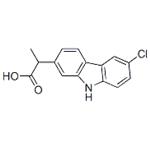
-
2026-09-14
- CAS:53716-49-7
- Purity: 0.99
- Carprofen
-

-
2026-09-11
- CAS:53716-49-7
- Min. Order: 1kg
- Purity: 98.5% ~101.5%; EP8.0
- Supply Ability: 800kg/month
- Carprofen
-

-
2026-09-01
- CAS:53716-49-7
- Min. Order: 1kg
- Purity: 99%
- Supply Ability: 1000kg
|
| | Carprofen Basic information |
| | Carprofen Chemical Properties |
| Melting point | 186-1880C | | Boiling point | 509.1±35.0 °C(Predicted) | | density | 1.2011 (rough estimate) | | refractive index | 1.5200 (estimate) | | storage temp. | Sealed in dry,2-8°C | | solubility | DMSO: soluble20mg/mL, clear | | form | powder | | pka | 4.84±0.30(Predicted) | | color | white to beige | | Merck | 14,1862 | | Major Application | forensics and toxicology
pharmaceutical (small molecule) | | InChI | InChI=1S/C15H12ClNO2/c1-8(15(18)19)9-2-4-11-12-7-10(16)3-5-13(12)17-14(11)6-9/h2-8,17H,1H3,(H,18,19) | | InChIKey | PUXBGTOOZJQSKH-UHFFFAOYSA-N | | SMILES | N1C2=C(C=C(Cl)C=C2)C2=C1C=C(C(C)C(O)=O)C=C2 | | CAS DataBase Reference | 53716-49-7(CAS DataBase Reference) | | EPA Substance Registry System | 9H-Carbazole-2-acetic acid, 6-chloro-.alpha.-methyl- (53716-49-7) |
| Hazard Codes | T,Xn | | Risk Statements | 25-36/37/38-20/21/22 | | Safety Statements | 45-36-26 | | RIDADR | UN 2811 | | WGK Germany | 3 | | RTECS | FE3180000 | | HazardClass | 6.1 | | PackingGroup | III | | HS Code | 29339900 | | Storage Class | 6.1C - Combustible acute toxic Cat.3
toxic compounds or compounds which causing chronic effects | | Hazard Classifications | Acute Tox. 3 Oral | | Toxicity | LD50 orally in mice: 400 mg/kg (Berger, Corraz) |
| | Carprofen Usage And Synthesis |
| Description | Carprofen is a non-steroidal anti-inflammatory drug (NSAID) commonly used in animals to combat pain and inflammation, particularly as associated with osteoarthritis. Like many NSAIDs, carprofen inhibits both cyclooxygenases COX-1 and COX-2 (IC50s = 22.3 and 3.9 μM, respectively). It also inhibits fatty acid amide hydrolase (IC50 = 74 μM), blocking the metabolism of the cannabinoid receptor ligand, arachidonoyl ethanolamide . | | Chemical Properties | Off-White Crystalline Solid | | Originator | Imadyl,Roche,Switz.,1981 | | History | Carprofen has strong anti-inflammatory and analgesic activity. It has been used in human medicine for more than 10 years at doses of 150 to 600 mg per day. In human clinical trials, Carprofen was generally well tolerated. Most adverse reactions were transient and mild, such as gastrointestinal discomfort or pain and nausea. The incidence of side effects in humans is similar to that of aspirin and other NSAIDs. However, for commercial reasons, carprofen has been withdrawn from the market and is no longer available for human use. | | Uses | Carprofen is a non-steroidal anti-inflammatory drug (NSAID) commonly used in animals to combat pain and inflammation, particularly as associated with osteoarthritis. Like many NSAIDs, carprofen inhibits both cyclooxygenases COX-1 and COX-2 (IC50s = 22.3 and 3.9 μM, respectively). It also inhibits fatty acid amide hydrolase (IC50 = 74 μM), blocking the metabolism of the cannabinoid receptor ligand, arachidonoyl ethanolamide . | | Uses | antiinflammatory, analgesic | | Uses | Carprofen is a non steroidal anti-inflammatory that is used by veterinarians for the relief of arthritic systems in dogs. It can be used for joint pain or post operative inflammation. Carprofen, is al
so used for the relief from pain and inflammation associated with osteoarthritis, hip dysplasia and other joint issues. | | Definition | ChEBI: Propanoic acid in which one of the methylene hydrogens is substituted by a 6-chloro-9H-carbazol-2-yl group. A non-steroidal anti-inflammatory drug, it is no longer used in human medicine but is still used for treatment of arthritis in elderly dogs. | | Manufacturing Process | A mixture of 34.9 g of 6-chloro-α-methyl-1,2,3,4-tetrahydrocarbazole-2-acetic
acid ethyl ester (mixture of diastereomers), 350 ml CP xylene and 56.0 g of
p-chloranil was stirred and heated under an atmosphere of dry nitrogen. The
reaction flask was wrapped in aluminum foil in order to keep out any
extraneous light. After the reaction mixture had stirred at reflux temperature
for 6 hours, heating and stirring were stopped and the reaction mixture was
left overnight at room temperature. The supernatant liquid was decanted through a filter. The residue was triturated with 100 ml of warm benzene and
the supernatant liquid was decanted through a filter. This process was
repeated three more times. Ether (300 ml) was added to the combined
filtrates. The solution was extracted with cold 2 N sodium hydroxide (3 x 100
ml), washed by extraction with water until neutral and dried over anhydrous
magnesium sulfate. Following filtration of the desiccant and evaporation of the
solvent, a residue of 35.5 g remained. Crystallization from 50 ml of methanol
gave 14.8 g of 6-chloro-α-methylcarbazole-2-acetic acid ethyl ester, MP 106°-
107.5°C (43.2%).
A stirred mixture of 11 g of 6-chloro-α-methylcarbazole-2-acetic acid ethyl
ester, 100 ml ethanol and 100 ml of 3 N sodium hydroxide was heated (N2
atmosphere). After 2 hours at reflux, the reaction mixture was concentrated
to dryness under reduced pressure. Water (300 ml) and ice (200 g) were
added to the residue and concentrated hydrochloric acid was added until the
mixture was strongly acid. The acidic mixture was extracted with ether (3 x
200 ml). The ether extracts were combined, washed by extraction with water
(3 x 100 ml) and dried over anhydrous magnesium sulfate. Following filtration
of the desiccant and evaporation of the solvent, a yield of 9.89 (98.2%) was
obtained. Crystallization from CHCl3 yielded 6.2 g (62.0%) of 6-chloro-α-
methylcarbazole-2-acetic acid, MP 197°-198°C. A second crop of 1.6 g, MP
195°-199°C was obtained from the mother liquors. | | Therapeutic Function | Antiinflammatory | | Mechanism of action | Carprofeng is a non-narcotic NSAID with analgesic and antipyretic properties. It acts in the same way as most NSAIDs in that Carprofeng acts by inhibiting cyclooxygenase (COX), which selectively inhibits COX-2, thereby inhibiting the release of several prostaglandins involved in the chronic inflammatory response that is thought to be present in canine OA. | | Side effects | Common side effects of Carprofeng in dogs include vomiting, diarrhoea, loss of appetite, constipation, behavioural changes; and in severe cases, black stools, gastrointestinal ulcers and gastrointestinal haemorrhage, jaundice, skin changes, involuntary muscle movements, and kidney damage (increased thirst, increased urination, and refusal to eat). | | Veterinary Drugs and Treatments | Carprofen is labeled (in the USA) for the relief of pain and inflammation
in dogs. It may also prove to be of benefit in other species as
well, but data is scant to support its safety beyond very short-term
use at this time. In Europe, carprofen is reportedly registered for
single dose use in cats, but there have been reported problems (e.g.,
vomiting) with cats receiving more than a single dose.
Carprofen is being investigated for antineoplastic effects in dogs
and may be a useful adjunctive treatment for some types of tumors
with COX-2 overexpression. | | References | [1] SARAH MALEK. Effect of analgesic therapy on clinical outcome measures in a randomized controlled trial using client-owned dogs with hip osteoarthritis.[J]. BMC Veterinary Research, 2012, 8: 185. DOI: 10.1186/1746-6148-8-185
[2] DOROTHY CIMINO BROWN. Ability of the canine brief pain inventory to detect response to treatment in dogs with osteoarthritis.[J]. Javma-journal of The American Veterinary Medical Association, 2008, 233 8: 1278-1283. DOI: 10.2460/javma.233.8.1278
[3] JIN LI. In vitro and in vivo profile of 2-(3-di-fluoromethyl-5-phenylpyrazol-1-yl)-5-methanesulfonylpyridine, a potent, selective, and orally active canine COX-2 inhibitor[J]. Bioorganic & Medicinal Chemistry, 2005, 13 5: Pages 1805-1809. DOI: 10.1016/j.bmc.2004.11.048
[4] De Souza, F.I., Zumiotti, A.V., and Da Silva, C.F. Neuregulins 1-α and 1-β on the regeneration the peripheral nerves[J]. Acta Ortop Bras.
[5] LAURA BERTOLACCI. A Binding Site for Nonsteroidal Anti-inflammatory Drugs in Fatty Acid Amide Hydrolase[J]. Journal of the American Chemical Society, 2012, 135 1: 22-25. DOI: 10.1021/ja308733u |
| | Carprofen Preparation Products And Raw materials |
|