|
|
| | Trehalose 6-phosphate dipotassium salt Basic information |
| Product Name: | Trehalose 6-phosphate dipotassium salt | | Synonyms: | trehalose-6-phosphate dipotassium;TREHALOSE 6-PHOSPHATE DIPOTASSIUM SALT(SALTDATA: dipotassium salt);Trehalose 6-phosphate (potassium salt);YKCUKYNZTFYPHM-CTDSUHBFSA-L;α-D-glucopyranosyl α-D-glucopyranoside 6-(dihydrogen phosphate);Α-D-GLUCOPYRANOSYL Α-D-GLUCOPYRANOSIDE 6-(DIHYDROGEN PHOSPHATE); DIPOTASSIUM SALT;[(2S,3R,4S,5S,6S)-3,4,5-trihydroxy-6-[(2S,3S,4S,5R,6S)-3,4,5-trihydroxy-6-(hydroxymethyl)tetrahydropyran-2-yl]oxy-tetrahydropyran-2-yl]methyl dihydrogen phosphate;Trehalose 6-phosphate diammonium salt | | CAS: | 136632-28-5 | | MF: | C12H21K2O14P | | MW: | 498.46 | | EINECS: | | | Product Categories: | Carbohydrate LibraryCarbohydrates;Carbohydrates;Carbohydrates A to;Carbohydrates P-ZBiochemicals and Reagents;Disaccharide;Metabolic Libraries;Metabolomics | | Mol File: | 136632-28-5.mol | 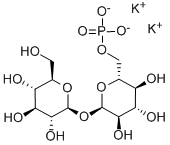 |
| | Trehalose 6-phosphate dipotassium salt Chemical Properties |
| Melting point | >140°C (dec.) | | storage temp. | −20°C | | solubility | Water (Slightly, Sonicated) | | form | Solid | | color | White to Pale Brown | | Stability: | Hygroscopic | | Major Application | agriculture | | InChIKey | KSPIKJRSOAXHOT-PVXXTIHASA-N | | SMILES | [K].[H][C@@]1(O[C@H](CO)[C@@H](O)[C@H](O)[C@H]1O)O[C@H]2O[C@H](COP(O)(O)=O)[C@@H](O)[C@H](O)[C@H]2O |
| Hazard Codes | Xn,T,F | | Risk Statements | 20/21/22-68/20/21/22-39/23/24/25-11 | | Safety Statements | 36/37 | | WGK Germany | 3 | | Storage Class | 6.1C - Combustible acute toxic Cat.3
toxic compounds or compounds which causing chronic effects | | Hazard Classifications | Acute Tox. 3 Dermal
Acute Tox. 4 Inhalation
Acute Tox. 4 Oral
STOT SE 1 |
| | Trehalose 6-phosphate dipotassium salt Usage And Synthesis |
| Uses | Trehalose is a natural non-reducing disaccharide found in plants, invertebrates, fungi, and bacteria. In addition to roles as an energy source and stress protectant, trehalose can function as a signaling molecule. Trehalose 6-phosphate is an intermediate in the biosynthesis of trehalose. It is generated from UDP-glucose and glucose 6-phosphate by trehalose 6-phosphate synthase (TPS or otsA). In plants, changes in trehalose 6-phosphate levels positively correlate with diurnal changes in sucrose and may regulate diverse processes, including starch degradation and flowering. | | Uses | Trehalose 6-Phosphate Potassium Salt is an intermediate in the synthesis of D-(+)-Trehalose (T718750), a disaccharide composed of two α-glucose units. D-(+)-Trehalose is used in many processed foods as well as in biopharmaceutical monoclonal antibody formulations. When plants’ sugar levels are low, they reduce their investment in fatty acid synthesis. Trehalose 6-phoshate (T6P) regulates oil synthesis in plants. (Chem. and Eng. News p. 9 Oct. 1, (2018)) | | Biological Activity | Trehalose 6-phosphate (T6P) is synthesised from glucose-6-phosphate (G6P) and uridine 5-diphospho-glucose. Trehalose-6-phosphate synthase catalyzes this reaction. T6P serves as a precursor for the synthesis of trehalose. It regulates sugar metabolism in in Arabidopsis plants and promotes its growth. In plants, T6P blocks the action of sucrose nonfermenting-1-related protein kinase 1, which affects the energy and carbon metabolism. |
| | Trehalose 6-phosphate dipotassium salt Preparation Products And Raw materials |
|