|
|
| | 2-(3-Bromopropoxy)tetrahydro-2H-pyran Basic information |
| Product Name: | 2-(3-Bromopropoxy)tetrahydro-2H-pyran | | Synonyms: | 2-(3-Bromopropoxy)tetrahydro-2H-pyran,98%,stabilized with potassium carbonate;2-(3-Bromopropoxy)tetrahydro-2H-pyran,1-Bromo-3-(tetrahydropyranyloxy)propane;2-(3-Bromopropoxy)tetrahydro-2H-pyran, stabilized with potassium carbonate, 98%;3-Bromo-O-tetrahydropyranyl-propanol;2-(3-broMopropoxy)oxane;3-broMopropyltetrahydropyranylether;2-(3-Bromopropoxy)oxane, 1-Bromo-3-[(tetrahydro-2H-pyran-2-yl)oxy]propane;2-(3-BROMOPROPOXY)TETRAHYDRO-2H-PYRAN | | CAS: | 33821-94-2 | | MF: | C8H15BrO2 | | MW: | 223.11 | | EINECS: | 145-852-9 | | Product Categories: | Pyrans, Piperidines & Piperazines;Pyrans, Piperidines &Piperazines | | Mol File: | 33821-94-2.mol | 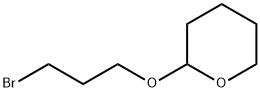 |
| | 2-(3-Bromopropoxy)tetrahydro-2H-pyran Chemical Properties |
| Boiling point | 64.5 °C/0.8 mmHg (lit.) | | density | 1.317 g/mL at 25 °C (lit.) | | refractive index | n20/D 1.478(lit.) | | Fp | 222 °F | | storage temp. | -20°C | | form | liquid | | Appearance | Colorless to light yellow Liquid | | BRN | 106236 | | InChI | InChI=1S/C8H15BrO2/c9-5-3-7-11-8-4-1-2-6-10-8/h8H,1-7H2 | | InChIKey | HJNHUFQGDJLQRS-UHFFFAOYSA-N | | SMILES | C1(OCCCBr)OCCCC1 | | CAS DataBase Reference | 33821-94-2(CAS DataBase Reference) |
| Hazard Codes | Xi | | Safety Statements | 23-24/25 | | WGK Germany | 3 | | F | 8-10 | | Hazard Note | Irritant | | HS Code | 29329900 | | Storage Class | 10 - Combustible liquids |
| | 2-(3-Bromopropoxy)tetrahydro-2H-pyran Usage And Synthesis |
| Chemical Properties | Clear colorless to yellow liquid | | Uses | 2-(3-Bromopropoxy)tetrahydro-2H-pyran may be used in organic synthesis studies. | | General Description | The latent alcohol functionality of this bifunctional building block can be generated using aqueous acid. | | Synthesis | GENERAL STEPS: The synthesis of the compound was reported in the literature (Pinchuk, A.N. et al. J. Med. Chem. 2006, 49, 2155-2165). A solution of 3-bromo-1-propanol (6.95 g, 50 mmol, 1 eq.) in DCM (25 mL) was added to a 125 mL round-bottomed flask, and 3,4-dihydro-2H-pyran (5.93 mL, 65 mmol, 1.3 eq.) was added slowly with stirring. The reaction mixture was stirred at room temperature overnight and the progress of the reaction was monitored by TLC (Spreader: 20% EtOAc in hexane solution, Color Developer: KMnO4) to confirm complete consumption of 3-bromo-1-propanol. After completion of the reaction, the solvent was evaporated under reduced pressure, and the resulting crude product was purified by rapid column chromatography on silica gel (silica gel dosage: 20 g, column diameter: 1.5 cm, eluent: 10% EtOAc/hexane, 100 mL) to afford 2-(3-bromopropoxy)tetrahydro-2H-pyran as a colorless, transparent oil in 86.4% yield (9.637 g). The product was detected by TLC (20% EtOAc in hexane solution) with Rf = 0.85. The NMR data were as follows: 1H NMR (400 MHz, CDCl3) δ: 4.59 (t, 1H, J = 3.52 Hz, H-7), 3.90-3.81 (m, 2H, H-6), 3.55-3.47 (m, 4H, H-4 + H-5), 2.16-2.08 (m, 2H, H-3), 1.90-1.64 (m, 2H, H-2), 1.57-1.50 (m, 4H, H-1); 13C NMR (100 MHz, CDCl3) δ: 98.90 (C-7), 64.88 (C-6), 62.26 (C-5), 32.90 (C-3), 30.59 (d, 2J-3) 30.59 (d, 2J = 6.04 Hz, C-4), 25.41 (C-2), 19.48 (C-1). | | References | [1] Synthetic Communications, 2007, vol. 37, # 12, p. 2031 - 2037
[2] Journal of Medicinal Chemistry, 2006, vol. 49, # 7, p. 2155 - 2165
[3] Organic Letters, 2014, vol. 16, # 11, p. 2818 - 2821
[4] Angewandte Chemie - International Edition, 2015, vol. 54, # 51, p. 15497 - 15500
[5] Angew. Chem., 2015, vol. 127, # 51, p. 15717 - 15720 |
| | 2-(3-Bromopropoxy)tetrahydro-2H-pyran Preparation Products And Raw materials |
|