- Trinexapac-ethyl
-

- $5.00
-
2023-03-27
- CAS:95266-40-3
- Min. Order: 1KG
- Purity: 0.99
- Supply Ability: 3t
- Trinexapac-ethyl
-

- $15.00
-
2021-08-12
- CAS:95266-40-3
- Min. Order: 1KG
- Purity: 99%+ HPLC
- Trinexapac-ethyl
-
- $1.00
-
2019-07-06
- CAS:95266-40-3
- Min. Order: 1KG
- Purity: 99%
- Supply Ability: 1000KG
|
| | Trinexapac-ethyl Basic information |
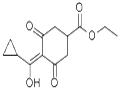
| Product Name: | Trinexapac-ethyl | | Synonyms: | 4-((Cyclopropylhydroxymethylene)-3,5-dioxocyclohexanecarboxylic acid, Ethyl ester;Epa pesticide chemical code 112602;Trinexapac-ethyl [iso];Trinexapac-ethyl (Cimetocarb-ethyl);-3,5-dioxocyclohexanecarboxylate;Ethyl 4-(cyclopropyl(hydroxy);TRINEXAPAC-ETHYL PESTANAL;Trinexapec-ethyl | | CAS: | 95266-40-3 | | MF: | C13H16O5 | | MW: | 252.26 | | EINECS: | 680-302-2 | | Product Categories: | Alpha sort;Pesticides&Metabolites;Q-ZAlphabetic;TP - TZ | | Mol File: | 95266-40-3.mol |  |
| | Trinexapac-ethyl Chemical Properties |
| Melting point | 32-36°C | | Boiling point | 355.44°C (rough estimate) | | density | 1.2380 (rough estimate) | | refractive index | nD30 1.5350 | | storage temp. | Sealed in dry,Room Temperature | | solubility | Chloroform (Slightly), Methanol (Slightly) | | pka | 4.7(at 25℃) | | color | Off-White to Dark Yellow | | Henry's Law Constant | 5.1×100 mol/(m3Pa) at 25℃, Duchowicz et al. (2020) | | Major Application | agriculture
environmental | | InChI | InChI=1S/C13H16O5/c1-2-18-13(17)8-5-9(14)11(10(15)6-8)12(16)7-3-4-7/h7-8,16H,2-6H2,1H3/b12-11- | | InChIKey | RVKCCVTVZORVGD-QXMHVHEDSA-N | | SMILES | C1(C(OCC)=O)CC(=O)/C(=C(/C2CC2)\O)/C(=O)C1 | | CAS DataBase Reference | 95266-40-3(CAS DataBase Reference) | | EPA Substance Registry System | Trinexapac-ethyl (95266-40-3) |
| WGK Germany | 2 | | RTECS | GU8473500 | | HS Code | 29183000 | | Storage Class | 11 - Combustible Solids | | Hazard Classifications | Aquatic Chronic 1
Skin Sens. 1B
STOT RE 2 | | Toxicity | LD50 in rats (mg/kg): 4460 orally; >4000 dermally (Kerber) |
| | Trinexapac-ethyl Usage And Synthesis |
| Description | Trinexapac-ethyl is a synthetic plant growth regulator developed by Syngenta, Switzerland. It inhibits the production of gibberellic acid and shortens the internodes on grasses grown for seed and cereals which results in a reduction in lodging. It can be used for crop height reduction, lodging prevention and yield protection in all varieties of winter and spring wheat, winter and spring barley and winter and spring oats, durum wheat, rye, triticale and grassland (seed crops). | | Uses | Trinexapac-ethyl is a synthetic plant growth regulator that is derived from cyclohexanecarboxylate. It is used to control the growth on various grass species and crops. Trinexapac-ethyl is approved for use on cereal crops such as barley, durum wheat, oats, rye, triticale and wheat as well as grassland, amenity turf and managed turf. | | Definition | ChEBI: Trinexapac-ethyl is an ethyl ester resulting from the formal condensation of the carboxy group of trinexapac with ethanol. It has a role as a xenobiotic, an environmental contaminant, a plant growth regulator, an agrochemical, a pro-agent and a gibberellin biosynthesis inhibitor. It is a member of cyclohexanones, a beta-hydroxy ketone, an enol, an ethyl ester and a member of cyclopropanes. It derives from a trinexapac. | | Production Methods | The production of trinexapac-ethyl involves a multi-step synthesis beginning with diethyl maleate and acetone, which react in an autoclave at elevated temperatures to form diethyl 2-acetone-1,4-succinate. This intermediate is then converted into 3-ethoxycarbonyl-5-oxocyclohex-1-en-1-alcohol sodium through controlled dropwise addition and heating. Subsequent steps involve esterification and cyclization reactions to form the final trinexapac-ethyl compound. | | Carcinogenicity | The U.S. EPA has classified trinexapac-ethyl as "not likely to be carcinogenic to humans."
No studies area available in humans to inform on carcinogenicity of trinexapac-ethyl.
The carcinogenic potential of trinexapac-ethyl has been well investigated in two guideline and GLP compliant dietary studies; a 2-year study in the Sprague-Dawley rat (Anon., 1992) and an 18-month study in the CD-1 mouse (Anon., 1991).
Overall, RAC agreed with the DS that there is insufficient evidence to support classification for carcinogenicity. | | Mode of action | Trinexapac-ethyl acts as an inhibitor of the action of a key enzyme in the formation of gibberellic acid (GA1), preventing the formation of the plant growth regulator gibberellins, which promotes cell elongation. In the absence of gibberellins the internodes of the plants fail to grow and prevent the plant from growing taller. This can be used to prevent lodging in crops and amenity turf, increase the yield in crops by redirecting energy into the production of reproductive parts and finally to reduce the frequency of mowing in turf. | | Pesticide Type | Plant Growth Regulator |
| | Trinexapac-ethyl Preparation Products And Raw materials |
|