- Acriflavine
-

-
2026-09-15
- CAS:8048-52-0
- Min. Order: 100G
- Purity: 98%min
- Supply Ability: 30KG/month
- ACRIFLAVINE USP/EP/BP
-

- $1.10
-
2026-08-20
- CAS:8048-52-0
- Min. Order: 1g
- Purity: 99.9%
- Supply Ability: 100 Tons min
- Acriflavine
-

- $98.00
-
2026-08-18
- CAS:8048-52-0
- Purity:
- Supply Ability: 10g
|
| | ACRIFLAVINE Basic information |
| Product Name: | ACRIFLAVINE | | Synonyms: | 2,8-DIAMINO-10-METHYLACRIDINIUM CHLORIDE;Acriflavine 10;Trypaflavine Neutral;GUANOSINE ULTRA PURE GRADE;4-Acetamino phenol ( APAP );Acriflavine 〔Trypaflavine〕;Acriflavine, 95%, mixture of 3,6-Diamino-10-methylacridinium Chloride and 3,6-Diaminoacridine;XANTHACRIDINE | | CAS: | 8048-52-0 | | MF: | C27H25ClN6 | | MW: | 468.98 | | EINECS: | 999-999-2 | | Product Categories: | marker | | Mol File: | 8048-52-0.mol | 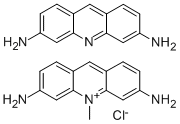 |
| | ACRIFLAVINE Chemical Properties |
| Melting point | 179-181 °C | | Boiling point | 612.69°C (rough estimate) | | density | 1.0933 (rough estimate) | | refractive index | 1.6000 (estimate) | | storage temp. | Store at -20°C | | solubility | H2O: soluble0.33g/mL (lit.)(lit.) | | form | Powder | | color | Deep orange to brownish-red | | Water Solubility | H2O: 0.33g/mL (lit.)(lit.) | | Merck | 14,123 | | InChI | 1S/C14H13N3.C13H11N3.ClH/c1-17-13-7-11(15)4-2-9(13)6-10-3-5-12(16)8-14(10)17;14-10-3-1-8-5-9-2-4-11(15)7-13(9)16-12(8)6-10;/h2-8H,1H3,(H3,15,16);1-7H,14-15H2;1H | | InChIKey | PEJLNXHANOHNSU-UHFFFAOYSA-N | | SMILES | C12C=C(N)C=CC1=CC1=CC=C(N)C=C1[N+]=2C.C12C=C(C=CC1=CC1=CC=C(N)C=C1N=2)N.[Cl-] | | CAS DataBase Reference | 8048-52-0(CAS DataBase Reference) | | EPA Substance Registry System | Xanthacridinum (8048-52-0) |
| | ACRIFLAVINE Usage And Synthesis |
| Chemical Properties | Acriflavine hydrochloride is deep orange to brownish-red powder | | Uses | Acriflavine is used in applications for dual fluorescence analysis of cellular DNA and protein simultaneously. | | Uses | Fluorescent label for high molecular weight RNA | | Biological Activity | Acriflavine also interacts with HIF-1α (hypoxia-inducible factor 1 α) and HIF-2α, and thereby suppresses dimer formation of HIF-1 and transcriptional function. It also has negative effect on tumor growth and vascularization. Acriflavine also exhibits trypanocidal, antibacterial and antiviral activities. | | Safety Profile | Poison by
subcutaneous route. Questionable
carcinogen with experimental tumorigenic
data. Human mutation data reported. A
topical antiseptic used in the treatment of
gonorrhea. When heated to decomposition
it emits very toxic fumes of NOx and Cl-.
See also 3,6-DIAMINO-10
METHYLACRIDINIUM CHLORIDE. | | Purification Methods | Treat acriflavin twice with freshly precipitated AgOH to remove proflavine, then recrystallise it from absolute methanol [Wen & Hsu J Phys Chem 66 1353 1962]. [Beilstein 22 III/IV 218.] |
| | ACRIFLAVINE Preparation Products And Raw materials |
|