|
|
| | 1,3-Dichloro-5,5-dimethylhydantoin Basic information |
| Product Name: | 1,3-Dichloro-5,5-dimethylhydantoin | | Synonyms: | DANTOIN;DACTIN;DICHLORO-DIMETHYL-HYDANTOINE;1,3-DICHLORO-5,5-DIMETHYLHYDANTOIN;1,3-DICHLORO-5,5-DIMETHYLHYDANTOINE;1,3-dichloro-5,5’-methylhydantoin;1,3-dichloro-5,5-dimethyl-4-imidazolidinedione;1,3-dichloro-5,5-dimethyl-hydantoi | | CAS: | 118-52-5 | | MF: | C5H6Cl2N2O2 | | MW: | 197.02 | | EINECS: | 204-258-7 | | Product Categories: | Water Ttreatment Chemicals;Imidazolines/ImidazolidinesBuilding Blocks;Halogenated Heterocycles;Heterocyclic Building Blocks;Imidazolines/Imidazolidines;Water treatment chemicals;Miscellaneous;Pyridines;water treatment;A | | Mol File: | 118-52-5.mol | 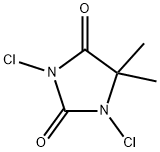 |
| | 1,3-Dichloro-5,5-dimethylhydantoin Chemical Properties |
| Melting point | 132-134 °C (lit.) | | Boiling point | 214.7±23.0 °C(Predicted) | | density | 1,5 g/cm3 | | vapor pressure | 0.003Pa | | refractive index | 1.5720 (estimate) | | Fp | 171 °C | | storage temp. | Keep in dark place,Sealed in dry,Room Temperature | | solubility | water: soluble0.21% at 25°C(lit.) | | pka | -3.44±0.40(Predicted) | | form | Crystalline Powder | | color | White | | PH | 4.4 (H2O)(HSDB) | | Water Solubility | 0.21 g/100 mL (25 ºC) | | Sensitive | Moisture Sensitive | | Sublimation | 100 ºC | | Merck | 14,3065 | | BRN | 146013 | | Henry's Law Constant | 9.9×100 mol/(m3Pa) at 25℃, HSDB (2015) | | Exposure limits | ACGIH:TLV-TWA 0.2 mg/m3; TLV-STEL 0.4 mg/m3
OSHA:PEL-TWA 0.2 mg/m3
NIOSH:REL-TWA 0.2 mg/m3; REL-STEL 0.4 mg/m3 | | Stability: | Stable, but a strong oxidizer - contact with combustible material may lead to fire. Incompatible with reducing agents, acids, strong bases. Moisture sensitive. | | InChI | 1S/C5H6Cl2N2O2/c1-5(2)3(10)8(6)4(11)9(5)7/h1-2H3 | | InChIKey | KEQGZUUPPQEDPF-UHFFFAOYSA-N | | SMILES | CC1(C)N(Cl)C(=O)N(Cl)C1=O | | LogP | -0.94 | | CAS DataBase Reference | 118-52-5(CAS DataBase Reference) | | EPA Substance Registry System | 1,3-Dichloro-5,5-dimethylhydantoin (118-52-5) |
| Hazard Codes | Xn,C,O,N | | Risk Statements | 22-36/37/38-34-8-50-43-31-20/21/22 | | Safety Statements | 26-36-45-36/37/39-17-61 | | RIDADR | UN 1479 5.1/PG 2 | | OEB | C | | OEL | TWA: 0.2 mg/m3, STEL: 0.4 mg/m3 | | WGK Germany | 3 | | RTECS | MU0700000 | | TSCA | TSCA listed | | HazardClass | 5.1 | | PackingGroup | II | | HS Code | 29332100 | | Storage Class | 5.1B - Oxidizing hazardous materials | | Hazard Classifications | Acute Tox. 4 Oral
Aquatic Acute 1
Aquatic Chronic 1
Ox. Sol. 2
Skin Irrit. 2
Skin Sens. 1 | | Hazardous Substances Data | 118-52-5(Hazardous Substances Data) | | Toxicity | LD50 oral in rabbit: 1520mg/kg | | IDLH | 5 mg/m3 |
| | 1,3-Dichloro-5,5-dimethylhydantoin Usage And Synthesis |
| Description | DCDMH is a combustible, white powder witha chlorine-like odor. Molecular weight=197.03; Freezing/Melting point=130℃; Flash point=175℃. HazardIdentification (based on NFPA-704 M Rating System):Health 3, Flammability 1, Reactivity 0 Oxidizer, . Waterreactive; slightly soluble; solubility=0.2%. | | Chemical Properties | DCDMH is a combustible, white powder.
Chlorine-like odor. | | Physical properties | White powder or four-sided crystals from chloroform with a chlorine-like odor. Aqueous solutions
are acidic. | | Uses | Chlorinating agent; disinfectant;
laundry bleach; in water treatment; intermediate
for drugs; insecticides; polymerization
catalyst | | Uses | Dantoin(R) DCDMH is an industrial bleaching agent based on dimethyl hydantoin. This product finds application wherever solid bleach is desired. | | Uses | Dantoin(R) DCDMH LD (low dust) is an industrial bleaching agent based on dimethyl hydantoin. This product finds application wherever solid bleach is desired. | | Definition | Methionine hydroxy analog c. 90%. | | General Description | White powder with a weak chlorine odor. Conflagrates at 414°F (turns brown). Chlorine gas evolves > 410°F. | | Air & Water Reactions | Sensitive to exposure to light, air, and moisture. Reacts with water or steam to produce toxic and corrosive fumes. | | Reactivity Profile | 1,3-Dichloro-5,5-dimethylhydantoin reacts violently with xylene. 1,3-Dichloro-5,5-dimethylhydantoin is incompatible with strong acids, easily oxidized materials, ammonia salts and sulfides. 1,3-Dichloro-5,5-dimethylhydantoin will react with water or steam to produce toxic and corrosive fumes. At a pH of 9, 1,3-Dichloro-5,5-dimethylhydantoin decomposes completely. | | Health Hazard | 1,3-Dichloro-5,5-dimethylhydantoin
powder in contact with water yields
hypochlorous acid, which is an irritant of the
eyes and mucous membranes. | | Fire Hazard | Flash point data for 1,3-Dichloro-5,5-dimethylhydantoin are not available. 1,3-Dichloro-5,5-dimethylhydantoin is probably combustible. | | Safety Profile | Moderately toxic by
ingestion. Mildly toxic by inhalation. A
severe slun irritant. Mutation data reported.
Avoid excessive contact because of effects
of active chlorine on skin. Some of the
hydantoins are central nervous system
depressants. Mixtures with xylene may
explode. Wdl react with water or steam to
produce toxic and corrosive fumes. When
heated to decomposition it emits toxic
fumes of Cl and NOx. See also
CHLORIDES. | | Synthesis | General procedure for the synthesis of 1,3-dichloro-5,5-dimethylimidazoline-2,4-dione from 5,5-dimethylhydantoin: Preparation of ethyl acetate, tetrahydrofuran and liquid chlorine in the ratio of 1:1:0.7 by volume, as well as 5,5-dimethylglycolide urea, anhydrous sodium carbonate and lanthanum-modified nanoscale Ga/Al composite solid bases in the ratio of 1:1.2:0.15 by mass. The specific dosage was as follows 30 mL of ethyl acetate, 30 mL of tetrahydrofuran, 21 mL of liquid chlorine, 7 g of 5,5-dimethylglycolide, 8.4 g of anhydrous sodium carbonate and 1.05 g of lanthanum-modified nanoscale Ga/Al composite solid base. (1) 7 g of 5,5-dimethylglycolide urea and 8.4 g of anhydrous sodium carbonate were added to a reaction vessel equipped with a spherical condenser tube, magnetically stirred, and reacted for 6 h at room temperature; (2) 1.05 g of lanthanum-modified nanoscale Ga/Al composite solid bases, 30 mL of ethyl acetate, and 30 mL of tetrahydrofuran were added sequentially to the mixture of step (1). Then 21 mL of liquid chlorine was added dropwise at a rate of 60 drops per minute, magnetic stirring was turned on, and the reaction was heated at 100 °C for 2 h. (3) The heated mixture from step (2) was transferred to a microwave reactor for 5 h. The mixture was then heated for 2 h. The mixture was then heated for 2 h. The reaction was then transferred to a microwave reactor for 5 h. After the reaction was completed, the mixture was cooled, filtration was performed, and the filter cake was washed with tetrahydrofuran. The filtrate was rotary evaporated to recover part of ethyl acetate, tetrahydrofuran and lanthanum-modified nanoscale Ga/Al composite solid bases; (4) the residual filtrate from step (3) was poured into pure water under continuous stirring to precipitate the product sufficiently, and pumped and filtered to obtain the crude product. The crude product was successively recrystallized with ethanol and pure water, and then recrystallized with toluene for the second time, and the target product 1,3-dichloro-5,5-dimethylimidazoline-2,4-dione was finally obtained. | | Potential Exposure | It is used as a chlorinating agent,
disinfectant, biocide, and laundry bleach. It is also used as
a polymerization catalyst in making vinyl chloride; and
in drug and pesticide synthesis. | | First aid | If this chemical gets into the eyes, remove anycontact lenses at once and irrigate immediately for at least15 min, occasionally lifting upper and lower lids. Seek medical attention immediately. If this chemical contacts the skin,remove contaminated clothing and wash immediately withsoap and water. Seek medical attention immediately. If thischemical has been inhaled, remove from exposure, beginrescue breathing (using universal precautions, includingresuscitation mask) if breathing has stopped and CPR if heartaction has stopped. Transfer promptly to a medical facility.When this chemical has been swallowed, get medical attention. Give large quantities of water and induce vomiting. Donot make an unconscious person vomit. Medical observationis recommended for 24-48 h after breathing overexposure,as pulmonary edema may be delayed. As first aid for pulmonary edema, a doctor or authorized paramedic may consideradministering a corticosteroid spray. | | Environmental fate | Chemical/Physical. Reacts with water (pH 7.0) releasing hypochlorous acid. At pH 9, nitrogen
chloride is formed (Windholz et al., 1983). | | storage | (1) Color Code—Yellow: Reactive Hazard; Storein a location separate from other materials, especially flammables and combustibles. (2) Color Code—White:Corrosive or Contact Hazard; Store separately in a corrosion-resistant location. Prior to working with this chemicalyou should be trained on its proper handling and storage.1,3-Dichloro-5,5-dimethyl-hydantoin must be stored toavoid contact with strong acids (such as sulfuric acid, nitricacid, or hydrochloric acid) and easily oxidized materials(such as ammonium salts and sulfides) since violent reactions occur and poisonous gases can be produced. Store intightly closed containers in a cool, well-ventilated area awayfrom water or steam. 1,3-Dichloro-5,5-dimethyl-hydantoindecomposes with formation of poisonous gases at201-210℃. If 1,3-dichloro-5,5-dimethyl-hydantoin contacts water or steam, it decomposes at lower temperaturesand produces poisonous gases, including chlorine. Sourcesof ignition, such as smoking and open flames, are prohibitedwhere 1,3-dichloro-5,5-dimethyl-hydantoin is used, handled,or stored in a manner that could create a potential fire orexplosion hazard. | | Shipping | UN1479 Oxidizing solid, n.o.s., Hazard Class:
5.1; Labels: 5.1-Oxidizer, Technical Name Required | | Purification Methods | Purify it by dissolving in conc H2SO4 and diluting with ice H2O, collect the solid, dry it in a vacuum and recrystallise it from CHCl3. It sublimes at 100o in a vacuum. It exhibits time-dependent hydrolysis at pH 9. [Petterson & Grzeskowiak J Org Chem 24 1414 1959, Beilstein 24 III/IV 1100.] | | Incompatibilities | A strong oxidizer. Contact with water
forms poisonous and corrosive gases. Mixtures with xylene
may explode. Not compatible with moisture (especially hot
water, steam), strong acids; easily oxidized materials (such
as ammonia salts; sulfides, etc.); reducing agents; strong
bases; ammonium salts; sulfides. Compounds of the
carboxyl group react with all bases, both inorganic and
organic (i.e., amines) releasing substantial heat, water and
a salt that may be harmful. Incompatible with arsenic compounds (releases hydrogen cyanide gas), diazo compounds,
dithiocarbamates, isocyanates, mercaptans, nitrides, and
sulfides (releasing heat, toxic and possibly flammable
gases), thiosulfates and dithionites (releasing hydrogen
sulfate and oxides of sulfur) | | Toxics Screening Level | The initial threshold screening level (ITSL) for the following bromo- and chloro dimethylhydantoins is 2 μg/m3, based on an 8-hour averaging time. | | Waste Disposal | Incineration (815.5�C/816�C,
0.5 second for primary combustion; 104.4�C/220�F, 1.0 second for secondary combustion). The formation of elemental
chlorine can be prevented by injection of steam or methane
into the combustion process. Any nitrogen oxides may be
abated by the use of thermal or catalytic devices | | References | [1] Patent: CN108484506, 2018, A. Location in patent: Paragraph 0016; 0018-0036
[2] Tetrahedron Letters, 2009, vol. 50, # 6, p. 656 - 658
[3] Journal fuer Praktische Chemie (Leipzig), 1926, vol. <2>113, p. 263 Anm.4 |
| | 1,3-Dichloro-5,5-dimethylhydantoin Preparation Products And Raw materials |
|