- PEDOT/PSS
-
- $1.00
-
2026-08-07
- CAS:155090-83-8
- Min. Order: 1KG
- Purity: 99%
- Supply Ability: 200000KG
|
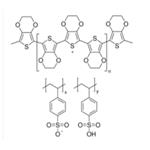
| Product Name: | PEDOT:PSS | | Synonyms: | POLY(STYRENESULFONATE)/POLY(2,3-DIHYDRO-;POLY(STYRENESULFONATE)/POLY(2,3-DIHYDT&;poly(3,4-ethylenedioxythioophene)poly(styrenesulfonate)aq.dispersion;Ethenylbenzenesulfonic acid homopolymer compound with 2,3-dihydrothieno[3,4-b]-1,4-dioxin homopolymer;PEDT/PSS;POLY(STYRENESULFONATE)/POLY(2,3-DIHYDROTHIENO(3,4-B)-1,4-DIOXIN);POLY(3,4-OXYETHYLENEOXYTHIOPHENE)/POLY(STYRENE SULFONATE);POLY(3,4-ETHYLENEDIOXYTHIOPHENE)/POLY (STYRENESULFONATE) | | CAS: | 155090-83-8 | | MF: | (C8H8O3S)x?x(C6H6O2S)x | | MW: | 0 | | EINECS: | 629-200-1 | | Product Categories: | OTFT/OFET/OPV Materials;VX:15689727968;OLED | | Mol File: | 155090-83-8.mol |  |
| | PEDOT:PSS Chemical Properties |
| | PEDOT:PSS Usage And Synthesis |
| Applications | Poly(3,4-ethylenedioxythiophene)-poly(styrenesulfonate), also named PEDOT: PSS, belongs to organic/polymer TE materials and has the advantages of water-processable, thermally stable, and can be highly conductive[1]. The charge storage of PEDOT:PSS in supercapacitors is due to redox reactions[2]. It is commonly included as an electroactive conductor in various organic devices(supercapacitors, displays, transistors, and energy‐converters). For example, spin-coating of the PEDOT:PSS water dispersion on n-type silicon wafer[3]. | | Application | PEDOT:PSS is the subject of a considerable amount of research, and is used for a range of applications within thin-film electronic fabrication. This include perovskite photovoltaics, organic photovoltaics, organic light emitting diodes, transparent conductors, organic electrochemical transistors, flexible electronics, thermoelectric generators, supercapitors, and energy storage | | Description | AI 4083, PH 1000, HTL Solar and HTL Solar 3 for thin-film electronic fabrication | | Chemical Properties | Dark blue liquid | | Uses | PEDOT:PSS can be used as an electrode material that forms a layered structure with a high mobility for charge carriers. It can be used for a wide range of energy based applications, such as organic photovoltaics (OPVs), dye sensitized solar cells (DSSCs), organic light emitting diodes (OLEDs) and supercapacitors. | | Uses | Screen Printing results on Autotype Autosta CT7 P77/55 screen with 300 mm/s
Curing temp. 130°C during 3 min | | Uses | Conductive ink based on the high conductivity grade PEDOT:PSS polymer dispersion. Suitable for deposition and patterning of transparent conductive films using slot die coating and spin coating in OPV application. | | General Description | A conducting polymer such as poly(3,4-ethylenedioxythiophene) doped with poly(styrene sulfonate) anions (PEDOT/PSS) is widely used in various organic optoelectronic devices. PEDOT: PSS is a blend of cationic polythiopene derivative, doped with a polyanion. High electrical conductivity and good oxidation resistance of such polymers make it suitable for electromagnetic shielding and noise suppression. Thus, the polymer film was found to possess high transparency throughout the visible light spectrum and even into near IR and near UV regions, virtually 100% absorption from 900-2,000 nm. No absorption maximum from 400-800 nm. Impact of small electric and magnetic fields on the polymer was studied. | | Materials Uses | PEDOT:PSS is highly conductive, largely transmissive to light, processible in water, and highly flexible. Stretchability is the enabling characteristic of a range of applications envisioned for PEDOT in energy and healthcare, such as wearable, implantable, and large-area electronic devices. The strategies to enhance the stretchability include blending with plasticizers or polymers, deposition on elastomers, formation of fibers and gels, and the use of intrinsically stretchable scaffolds for the polymerization of PEDOT[4]. | | References |
[1] Kurushima Y, et al. Effect of PEDOT:PSS composition on photovoltaic performance of PEDOT:PSS/n-Si hybrid solar cells. Japanese Journal of Applied Physics, 2021; 60: 091001.
[2] Fan Z, et al. Thermoelectric Properties of PEDOT:PSS. Advanced Electronic Materials, 2019; 5: 1800769.
[3] Volkov A, et al. Understanding the Capacitance of PEDOT:PSS. Advanced Functional Materials, 2017; 27: 1700329.
[4] Kayser, L. V., Lipomi, D. J. (2019). Stretchable Conductive Polymers and Composites Based on PEDOT and PEDOT:PSS. Advanced Materials, 31 10. https://doi.org/10.1002/adma.201806133
|
| | PEDOT:PSS Preparation Products And Raw materials |
|