|
|
| | COUMAFURYL Basic information |
| Product Name: | COUMAFURYL | | Synonyms: | 2H-1-Benzopyran-2-one, 3-[1-(2-furanyl)-3-oxobutyl]-4-hydroxy-;3-(1-(2-furanyl)-3-oxobutyl)-4-hydroxy-2h-1-benzopyran-2-on;3-(1-Furyl-3-acetylethyl)-4-hydroxycoumarin;3-(alpha-acetonylfurfuryl)-4-hydroxy-coumari;3-(alpha-acetonylfurfuryl)-4-hydroxycoumarin;3-(alpha-Furyl-beta-acetylaethyl)-4-hydroxycumarin;3-[1-(2-Furyl)-3-oxobutyl]-4-hydroxy-2H-chromen-2-one;4-(2-Furyl)-4-(4-hydroxy-3-coumarinyl)-2-butanone | | CAS: | 117-52-2 | | MF: | C17H14O5 | | MW: | 298.29 | | EINECS: | 204-195-5 | | Product Categories: | | | Mol File: | 117-52-2.mol | 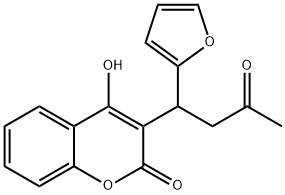 |
| | COUMAFURYL Chemical Properties |
| Melting point | 124° | | Boiling point | 359.71°C (rough estimate) | | density | 1.2006 (rough estimate) | | refractive index | 1.6200 (estimate) | | Fp | >212 °C | | solubility | Chloroform (Slightly), Methanol (Slightly) | | pka | 4.50±1.00(Predicted) | | color | White | | Merck | 13,2582 | | BRN | 6817711 | | Major Application | agriculture
environmental | | InChI | 1S/C17H14O5/c1-10(18)9-12(13-7-4-8-21-13)15-16(19)11-5-2-3-6-14(11)22-17(15)20/h2-8,12,19H,9H2,1H3 | | InChIKey | JFIXKFSJCQNGEK-UHFFFAOYSA-N | | SMILES | CC(=O)CC(c1ccco1)C2=C(O)c3ccccc3OC2=O | | EPA Substance Registry System | Coumafuryl (117-52-2) |
| Hazard Codes | T | | Risk Statements | 25-48/25-52/53 | | Safety Statements | 37-45-61 | | RIDADR | 3027 | | WGK Germany | 3 | | RTECS | GN4850000 | | HazardClass | 6.1(a) | | PackingGroup | II | | Storage Class | 6.1A - Combustible acute toxic Cat. 1 and 2
very toxic hazardous materials | | Hazard Classifications | Acute Tox. 2 Oral
Aquatic Chronic 3
STOT RE 1 Oral | | Hazardous Substances Data | 117-52-2(Hazardous Substances Data) | | Toxicity | LDLo orl-rat: 400 mg/kg 85GYAZ -,115,71 |
| | COUMAFURYL Usage And Synthesis |
| Description | Coumafuryl is an obsolete anticoagulant rodenticide. It is moderately soluble in water and is not volatile. Data suggests it is mobile and so it may have potential to leach to groundwater but its pattern of use would tend to significantly reduce the risk. Little is known about its toxicity to biodiversity. It is highly toxic to mammals via the oral route. | | Chemical Properties | Coumafuryl is a colorless, white, crystalline solid or powder. | | Uses | Rodenticide. | | Production Methods | Coumafuryl is commercially produced through a condensation reaction between 4-hydroxycoumarin and 2-furylmethyl ketone. This synthesis typically occurs in the presence of a base such as sodium hydroxide and a solvent like ethanol or acetic acid, under controlled temperature conditions to facilitate the formation of the desired compound. After the reaction, the product is purified through crystallisation and drying to yield a white to off-white powder. | | Definition | ChEBI: Coumafuryl is a hydroxycoumarin. | | Mechanism of action | Anticoagulant - interferes with the production of blood clotting factors in the liver by blocking the action of vitamin K | | Safety Profile | Poison by ingestion and possiblyother routes. | | Potential Exposure | This material is an anticoagulant rodenticide. Therefore, those involved in its manufacture, formulation, and application are at risk. | | Shipping | UN2811 Toxic solids, organic, n.o.s., Hazard Class: 6.1; Labels: 6.1-Poisonous materials, Technical Name Required. UN3027 Coumarin derivative pesticides, solid, toxic, Hazard Class: 6.1; Labels: 6.1-Poisonous materials | | Incompatibilities | Incompatible with oxidizers (chlorates, nitrates, peroxides, permanganates, perchlorates, chlorine, bromine, fluorine, etc.); contact may cause fires or explosions. Keep away from alkaline materials, strong bases, strong acids, oxoacids, epoxides. At room temperature this material can decompose rapidly to cobalt carbonyl and hydrogen gas; at 52°C cobalt carbonyl decomposes, producing toxic fumes of cobalt and oxides of carbon | | Pesticide Type | Rodenticide |
| | COUMAFURYL Preparation Products And Raw materials |
|