- Periplocin
-

- $30.00
-
2026-07-15
- CAS:13137-64-9
- Purity: 99.96%
- Supply Ability: 10g
- Periplocin
-
-
2023-02-24
- CAS:13137-64-9
- Min. Order: 5mg
- Purity: ≥98%(HPLC)
- Supply Ability: 10 g
- periplocin
-

- $9.80
-
2020-02-11
- CAS:13137-64-9
- Min. Order: 1g
- Purity: >98%
- Supply Ability: 20 tons
|
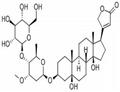
| Product Name: | Periplocoside | | Synonyms: | Periplocoside;3β-[(4-O-β-D-Glucopyranosyl-3-O-methyl-2,6-dideoxy-β-D-ribo-hexopyranosyl)oxy]-5,14-dihydroxy-5β,14β-card-20(22)-enolide;Card-20(22)-enolide, 3-[(2,6-dideoxy-4-O-β-D-glucopyranosyl-3-O-methyl-β-D-ribo-hexopyranosyl)oxy]-5,14-dihydroxy-, (3β,5β)-;4-((3S,5S,8R,9S,10R,13R,14S,17R)-5,14-Dihydroxy-3-(((2R,4S,5R,6R)-4-methoxy-6-methyl-5-(((2S,3R,4S,5S,6R)-3,4,5-trihydroxy-6-(hydroxymethyl)tetrahydro-2H-pyran-2-yl)oxy)tetrahydro-2H-pyran-2-yl)oxy)-10,13-dimethylhexadecahydro-1H-cyclopenta[a]phenanthren-17-yl)furan-2(5H)-one;Periplocin, 10 mM in DMSO;Periplocin;ACQYGF453 | | CAS: | 13137-64-9 | | MF: | C36H56O13 | | MW: | 696.82 | | EINECS: | | | Product Categories: | | | Mol File: | 13137-64-9.mol |  |
| | Periplocoside Chemical Properties |
| Melting point | 205°C | | Boiling point | 610.7°C (rough estimate) | | alpha | D20 +32° | | density | 1.1241 (rough estimate) | | refractive index | 1.7500 (estimate) | | storage temp. | under inert gas (nitrogen or Argon) at 2-8°C | | solubility | DMSO : 250 mg/mL (358.77 mM; Need ultrasonic) | | form | powder | | pka | 12.89±0.70(Predicted) | | color | White | | Water Solubility | 7.937g/L(cold water) | | InChIKey | KWBPKUMWVXUSCA-WVOVULELNA-N | | SMILES | O1CC(=CC1=O)[C@@H]2[C@@]3([C@@](C4C([C@@]5([C@@](C[C@H](CC5)O[C@@H]6OC([C@H](C(C6O)OC)O)CO[C@H]7C(O[C@@H](CC7O)O)C)(CC4)O)C)CC3)(CC2)O)C |
| WGK Germany | WGK 3 | | Storage Class | 6.1A - Combustible acute toxic Cat. 1 and 2
very toxic hazardous materials | | Hazard Classifications | Acute Tox. 2 Inhalation
Acute Tox. 2 Oral
STOT RE 2 | | Toxicity | LD in rabbits, rats (mg/kg): 10, 480 s.c. (MacKeith) |
| | Periplocoside Usage And Synthesis |
| Preparation | Method 1: A method for preparing Periplocoside, comprising the following steps:
1) Drying the roots or stems of *Salix viminalis* at a predetermined temperature, and pulverizing the dried roots or stems to obtain *Salix viminalis* root or stem powder;
2) Placing a predetermined weight of *Salix viminalis* root or stem powder into a container, and adding a predetermined amount of ethanol solution to the container and stirring to obtain an ethanol mixture of *Salix viminalis* root or stem powder;
3) After ultrasonic extraction of the ethanol mixture of *Salix viminalis* root or stem powder, cooling it to room temperature, filtering it, and concentrating the filtrates to dryness to obtain salicylic acid. Method 2: A method for preparing cypermethrin, comprising the following steps: 1) Extraction of Perilla frutescens root bark: Perilla frutescens root bark is extracted using 40%–80% ethanol or 40%–100% methanol (v/v) as the extraction solvent. After extraction, the solvent is evaporated, water is added, and the mixture is filtered or centrifuged to obtain a clear aqueous solution of Perilla frutescens root bark; 2) Macroporous resin adsorption separation: The aqueous solution of Perilla frutescens root bark is adsorbed onto a macroporous resin and eluted with a gradient of 10%–95% ethanol. Each eluted fraction is collected, concentrated, and subjected to thin-layer chromatography. Color is developed using a cardiac glycoside-specific colorimetric reagent. The fractions containing cardiac glycosides are collected and combined; 3) High-performance liquid chromatography (HPLC) preparation and separation: The cardiac glycoside fraction was prepared by HPLC using a reversed-phase column with a mobile phase of methanol:water at a volume ratio of 30-60:70-40 or acetonitrile:water at a volume ratio of 15-40:85-60. The elution curve was monitored at 217-220 nm using an ultraviolet detector to guide product collection. The collected solution was concentrated and dried to obtain Periplocoside. | | Chemical Properties | Soluble in methanol and DMSO Derived from Periploca odorifera | | Uses | Periplocin can be used to improve bone health to prevent, alleviate, or treat osteoporosis. | | in vivo | Periplocin (5-20 mg/kg; intraperitoneal injection; daily; for 14 days; female SCID mice) treatment represses the growth of hepatocellular carcinoma (HCC) in xenograft tumor model in mice[2]. | Animal Model: | Female SCID mice (6-8 weeks old) injected with Huh-7 cells[2] | | Dosage: | 5 mg/kg, 20 mg/kg | | Administration: | Intraperitoneal injection; daily; for 14 days | | Result: | Repressed the growth of hepatocellular carcinoma (HCC) in xenograft tumor model in mice.
|
|
| | Periplocoside Preparation Products And Raw materials |
|