- Fenbutatin oxide
-

- $4.00
-
2026-07-14
- CAS:13356-08-6
- Min. Order: 1box
- Purity: 99%
- Supply Ability: 20tos
- Fenbutatin oxide
-

- $6.00
-
2025-07-29
- CAS:13356-08-6
- Min. Order: 1kg
- Purity: 99%
- Supply Ability: 2000KG/Month
- Fenbutatin oxide
-

- $6.00
-
2025-03-28
- CAS:13356-08-6
- Min. Order: 1KG
- Purity: 99%
- Supply Ability: 20TONS
|
| | Fenbutatin oxide Basic information |
| Product Name: | Fenbutatin oxide | | Synonyms: | bendex;bis(tris(beta,beta-dimethylphenethyl)tin)oxide;di(tri-(2,2-dimethyl-2-phenylethyl)tin)oxide;Distannoxane,hexakis(2-methyl-2-phenylpropyl)-;ent27738;fenbutatin;fenbutatin-oxyde;fenylbutatinoxide | | CAS: | 13356-08-6 | | MF: | C60H78OSn2 | | MW: | 1052.68 | | EINECS: | 236-407-7 | | Product Categories: | Organometallics;FUNGICIDE | | Mol File: | 13356-08-6.mol | 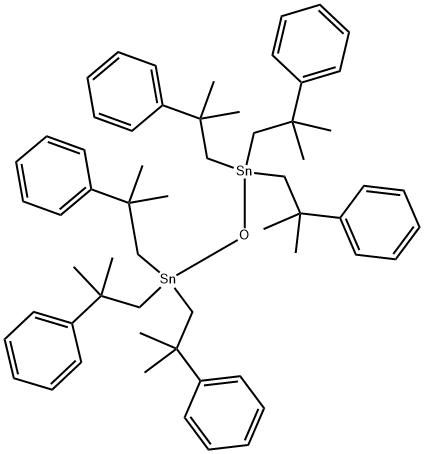 |
| | Fenbutatin oxide Chemical Properties |
| Melting point | 142-145°C | | Boiling point | 235-240 °C(Press: 0.05 Torr) | | density | 0.42 g/cm3 | | vapor pressure | 8.5×10⁻⁸ Pa (20 °C) | | Fp | 100 °C | | storage temp. | Sealed in dry,Room Temperature | | solubility | Chloroform (Slightly), DMSO (Very Slightly, Heated, Sonicated) | | form | solid | | Water Solubility | 0.005 mg l-1 (23 °C) | | Hydrolytic Sensitivity | 4: no reaction with water under neutral conditions | | Merck | 13,3991 | | Henry's Law Constant | 4.9×10³ mol/(m3Pa) at 25℃, HSDB (2015) | | Major Application | agriculture
environmental | | InChI | InChI=1S/6C10H13.O.2Sn/c6*1-10(2,3)9-7-5-4-6-8-9;;;/h6*4-8H,1H2,2-3H3;;; | | InChIKey | HOXINJBQVZWYGZ-UHFFFAOYSA-N | | SMILES | [Sn](CC(C)(C1=CC=CC=C1)C)(CC(C)(C1=CC=CC=C1)C)(CC(C)(C1=CC=CC=C1)C)O[Sn](CC(C)(C1=CC=CC=C1)C)(CC(C)(C1=CC=CC=C1)C)CC(C)(C1=CC=CC=C1)C | | EPA Substance Registry System | Fenbutatin oxide (13356-08-6) |
| Hazard Codes | Xn;N,N,Xn,T+ | | Risk Statements | 21-36/38-50/53-26 | | Safety Statements | 28-36/37-45-60-61 | | RIDADR | UN 2811 | | WGK Germany | 3 | | RTECS | JN8770000 | | TSCA | TSCA listed | | HazardClass | 9 | | PackingGroup | III | | Storage Class | 6.1A - Combustible acute toxic Cat. 1 and 2
very toxic hazardous materials | | Hazard Classifications | Acute Tox. 2 Inhalation
Aquatic Acute 1
Aquatic Chronic 1
Eye Irrit. 2
Skin Irrit. 2 | | Hazardous Substances Data | 13356-08-6(Hazardous Substances Data) | | Toxicity | LD50 in rats, rabbits (mg/kg): >2000 orally; >2000 percutaneously (Zweig) |
| | Fenbutatin oxide Usage And Synthesis |
| Description | Fenbutin oxide is an acaricide used to control a wide range of phytophagous mites and other insects although it is not now used in the developed world. It has a low aqueous solubility but is soluble in several organic solvents. This substance tends to be very persistent in soil and water systems. It is not highly volatile. Toxicity to fish is high but moderate to low for many other species. Fenbutin oxide has a low human oral toxicity but may be fatal if inhaled. | | Chemical Properties | The pure substance is a white crystalline solid. Melting point: 145 °C (138–139 °C for the technical grade); vapour pressure: 6.7 × 10⁻⁶ Pa. It is sparingly soluble in many organic solvents, with solubility values of 380 g/L in dichloromethane, 140 g/L in benzene, and 6 g/L in acetone, and approximately 0.005 mg/L in water. It is stable to light, heat, oxygen, and acids. Water can convert it into tris(2-methyl-2-phenylpropyl)stannane hydroxide. However, at room temperature it slowly reverts to the parent compound, while at 98 °C the conversion occurs rapidly. | | Uses | Fenbutatin oxide is a non-systemic acaricide used to control a
wide range of phytophagous mites on deciduous fruits, citrus, vines,
selected nut crops, bananas, glasshouse crops and ornamentals. | | Uses | Fenbutatin Oxide is an organotin pesticide. Fenbutatin Oxide is widely used as an aracacide in the control of mites, in particular spider mites. | | Definition | ChEBI: Fenbutatin oxide is an organotin acaricide. | | Production Methods | Fenbutatin oxide is commercially produced through a multi-step synthesis involving organotin compounds. The process typically begins with tris(2-methyl-2-phenylpropyl)tin, which is reacted in an organic solvent like toluene under anhydrous conditions to prevent hydrolysis. A dehydrating agent is used to facilitate the formation of the distannoxane bridge, a key structural feature of fenbutatin oxide. The reaction mixture is heated and stirred to complete oxidation and condensation, followed by purification through filtration and solvent evaporation. | | General Description | White crystalline solid with a mild odor. | | Air & Water Reactions | Insoluble in water. | | Reactivity Profile | Fenbutatin oxide is in the family of tin compounds widely used as stabilizers for plastics, additives to paint(as antifouling agents). Some have catalytic properties. Examples include butyl tin, dibutyl tin oxide. Their main hazard is associated with their high toxicity, in skin adsorption or inhalation. | | Agricultural Uses | Insecticide, Miticide: A U.S. EPA restricted Use Pesticide (RUP). A selective
miticide for deciduous pome and stone fruits, citrus fruits, grapes, vegetables, berry fruit, nut crops (selected),
ornamentals and greenhouse crops. | | Trade name | BENDEX®; NEOSTANOX®;
OSDARAN®; SD-14114®; SHELL SD-14114®;
TORQUE®; VENDEX® | | Mechanism of action | Selective, non-systemic with contact and stomach action, acts by inhibiting oxidative phosphorylation. Inhibitor of mitochondrial ATP synthase. | | Potential Exposure | Organotin/phenyltin insecticide and
selective miticide for deciduous pome and stone fruits, citrus fruits, grapes, vegetables, berry fruit, nut crops
(selected), ornamentals, and greenhouse crops. A United
States Environmental Protection Agency Restricted Use
Pesticide (RUP) | | Environmental Fate | Chemical/Physical. Reacts with moisture forming tris(2-methyl-2-phenylpropyl)tin hydroxide (Worthing and Hance, 1991). | | Metabolic pathway | Fenbutatin oxide is quite stable to hydrolytic degradation. Metabolism in
soils, plants and animals is minimal. The extensive and irreversible
adsorption/binding to cationic and organic matter is the primary dissipation
mechanism in the soil environment. Cleavage of the neophenyl-tin
linkages is the primary degradation and metabolic pathway (Scheme 1).
Transformation of the neophenyl moiety has not been observed. Most of
the information reported below was obtained from experiments using
119mSlna belhg conducted by DuPont. | | Shipping | UN2811 Toxic solids, organic, n.o.s., Hazard
Class: 6.1; Labels: 6.1-Poisonous materials, Technical
Name Required | | Degradation | Fenbutatin oxide (1) dissociates slowly in water to the corresponding
hydroxide [tris(2-methyl-2-phenylpropyl)tin hydroxide 21. The neophenyl
moiety of fenbutatin oxide was stable at pH 5, 7, and 9 at 25 °C
with minimal degradation occurring after 30 days (Home, 1987a).
The photodegradation of fenbutatin oxide in pH 7 buffer solution was a
significant degradation process with a DT50 of approximately 51 days
following continuous exposure to simulated sunlight at 25 °C (Home,
1987b). Fenbutatin oxide underwent hydrolysis with a loss of two moles
of the 2-methyl-2-phenylprop yl moiety, yielding dlhydroxy-bis(2-methyl-
2-phenylpropyl)stannane (3), accounting for ca. 23% of the initial
concentration after 15 days of continuous irradiation. Fenbutatin oxide
and its metabolites react reversibly with water to form the analogous
oxide/hydroxide compounds (Gray et a1 ., 1995). | | Incompatibilities | May form explosive mixture with air.
Decomposes above 230C. Contact with water causes slow
decomposition. Orgotin oxides can be strongly basic and
will react, possibly dangerously, with acidic compounds
and mixtures | | Waste Disposal | Organic tin compounds may
be disposed of in sealed containers in secured sanitary landfill. Chemical Treatability of tin; Concentration Process:
Chemical precipitation; Chemical Classification: Metals;
Scale of Study: Pilot scale; Type of Wastewater Used:
Synthetic wastewater; Results of Study: At 600 ppm,
95.3% reduction with alum. At 500 ppm, 98% reduction
with ferric chloride, 92% reduction with lime (three coagulants used: 200 mg of alum at pH = 6.4, 40 ppm of ferric
chloride @ pH = 6.2, 41 ppm of lime @ pH = 11.5
Chemical coagulation was followed by dual media filtration). Consult with environmental regulatory agencies
for guidance on acceptable disposal practices. Incineration
with effluent gas scrubbing is recommended. Containers
must be disposed of properly by following package label
directions or by contacting your local or federal environmental control agency, or by contacting your regional EPA
office. | | Pesticide Type | Acaricide; Insecticide |
| | Fenbutatin oxide Preparation Products And Raw materials |
|