- ITE
-

- $34.00
-
2026-07-27
- CAS:448906-42-1
- Purity: 99.14%
- Supply Ability: 10g
- ITE
-

-
2026-07-03
- CAS:448906-42-1
- Min. Order: 1KG
- Purity: 98%
- Supply Ability: 20Tons
- ITE
-

- $1.00
-
2019-07-06
- CAS:448906-42-1
- Min. Order: 1kg
- Purity: 95%-99%
- Supply Ability: 100kg
|
| Product Name: | ITE | | Synonyms: | ITE;2-(1H-INDOL-3-YLCARBONYL)-4-THIAZOLECARBOXYLIC ACID METHYL ESTER;2-(1'H-INDOLE-3'-CARBONYL)-THIAZOLE-4-CARBOXYLIC ACID;2-(1'H-indole-37-carbonyl)-thiasole-4-carboxylic acid methyl ester;Methyl 2-(1H-indole-3-carbonyl)thiazole-4-carboxylate;methyl 2-(1H-indole-3-carbonyl)-1,3-thiazole-4-carboxylate;ARYL HYDROCARBON RECEPTOR LIGAND;4-Thiazolecarboxylic acid, 2-(1H-indol-3-ylcarbonyl)-, methyl ester | | CAS: | 448906-42-1 | | MF: | C14H10N2O3S | | MW: | 286.31 | | EINECS: | | | Product Categories: | | | Mol File: | 448906-42-1.mol | 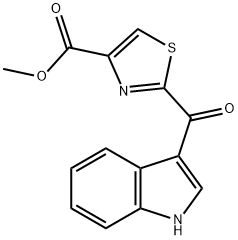 |
| Melting point | 234 - 236°C | | Boiling point | 520.4±48.0 °C(Predicted) | | density | 1.427±0.06 g/cm3(Predicted) | | storage temp. | 2-8°C | | solubility | DMSO: 30 mg/mL, soluble | | form | solid | | pka | 14.38±0.30(Predicted) | | color | Off-White to Light Yellow | | InChI | InChI=1S/C14H10N2O3S/c1-19-14(18)11-7-20-13(16-11)12(17)9-6-15-10-5-3-2-4-8(9)10/h2-7,15H,1H3 | | InChIKey | KDDXOGDIPZSCTM-UHFFFAOYSA-N | | SMILES | S1C=C(C(OC)=O)N=C1C(C1C2=C(NC=1)C=CC=C2)=O |
| Hazard Codes | Xi | | Risk Statements | 36/37/38 | | Safety Statements | 26-36 | | WGK Germany | 3 | | Storage Class | 11 - Combustible Solids | | Hazard Classifications | Eye Irrit. 2
Skin Irrit. 2
STOT SE 3 |
| Uses | ITE is an endogenous AHR ligand that parenterally or orally induces FoxP3+ Treg that suppress exprimental autoimmune encephalomyelitis. ITE promotes the induction of active immunology tolerance and identifies nontoxic endogenous AHR ligands. | | Definition | ChEBI: 2-[1H-indol-3-yl(oxo)methyl]-4-thiazolecarboxylic acid methyl ester is an indolyl carboxylic acid. | | Biological Activity | Endogenous agonist for the transcription factor aryl hydrocarbon receptor (AHR); K i = 3 nM for binding to murine AHR. Transactivates DRE-containing reporter gene constructs in Hepa1c1c7 cells ~ 5-fold more potently than β -naphthoflavone. Active in vivo . | | in vivo | ITE (200 μg, i.p.) significantly suppresses the development of experimental autoimmune uveitis (EAU) in mice. ITE reduces the proportions of cells expressing IFN-γ, IL-17, or IL-10 in mice. ITE also suppresses the secretion of inflammatory cytokines by LN cells in mice[2]. | | storage | Store at RT |
| | ITE Preparation Products And Raw materials |
|