|
|
| Product Name: | Tefluthrin | | Synonyms: | TEFLUTHRIN;(2,3,5,6-tetrafluoro-4-methylphenyl)methylester,(1-alpha,3-alpha(z))-(+-yl;forza;pp993;2,3,5,6-tetrafluoro-4-methylbenzyl(z)-(1rs,3rs)-3-(2-chloro- 3,3,3-trifluoro-1-propenyl-2,2-dimethylcyclopropanecarboxylate;FORCE;FIREBAN;2,3,5,6-tetrafluoro-4-methylbenzyl(Z)(1RS,3RS)-3-(2-chloro-3,3,3-trifluoroprop-1-enyl)-2,2-dimethylcyclopropane=crboxylate | | CAS: | 79538-32-2 | | MF: | C17H14ClF7O2 | | MW: | 418.73 | | EINECS: | 616-699-6 | | Product Categories: | Agro-Products;Aromatics;Intermediates & Fine Chemicals;Pharmaceuticals;PyrethroidsPesticides&Metabolites;Alpha sort;Insecticides;Pesticides;Q-ZAlphabetic;TA - TE | | Mol File: | 79538-32-2.mol | 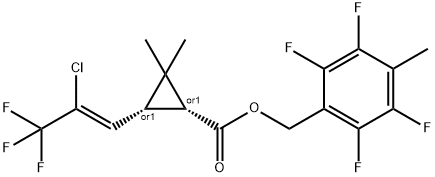 |
| | Tefluthrin Chemical Properties |
| Melting point | 44-46°C | | Boiling point | bp1.33hPa 156° | | density | 1.23 | | vapor pressure | 8×10⁻³ Pa (20 °C) | | storage temp. | 0-6°C | | solubility | Chloroform (Slightly), Methanol (Slightly) | | Water Solubility | 0.02 mg l-1 (20 °C) | | pka | 9 | | Merck | 13,9192 | | BRN | 8398039 | | Henry's Law Constant | 6.2×10⁻³ mol/(m3Pa) at 25℃, HSDB (2015) | | InChI | 1S/C17H14ClF7O2/c1-6-11(19)13(21)7(14(22)12(6)20)5-27-15(26)10-8(16(10,2)3)4-9(18)17(23,24)25/h4,8,10H,5H2,1-3H3/b9-4-/t8-,10-/m0/s1 | | InChIKey | ZFHGXWPMULPQSE-UKSCLKOJSA-N | | SMILES | Cc1c(F)c(F)c(COC(=O)C2C(\C=C(/Cl)C(F)(F)F)C2(C)C)c(F)c1F | | LogP | 6.500 | | EPA Substance Registry System | Tefluthrin (79538-32-2) |
| Hazard Codes | T+ | | Risk Statements | 23/24-28 | | Safety Statements | 22-28-36/37/39-45 | | RIDADR | UN 3349 | | WGK Germany | 3 | | RTECS | GZ1227850 | | HazardClass | 6.1(a) | | PackingGroup | I | | HS Code | 29162090 | | Storage Class | 6.1A - Combustible acute toxic Cat. 1 and 2
very toxic hazardous materials | | Hazard Classifications | Acute Tox. 1 Inhalation
Acute Tox. 2 Dermal
Acute Tox. 2 Oral
Aquatic Acute 1
Aquatic Chronic 1 | | Hazardous Substances Data | 79538-32-2(Hazardous Substances Data) | | Toxicity | LD50 technical grade in rats (mg/kg): 35 orally; 200-1000 dermally (Marrs, Gordon) |
| | Tefluthrin Usage And Synthesis |
| Description | Tefluthrin is a synthetic pyrethroid pesticide and is synthesized from the flower heads of chrysanthemum cinerariaefolium which contain the natural pyrethroids esters of chrysanthemumic acid or pyrethric acid. It is approved in Germany for the use of controlling a wide range of soil pests including coleoptera, lepidoptera and diptera in crops such as maize, sugar beet, corn, grains, and cotton. | | References | [1] http://www.toxipedia.org/display/toxipedia/Tefluthrin
[2] http://sitem.herts.ac.uk/aeru/ppdb/en/Reports/617.htm | | Chemical Properties | Pale Yellow Low Melting Solid | | Uses | Tefluthrin is used as a soil insecticide to control Coleoptera,
Lepidoptera and Diptera in maize, sugar beet and other crops. | | Uses | Tefluthrin is a pyrethroid based insecticide. Tefluthrin is used in the control of a broad range of soil pests, including members of the Coleoptera, Lepidoptera, and Diptera. | | Definition | ChEBI: A cyclopropanecarboxylate ester resulting from the formal condensation of the carboxy group of 3-[(1Z)-2-chloro-3,3,3-trifluoroprop-1-en-1-yl]-2,2-dimethylcyclopropanecarboxylic acid with the hydroxy group of 2,3,5,6-tetrafluoro-4-methylbe
zyl alcohol. | | Production Methods | The production of tefluthrin involves a multi-step organic synthesis, beginning with the preparation of cyhalothrin acid chloride, a reactive intermediate. This compound undergoes esterification with 4-methyl-2,3,5,6-tetrafluorobenzyl alcohol, forming the ester linkage that defines tefluthrin’s structure. The reaction typically requires a base catalyst and an anhydrous solvent to facilitate the nucleophilic substitution and prevent hydrolysis. Temperature control and purification steps, such as recrystallisation or chromatography, are crucial to isolate the desired product and remove by-products. | | Agricultural Uses | Insecticide, Miticide: A U.S. EPA restricted use Pesticide (RUP).
Registered in the U.S. for use on corn. Elsewhere it is registered
for use on a variety of crops, e.g., peanuts, sweet
potato, sugarcane, cabbage, radish, Brussels sprouts, and
strawberries. Registered for use in EU countries. | | Trade name | FORCE®; FORCE® ST; FORZA®; JF
6064®; KOMET-RP®; PP 993®; R 151993® | | Mechanism of action | Contact and respiratory action with some repellant effects. Sodium channel modulator. | | Pharmacology | The commercialized
compound, tefluthrin, was recommended to
control soil-inhabiting pests (28). The most salient feature
of the compound, which justifies its use exclusively for better
performance of tefluthrin as a soil insecticide compared
with cyhalothrin, is its approximately four orders ofmagnitude
higher vapor pressure (V.P. = 8.4 vs. 0.001 mPa; see
Table 6). Beside the quick insecticidal action attributed to
fast penetration, tefluthrin also displays toxic symptoms
at its sublethal dose, which could play an important role
in field performance (179). The most active configuration
of tefluthrin, (Z)(1RS)-cis-isomer mixture, is the optically
active (Z)(1R)-cis-isomer. | | Metabolic pathway | When a goat is dosed with 14C-tefluthrin orally,
extensive metabolism occurs in the goat by ester
cleavage and oxidation at a variety of positions on the
molecules. Low radioactive residues are detected in
the milk, fat, and muscle, with tefluthrin as the largest
individual component of the residue. Higher residues
are present in the kidney and liver, and only a small
percentage of this residue is due to tefluthrin. The
remainder in the kidney and liver is a complex mixture
of metabolites. In total, eight metabolites are identified
in the feces and urine as well as other tissues such as
fat, muscle, kidney, and liver. | | Degradation | Tefluthrin is a stable compound, being resistant to hydrolysis at pH 5-7
for at least 30 days. At pH 9, 7% hydrolysis occurred in 30 days. It is
readily hydrolysed at higher pH to afford the cyclopropanecarboxylic
acid (2) and 2,3,5,6-tetrafluoro-4-methylbenzyl alcohol (3). Exposure in
aqueous solution at pH 7 to sunlight causes about 30% degradation in 31
days. Conversion to the trans-isomer occurred and hydrolysis to cis- and
trans-2 and 3 followed. | | Pesticide Type | Insecticide |
| | Tefluthrin Preparation Products And Raw materials |
|