1,4-Dimethylnaphthalene manufacturers
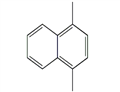
- Naphthalene,1,4-dimethyl-
-
-
2021-01-28
- CAS:571-58-4
- Min. Order: 25Kg/Drum
- Purity: 99%min
- Supply Ability: 10000 Kilogram/Kilograms per Day
|
| | 1,4-Dimethylnaphthalene Basic information |
| | 1,4-Dimethylnaphthalene Chemical Properties |
| Melting point | -18 °C (lit.) | | Boiling point | 262-264 °C/751 mmHg (lit.) | | density | 1.016 g/mL at 25 °C (lit.) | | refractive index | n20/D 1.613(lit.) | | Fp | >230 °F | | storage temp. | 2-8°C | | form | liquid | | color | Colorless to Light yellow to Light orange | | Water Solubility | 9.634mg/L(25 ºC) | | BRN | 2039842 | | Henry's Law Constant | 2.6×10⁻² mol/(m3Pa) at 25℃, Duchowicz et al. (2020) | | InChI | InChI=1S/C12H12/c1-9-7-8-10(2)12-6-4-3-5-11(9)12/h3-8H,1-2H3 | | InChIKey | APQSQLNWAIULLK-UHFFFAOYSA-N | | SMILES | C1(C)=C2C(C=CC=C2)=C(C)C=C1 | | LogP | 4.370 | | CAS DataBase Reference | 571-58-4(CAS DataBase Reference) | | EPA Substance Registry System | 1,4-Dimethylnaphthalene (571-58-4) |
| Safety Statements | 23-24/25 | | WGK Germany | 3 | | RTECS | QJ4440000 | | HS Code | 2902.90.9000 | | Storage Class | 10 - Combustible liquids | | Hazard Classifications | Acute Tox. 4 Oral
Aquatic Acute 1
Aquatic Chronic 3
Asp. Tox. 1
Eye Irrit. 2 |
| | 1,4-Dimethylnaphthalene Usage And Synthesis |
| Description | 1,4-dimethylnaphthalene is a growth inhibitor used on potatoes. It has a very low aqueous solubility and is highly volatile. | | Uses | 1,4-Dimethylnaphthalene is a polycyclic aromatic hydrocarbon (PAH) that has been found in dust particulate matter and is associated with activation of aryl hydrocarbon receptor as a major toxic mode of action in WB-F344 cell line. 1,4-Dimethylnaphthalene has been found to retard the development of epidermoid carcinomas in hamster buccal pouch. 1,4-Dimethylnaphthalene alters the genes associated with the maintenance of a G1/S phase block possibly through the induction of the cell cycle inhibitors KRP1 and KRP2 in potatoes. | | Production Methods | The commercial production of 1,4-dimethylnaphthalene typically involves a multi-step chemical process. One industrial method begins with the cyclization of 5-phenyl-2-hexene in the presence of acid catalysts to form crude 1,4-dimethyl-1,2,3,4-tetrahydronaphthalene. This intermediate is then subjected to dehydrogenation to yield crude 1,4-dimethylnaphthalene, which is subsequently purified through distillation to remove isomeric impurities like 1,3-dimethylnaphthalene. An alternative synthesis route uses 1,4-dichloronaphthalene and a methyl Grignard reagent in the presence of a nickel-phosphine catalyst, followed by distillation and solvent recovery, achieving high conversion efficiency and selectivity. Extraction from potato skins is also possible and has been explored as a more natural alternative for use as a sprout suppressant in stored potatoes. | | Definition | ChEBI: A dimethylnaphthalene carrying methyl groups at positions 1 and 4. | | Synthesis Reference(s) | The Journal of Organic Chemistry, 46, p. 1251, 1981 DOI: 10.1021/jo00320a005 | | Mechanism of action | Inhibits potato sprouting by mimicking natural plant hormones | | Pesticide Type | Plant Growth Regulator |
| | 1,4-Dimethylnaphthalene Preparation Products And Raw materials |
|