- 2,2,3-TRIMETHYLBUTANE
-

-
2019-12-25
- CAS:464-06-2
- Min. Order: 1KG
- Purity: 95%-99%
- Supply Ability: 1kg; 100kg; 1000kg
|
| | 2,2,3-Trimethylbutane Basic information |
| Product Name: | 2,2,3-Trimethylbutane | | Synonyms: | 2,3,3-TRIMETHYLBUTANE;PENTAMETHYLETHANE;TRIPTANE;2,2,3-trimethyl-butan;butane,2,2,3-trimethyl-;isopropyltrimethylmethane;trimethylbutane(non-specificname);Triptan | | CAS: | 464-06-2 | | MF: | C7H16 | | MW: | 100.2 | | EINECS: | 207-346-3 | | Product Categories: | | | Mol File: | 464-06-2.mol | 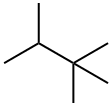 |
| | 2,2,3-Trimethylbutane Chemical Properties |
| Melting point | −25 °C(lit.) | | Boiling point | 80.9 °C(lit.) | | density | 0.69 g/mL at 25 °C(lit.) | | vapor pressure | 3.37 psi ( 37.7 °C) | | refractive index | n20/D 1.389(lit.) | | Fp | 20 °F | | form | Liquid | | color | Clear colorless | | explosive limit | ~7% | | Water Solubility | 4.38mg/L at 25℃ | | Thermal Conductivity | 0.124 W/(m·K) at 25 ℃ | | Specific Heat Capacity | Cp(liquid): 2.13 J/(g·K), at 25℃ | | BRN | 1730756 | | Henry's Law Constant | 3.2×10⁻⁶ mol/(m3Pa) at 25℃, Mackay et al. (2006) | | Exposure limits | TLV-TWA: 200 ppm; TLV-STEL: 400 ppm | | Dielectric constant | 1.9(20℃) | | InChI | 1S/C7H16/c1-6(2)7(3,4)5/h6H,1-5H3 | | InChIKey | ZISSAWUMDACLOM-UHFFFAOYSA-N | | SMILES | CC(C)C(C)(C)C | | LogP | 3.59 | | CAS DataBase Reference | 464-06-2(CAS DataBase Reference) | | EPA Substance Registry System | 2,2,3-Trimethylbutane (464-06-2) |
| Hazard Codes | F,Xn,N | | Risk Statements | 11-38-50/53-65-67 | | Safety Statements | 9-16-29-33-60-61-62 | | RIDADR | UN 1206 3/PG 2 | | WGK Germany | 1 | | Autoignition Temperature | 842 °F | | TSCA | TSCA listed | | HazardClass | 3.1 | | PackingGroup | II | | HS Code | 29011000 | | Storage Class | 3 - Flammable liquids | | Hazard Classifications | Aquatic Acute 1
Aquatic Chronic 1
Asp. Tox. 1
Flam. Liq. 2
Skin Irrit. 2
STOT SE 3 |
| | 2,2,3-Trimethylbutane Usage And Synthesis |
| Description | 2,2,3-Trimethylbutane (i.e., triptane) is a potential gasoline octane booster with a research octane number (RON) of 112. it is also used as a fuel additive and in comparative rate of thermal decomposition (CRTD) single-pulse surge tube studies[1-2]. | | Chemical Properties | Colorless liquid. Soluble in alcohol;
insoluble in water. | | Uses | Organic synthesis, aviation fuel. | | Preparation | 2,2,3-Trimethylbutane (triptane) selectively forms from dimethyl ether at low temperatures on acid zeolites[3].
We report herein the first selective catalytic conversion of DME to
triptane on halide-free catalysts,
specifically on crystalline solid
acids, at much lower reaction temperatures (453–493 K) and higher
DME pressures (60–250 kPa) than
in established methanol/DME to
hydrocarbon processes. Low temperatures avoid intervening skeletal
isomerization and b-scission of triptyl chains or their precursors. These
processes would otherwise occur
before the methylation events that
form the C7 chains containing the
triptane backbone, which desorb irreversibly as triptane.
 | | Synthesis Reference(s) | Tetrahedron Letters, 21, p. 3151, 1980 DOI: 10.1016/S0040-4039(00)77432-6 | | Hazard | Flammable, moderate fire risk. | | References | [1] NOUR ATEF. Chemical kinetic study of triptane (2,2,3-trimethylbutane) as an anti-knock additive[J]. Combustion and Flame, 2019. DOI:10.1016/j.combustflame.2019.09.006.
[2] TSANG W. Comparative rate single-pulse shock tube studies on the thermal decomposition of cyclohexene, 2,2,3-trimethylbutane, isopropyl bromide, and ethylcyclobutane[J]. International Journal of Chemical Kinetics, 1970. DOI:10.1002/kin.550020406.
[3] JOHNH. AHN; Enrique I Prof; Burcin Temel Dr. Selective Homologation Routes to 2,2,3-Trimethylbutane on Solid Acids[J]. Angewandte Chemie International Edition, 2009. DOI:10.1002/anie.200900541.
|
| | 2,2,3-Trimethylbutane Preparation Products And Raw materials |
|