- Vinylene carbonate
-
- $1.00
-
2026-09-12
- CAS:872-36-6
- Min. Order: 1kg
- Purity: 99%
- Supply Ability: 10000kg
- Vinylene carbonate
-

-
2026-08-25
- CAS:872-36-6
- Min. Order: 1kg
- Purity: 99.99%
- Supply Ability: 2o tons
- Vinylene carbonate
-

- $212.00
-
2026-08-12
- CAS:872-36-6
- Min. Order: 1KG
- Purity: 98%
- Supply Ability: 1-10mt
|
| | Vinylene carbonate Basic information |
| Product Name: | Vinylene carbonate | | Synonyms: | Vinylene carbonate, 97+%, stab. with BHT;Vinylene carbonate contains <=2% BHT as stabilizer, 97%;The ethylene carbonate;Vinylene carbonate contains 80 ppm BHT as stabilizer, 99%;WITH HYDROQUINONE;Vinylene carbonate 99.5%, acid <200 ppm, H2O <100 ppm;Vinylene carbonate, 97%, stabilized;Vinylene carbote | | CAS: | 872-36-6 | | MF: | C3H2O3 | | MW: | 86.05 | | EINECS: | 212-825-5 | | Product Categories: | Fine Chemical;fine chemicals;Other | | Mol File: | 872-36-6.mol | 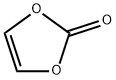 |
| | Vinylene carbonate Chemical Properties |
| Melting point | 19-22 °C(lit.) | | Boiling point | 162 °C(lit.) | | density | 1.360 g/mL at 20 °C | | vapor pressure | 3.35hPa at 25℃ | | refractive index | n20/D 1.421(lit.) | | Fp | 163 °F | | storage temp. | 2-8°C | | solubility | 11.5 g/100 mL | | form | Liquid | | Specific Gravity | 1.355 | | color | Colorless to pale yellow | | Water Solubility | 11.5 g/100 mL | | Sensitive | Moisture Sensitive | | BRN | 105683 | | InChI | 1S/C3H2O3/c4-3-5-1-2-6-3/h1-2H | | InChIKey | VAYTZRYEBVHVLE-UHFFFAOYSA-N | | SMILES | O=C1OC=CO1 | | LogP | -0.36 at 20℃ | | CAS DataBase Reference | 872-36-6(CAS DataBase Reference) | | NIST Chemistry Reference | 1,3-Dioxol-2-one(872-36-6) | | EPA Substance Registry System | 1,3-Dioxol-2-one (872-36-6) |
| Hazard Codes | Xi,N,T | | Risk Statements | 43-36-51/53-48/22-41-38-24-22 | | Safety Statements | 37/39-26-24-61-45-36/37/39 | | RIDADR | UN2810 - class 6.1 - PG 3 - EHS - Toxic, liquids, organic, n.o.s., HI: all | | WGK Germany | 3 | | RTECS | FG3325000 | | TSCA | TSCA listed | | HazardClass | 6.1 | | HS Code | 29209090 | | Storage Class | 6.1C - Combustible acute toxic Cat.3
toxic compounds or compounds which causing chronic effects | | Hazard Classifications | Acute Tox. 3 Dermal
Acute Tox. 4 Oral
Aquatic Chronic 2
Eye Dam. 1
Skin Irrit. 2
Skin Sens. 1
STOT RE 2 Oral |
| | Vinylene carbonate Usage And Synthesis |
| Chemical Properties | clear colorless to light yellow liquid | | Uses | Vinylene carbonate is used as an additive to electrolyte solutions for anode side Lithiumion batteries. It also acts as a sealant to seal at least a portion of the silicon-polyvinyl acid interface. It is further used for great improvement of high temperature performance of the battery. | | Application | Vinylene carbonate (VC) can be used as an electrolytic additive for ionic liquid electrolyte for the formation of lithium-ion batteries. It can also be used in the formation of hybrid solid electrolyte interphase (SEI) for the fabrication of lithium-based batteries. | | Preparation | Vinylene carbonate is produced by the known method by eliminating hydrogen chloride from chloroethylene glycol carbonate by means of tertiary amines, in particular triethylamine. Chloroethylene glycol carbonate is obtained by free radical chlorination of ethylene glycol carbonate by means of chlorine or sulphuryl chloride. This synthesis was published for the first time in 1953 by Newman and Addor (JACS, 1953, page 1263; JACS 1955, page 3789). | | General Description | This product has been enhanced for energy efficiency. Carbonate building block offered as a solution in ethyl acetate for more convenient handling. Vinylene carbonate may also be used as a dienophile in Diels-Alder reactions. | | Flammability and Explosibility | Non flammable | | Synthesis | General procedure for the synthesis of vinylidene carbonate from chlorinated ethylene carbonate (CEC): 61.3 kg (500 mmol) of chlorinated ethylene carbonate, 151 kg (1500 mmol) of triethylamine, 120 kg of ethyl acetate, and 61.3 g of p-tert-butyl catechol were added to a mixer and stirred until completely dissolved. The mixed solution was injected into a horizontal tubular reactor at a flow rate of 0.05 m/s, and the reaction temperature was controlled at 25-30 °C for 100 min. After completion of the reaction, the solid triethylamine hydrochloride was removed by filtration. The filtrate was washed with 30% sodium hydroxide solution and then indirectly heated by steam (0.25 MPa), and the evaporated triethylamine was recovered by a condenser. The treated filtrate was added to the coolant of the dechlorination section and distilled under reduced pressure to recover ethyl acetate. Subsequently, distillation was carried out with a controlled pressure of 0.098 MPa and the fractions at 160-165 °C were collected to give vinylidene carbonate in 96.5% yield and 99.5% GC purity. | | Purification Methods | Purify it by zone melting, or distillation, and stabilize it with 0.5% of 2,6-di-tert-butyl-p-cresol. [Beilstein 19 III/IV 1597, 19/4 V 72.] | | Toxics Screening Level | The initial threshold screening level (ITSL) for vinylene carbonate (CAS # 872-36-6) is 0.1 μg/m3 based on an annual averaging time. | | References | [1] Patent: CN104844556, 2017, B. Location in patent: Paragraph 0029; 0030
[2] Patent: CN106699720, 2017, A. Location in patent: Paragraph 0017
[3] Patent: CN106632225, 2017, A. Location in patent: Paragraph 0017; 0018; 0019; 0020; 0021
[4] Patent: US2009/176997, 2009, A1. Location in patent: Page/Page column 2-3
[5] Patent: WO2006/119911, 2006, A1. Location in patent: Page/Page column 4 |
| | Vinylene carbonate Preparation Products And Raw materials |
|