Aldehyde Reactive Probe (trifluoroacetate salt) manufacturers
|
| | Aldehyde Reactive Probe (trifluoroacetate salt) Basic information |
| Product Name: | Aldehyde Reactive Probe (trifluoroacetate salt) | | Synonyms: | Aldehyde Reactive Probe (trifluoroacetate salt);ARP [N-(AMinooxyacetyl)-N'-(D-biotinoyl) hydrazine, trifluoroacetic acid salt];YJYRTJQOEOYKFD-AEXHUXLESA-N;Aldehyde Reactive Probe;Aldehyde Reactive Probe TFA | | CAS: | 627090-10-2 | | MF: | C14H22F3N5O6S | | MW: | 445.41 | | EINECS: | | | Product Categories: | | | Mol File: | 627090-10-2.mol | 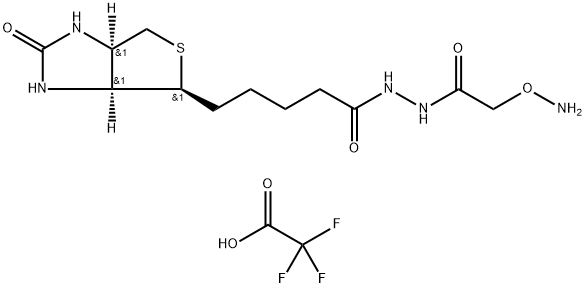 |
| | Aldehyde Reactive Probe (trifluoroacetate salt) Chemical Properties |
| storage temp. | Store at -20°C | | solubility | DMF: 20 mg/ml; DMSO: 15 mg/ml; PBS (pH 7.2): 3 mg/ml | | form | A crystalline solid |
| | Aldehyde Reactive Probe (trifluoroacetate salt) Usage And Synthesis |
| Description | DNA is continually damaged by endogenous and environmental agents leading to the formation of abasic (apurinic/apyrimidinic, AP) sites that are disruptive to DNA synthesis. Aldehyde Reactive Probe (ARP) is a biotinylated reagent for the detection and quantification of AP sites in damaged DNA. ARP reacts with aldehyde groups formed when reactive oxygen species depurinate DNA, resulting in covalent linkage of biotin to these AP sites. The biotin-tagged DNA can then be detected using common avidin-conjugated reporters such as avidin-HRP. The ARP method is highly sensitive, enabling detection of 2.4 AP sites per 1x10⁷ nucleotides of DNA. | | Uses | Aldehyde reactive probe (TFA) is a biotinylated reagent for the detection and quantification of AP sites in damaged DNA[1]. | | References | [1] Ayumi Asaeda, et al. Highly sensitive assay of DNA abasic sites in mammalian cells-optimization of the aldehyde reactive probe method. Analytica Chimica Acta 365 (1998) 35-41. |
| | Aldehyde Reactive Probe (trifluoroacetate salt) Preparation Products And Raw materials |
|