


NCl3 Resonance Structures and Lewis StructureExplained Step-by-Step
May 29,2026
Benzene is a colorless, volatile, highly flammable liquid that is a useful solvent used extensively in the chemical industry.
Resonance structures

Benzene, C6H6, has two equally valid Lewis structures. Both have three C-C and three C=C, with all C and H atoms neutral and where each C is attached to one H and two C atoms.
The difference is which C atoms are attached by C-C and C=C (to help understand this, try numbering the C atoms 1 to 6, starting with number 1 at the top and going around to the right). These Lewis structures (the resonance contributors) each show single bonds and double bonds which would imply that there should be two difference bond lengths present in a molecule of benzene. However, that is not the case. The experimentally measured values show that there is one bond length of about 139 pm.
Step-by-Step Drawing the lewis structure of C6H6

Step 1: Calculate the total number of valence electrons
Each carbon atom contributes 4 valence electrons, and each hydrogen atom contributes 1, giving a total of 6 x 4 + 6 x 1 = 30 valence electrons.
Step 2: Determine the central atom
Carbon (C) is the central atom in benzene because it is the primary element in the molecule.
Step 3: Draw covalent bonds (shared electrons)
Connect each carbon atom to the next with a single bond (line) and distribute the remaining electrons as lone pairs around each carbon atom. Each hydrogen atom will be attached to a carbon atom with a single bond.
Step 4: Assign lone pairs of electrons (satisfying the octet rule)
Ensure each carbon atom has 8 electrons (2 lone pairs and 2 bonding pairs), and each hydrogen atom has 2 electrons (1 lone pair and 1 bonding pair).
Step 5: Check stability
Formal charges may not be necessary as all atoms have achieved the octet rule. However, the alternating single and double bonds in benzene result in resonance structures, indicating delocalized π electrons.
- Related articles
- Related Qustion
- Where Can We Find Benzene in Everyday Life? Mar 12, 2024
Benzene is an organic compound finds widespread application in both industrial and everyday settings.This article will introduce its existence in daily life, which may surprise you.
- Polarity of Benzene Dec 22, 2023
Benzene is a liquid hydrocarbon molecule. A benzene ring, which is made up of six carbon atoms bound together in a hexagonal configuration with alternate single and double bonds, is present in benzene since it is an aromatic molecule.
- Benzene——Environmental Fate Nov 19, 2021
Benzene is a clear, colorless, highly flammable and volatile, liquid aromatic hydrocarbon with a gasoline-like odor. Benzene is found in crude oils and as a by-product of oil-refining processes. In industry benzene is used as a solvent, as

Copper(I) cyanide is primarily used as a basic raw material in fine chemical production. It can be used in electroplating of copper and its alloys.....
Jul 22,2026API
The Lewis structure of tellurium tetrachloride (TeCl4) exhibits bonding characteristics with accessible d orbitals.....
May 29,2026Inorganic chemistry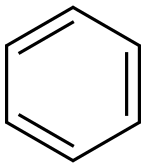
Benzene
71-43-2You may like
- Electrochemical Reduction of 1-Bromo-4-nitrobenzene
Aug 15, 2026
- What are the hazards of Isopropylamine?
Aug 10, 2026
- How to draw lewis structure for CCl3?
Jul 28, 2026
- Benzene; Benzol
-

- 2026-08-18
- CAS:71-43-2
- Min. Order: 1000kg
- Purity: ≥99.9%
- Supply Ability: 100 tons
- Benzene
-
- $100.00
- 2026-08-17
- CAS:71-43-2
- Min. Order: 1KG
- Purity: 99%
- Benzene
-

- $1.00
- 2026-07-26
- CAS:71-43-2
- Min. Order: 1g
- Purity: 99
- Supply Ability: 20tons