


Study on Alpha-Angelica Lactone
Aug 20,2026
Alpha-Angelica lactone is a pale yellow, oily, liquid lactone compound with a caramel- and vanilla-like aroma. It is slightly soluble in water and readily soluble in organic solvents such as alcohols and ethers. Its molecular structure contains an unsaturated lactone ring, enabling it to undergo chemical reactions such as hydrolysis, addition reactions, and ring-opening polymerization. This substance is commonly used as a food flavoring agent in the formulation of baking and confectionery flavorings. It also serves as an important organic synthesis building block for the preparation of pharmaceuticals and fine chemicals.

Photoionization Oxidation of Alpha-Angelica lactone
Angelica lactones (α, β, and γ angelica lactone) are classified as butenolides, which are lactones with four carbon atoms in their heterocyclic structure. These five-membered heterocycles are essential synthons that are found in several natural products, specifically, in compounds with biological activities. Alpha-angelica lactone (Tb = 167–170 °C) and beta-angelica lactone (Tb = 208–209 °C) are volatile species. Alpha-Angelica lactone (AAL) has an odor similar to that of coconut, chocolate, or vanilla and it is traditionally used in perfumes. In the past, an angelica root extract containing angelica lactones has been used as a tobacco additive, imparting a smoothing, caramel smoke taste. AAL has been found in Angelica genus plants, raisins, white bread, soybeans, and licorice. Recently, alpha-Angelica lactone was defined as a new platform molecule, which can be created from the lignocellulosic material levulinic acid (LA) with a 95% yield, making its synthesis easily achievable. This investigation is focused on the characterization of alpha-Angelica lactone oxidation initial steps at 298, 550, and 700 K initiated by O(3P), using synchrotron photoionization multiplexed mass spectrometry. This low-temperature region is particularly important for understanding and predicting the autoignition behavior of fuels, which is relevant in new advanced engines, based, for instance on HCCI (homogeneous-charge compression ignition). The primary products were identified through their photoionization spectra, and their formation was explained via computation of the potential energy surface using the CBS–QB3 composite model.[1]
The oxidation of alpha-Angelica lactone initiated by O(3P) was studied at 298, 550, and 700 K. This reaction was carried out at the Lawrence Berkeley National Laboratory using synchrotron radiation coupled with a multiplex photoionization mass spectrometer. The primary products were characterized by mass-to-charge ratios, adiabatic ionization energies, and photoionization spectra. The only observed pathway was the O(3P) addition to the unsaturated carbons. The hydrogen abstraction pathway by atomic oxygen was not kinetically favorable because it proceeds through a high energy barrier. The O(3P) addition pathway started with the formation of two triplet diradicals (C and D), which underwent intersystem crossing to form the singlet epoxide (E). The reaction pathways were computed using the CBS–QB3 composite model. Four products were generated by unimolecular dissociation of epoxide E, ketene, acetaldehyde, methyl vinyl ketone, and methylglyoxal. Two products formed directly from the diradical D via intersystem crossing, i.e., dimethyl glyoxal and 5-methyl-2,4-furandione. The branching fraction of each primary product was C atom-balanced, i.e., for our reactant alpha-Angelica lactone, the total branching fractions summed to 500% because of the presence of five carbon atoms. Therefore, each single branching fraction was multiplied by the C atom number present in the specific product and divided by 5 to report the total branching fractions to 100%.
Diastereoselective Organocatalytic Addition of α-Angelica Lactone to β-Halo-α-Ketoesters
Previously, researchers have developed a number of methods for their synthesis,2 as well as their application in complexity-building transformations encompassing a variety of reaction manifolds (i.e., transfer hydrogenation, Henry reaction, acetone aldol, benzoin addition, and homoenolate addition). While these methods have provided access to a wide array of fully substituted glycolic acid scaffolds, there are few examples of the addition of prochiral nucleophiles. The application of alpha-Angelica lactone as a nucleophile presents an interesting opportunity to build more stereochemically complex products. Unlike previously deployed pro-nucleophiles, α-angelica lactone poses additional challenges with respect to (1) reactivity due to the imposition of increased steric bulk; (2) regioselectivity (α- vs γ-nucleophilicity of the dienolate); and (3) stereoselectivity (eight stereoisomers are possible in the α-addition mode). This class of nucleophile has been studied in the stereoselective addition to nitrostyrenes and other prochiral electrophiles using cinchona alkaloid-derived thiourea organocatalysts. Other additions to nitrostyrenes, aldimines, enones, enals, and vinyl sulfones have also been studied. In all of these cases, the α-angelica lactone exhibited electrophilic trapping at the γ-carbon. A rare example from Boukouvalas achieved α-trapping with alpha-Angelica lactone via in situ generation of tin or boron dienolates for addition into aldehydes. Herein, we describe initial studies toward the creation of complex stereotriads in the form of a quinidine-catalyzed diastereoselective aldol addition of α-angelica lactone to β-halo-α-ketoesters. The alpha-Angelica lactone displays unusual regioselectivity in this reaction, acting as a nucleophile at the α-position to provide fully substituted glycolic esters with three contiguous stereocenters. Subsequent diastereoselective hydrogenation provides an additional stereocenter within the lactone.[2]
References
[1]Rezaei G, Meloni G. Study of the Synchrotron Photoionization Oxidation of Alpha-Angelica Lactone (AAL) Initiated by O(3P) at 298, 550, and 700 K. Molecules. 2021 Jul 3;26(13):4070. doi: 10.3390/molecules26134070. PMID: 34279410; PMCID: PMC8271512.
[2]Griswold JA, Horwitz MA, Leiva LV, Johnson JS. Diastereoselective Organocatalytic Addition of α-Angelica Lactone to β-Halo-α-ketoesters. J Org Chem. 2017 Feb 17;82(4):2276-2280. doi: 10.1021/acs.joc.6b03059. Epub 2017 Feb 6. Erratum in: J Org Chem. 2017 Apr 7;82(7):4006. doi: 10.1021/acs.joc.7b00533. Erratum in: J Org Chem. 2017 Jun 2;82(11):5995. doi: 10.1021/acs.joc.7b01160. PMID: 28164699; PMCID: PMC5324730.
- Related articles
- Related Qustion

Phthalonitrile is a crystalline intermediate with two cyano groups for cyclization polymerization, widely used for phthalocyanine dyes and high?performance polymers.....
Aug 20,2026Chemical Reagents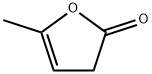
alpha-Angelica lactone
591-12-8You may like
- Electronic & Atmospheric Study of Isobutyl Formate
Aug 20, 2026
- Application Research of Sucrose Palmitate
Aug 20, 2026
- What are the side effects of aluminum hydroxide?
Aug 18, 2026
alpha-Angelica lactone manufacturers
- α-Angelica lactone
-

- $29.00
- 2026-07-27
- CAS:591-12-8
- Purity: 99.79%
- Supply Ability: 10g
- alpha-Angelica lactone
-
- $5.00
- 2026-05-28
- CAS:591-12-8
- Min. Order: 1KG
- Purity: 99%
- Supply Ability: 10000kg
- alpha-Angelica lactone
-
- $1.00
- 2026-03-20
- CAS:591-12-8
- Min. Order: 1kg
- Purity: 99%
- Supply Ability: 10 mt