


Ethanone, 1-[3-(dimethylamino)phenyl]-2,2,2-trifluoro- (9CI) synthesis
- Product Name:Ethanone, 1-[3-(dimethylamino)phenyl]-2,2,2-trifluoro- (9CI)
- CAS Number:33284-23-0
- Molecular formula:C10H10F3NO
- Molecular Weight:217.19

16518-62-0
172 suppliers
$12.00/1g

104863-67-4
141 suppliers
$5.00/250mg
33284-23-0
23 suppliers
inquiry
Yield:33284-23-0 79%
Reaction Conditions:
Stage #1: 3-bromo-N,N-dimethylanilinewith n-butyllithium in tetrahydrofuran;hexane at -90; for 0.583333 h;Inert atmosphere;
Stage #2: N-methoxy-N-methyltrifluoroacetamide in tetrahydrofuran;hexane at -90 - 20;Inert atmosphere;
Steps:
3 5.3 Synthesis of 2,2,2-trifluoro-1-(3-dimethylaminophenyl)ethanone (1)
It was prepared as outlined in Scheme 1 In an oven-dried 50 mL round bottom flask under an atmosphere of anhydrous argon, THF (10 mL) was added followed by 3-bromo-N,N-dimethylaniline (5.00 mmol, 1.00 g). This clear, colourless solution was cooled to -90 °C using a Juablo cooler with a cold finger and an isopropanol bath in an appropriate sized Dewar. The aniline reagent solution was stirred at this temperature for 15 min to ensure the solution was sufficiently cold. Butyl lithium (3.44 mL, 1.60 M in hexanes) was added dropwise at -90 °C over 20 min. The resulting clear light yellow solution was stirred for 15 min at -90 °C. To this 3-lithium N,N-dimethylaniline intermediate was added N-methoxy-N-methyl-2,2,2-trifluoroacetamide (5.50 mmol, 0.857 g) dissolved in anhydrous THF (4 mL), dropwise over 15 min. The resulting solution was stirred at -90 °C for 30 min then warmed to room temperature by removing the reaction flask from the cooling bath. The resulting reaction mixture was stirred for 16 h at room temperature then extracted with 1 M HCl (3 * 10 mL). The combined aqueous layers were added to a separatory funnel and solid NaHCO3 was added until the solution stopped bubbling. During this addition a yellow liquid formed on the top of the aqueous layer. The aqueous layer was extracted with diethyl ether (3 * 15 mL). The combined organic layers were dried over Na2SO4, gravity filtered and concentrated in vacuo. The crude viscous yellow liquid was purified by flash chromatography on silica gel (5% ethyl acetate/94% hexanes/1% triethylamine, Rf: 0.38) to afford the desired product as a clear yellow liquid (0.854 g, 79%): 1HNMR (CDCl3): d 3.02 (s, 6H), 7.02-7.05 (m, 1H), 7.36-7.38 (m,3H) (Supplementary Fig. S1). 13C NMR (CDCl3): d 40.0, 112.3,116.8 (q, JC,F = 298.2 Hz), 117.9, 119.1, 129.5, 130.4, 150.5, 181.0(q, JC,F = 34.3 Hz) (Supplementary Fig. S2). IR (Neat): 2898 (m),2814 (w), 1709 (s), 1600 (s), 1573 (s), 1503 (s), 1437 (m), 1363(m), 1105 (s), 1007 (s) cm1 (Supplementary Fig. S3). LRMS m/z: 218 (M+1, 11), 217 (M+, 100), 216 (74), 148 (24), 120 (24), 119(13), 118 (10), 104 (10), 77 (11), 74 (13) (Supplementary Fig. S4). HRMS (ESI): MH+ found 218.0786, calculated for C10H11F3-NO+ = 218.0787(Supplementary Fig. S5). HPLC: retention time 2.59 min; purity 96.1% (Supplementary Fig. S6).
References:
Jollymore-Hughes, Courtney T.;Pottie, Ian R.;Martin, Earl;Rosenberry, Terrone L.;Darvesh, Sultan [Bioorganic and Medicinal Chemistry,2016,vol. 24,# 21,p. 5270 - 5279]

75-46-7
0 suppliers
$150.00/50g

16518-64-2
58 suppliers
$45.00/100mg
33284-23-0
23 suppliers
inquiry

591-19-5
306 suppliers
$10.00/10g
33284-23-0
23 suppliers
inquiry
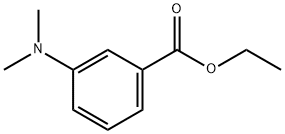

383-63-1
465 suppliers
$10.00/25g
16518-62-0
172 suppliers
$12.00/1g
33284-23-0
23 suppliers
inquiry