


Mepanipyrim
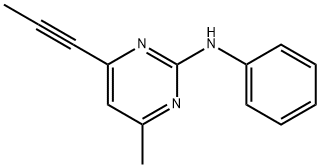
- CAS No.
- 110235-47-7
- Chemical Name:
- Mepanipyrim
- Synonyms
- FRUPICA;Mepanioyrim;mepanipyrin;Mepanipyrim;Mepanipyrim 50;Mepanipyrim-D5;Mepanipyrim [iso];MEPANIPYRIM STANDARD;Mepanipyrim in Acetonitrile;Mepanipyrim@100 μg/mL in AcCN
- CBNumber:
- CB3230301
- Molecular Formula:
- C14H13N3
- Molecular Weight:
- 223.27
- MDL Number:
- MFCD01656050
- MOL File:
- 110235-47-7.mol
- MSDS File:
- SDS
- TDS File:
- TDS
| Melting point | 125-126° (Maeno); also reported as 132.8° (Hayashi) |
|---|---|
| Boiling point | 418.2±47.0 °C(Predicted) |
| Density | 1.16±0.1 g/cm3(Predicted) |
| vapor pressure | 2.32 x l0-5 Pa (20 °C) |
| Flash point | 131 °C |
| storage temp. | 0-6°C |
| solubility | Chloroform (Slightly), Methanol (Slightly) |
| pka | 4.5 (est. base) |
| Water Solubility | 3.1 mg l-1(20 °C) |
| color | White to Off-White |
| Henry's Law Constant | 6.0×10² mol/(m3Pa) at 25℃, Maniere et al. (2011) |
| Major Application |
agriculture environmental |
| InChI | 1S/C14H13N3/c1-3-7-13-10-11(2)15-14(17-13)16-12-8-5-4-6-9-12/h4-6,8-10H,1-2H3,(H,15,16,17) |
| InChIKey | CIFWZNRJIBNXRE-UHFFFAOYSA-N |
| SMILES | CC#Cc1cc(C)nc(Nc2ccccc2)n1 |
| LogP | 3.280 |
| EWG's Food Scores | 2 |
| FDA UNII | B150X76OJY |
| Proposition 65 List | Mepanipyrim |
| Pesticides Freedom of Information Act (FOIA) | Mepanipyrim |
| EPA Substance Registry System | Mepanipyrim (110235-47-7) |
| UNSPSC Code | 41116107 |
| NACRES | NA.24 |
SAFETY
Risk and Safety Statements
| Symbol(GHS) |   GHS08,GHS09 |
|---|---|
| Signal word | Warning |
| Hazard statements | H351-H410 |
| Precautionary statements | P202-P273-P280-P308+P313-P391-P405 |
| PPE | Eyeshields, Faceshields, Gloves |
| Hazard Codes | N,Xn |
| Risk Statements | 51/53-50/53-40 |
| Safety Statements | 60-61-46-36/37 |
| RIDADR | UN3077 9/PG 3 |
| WGK Germany | 2 |
| RTECS | UV6261540 |
| Storage Class | 11 - Combustible Solids |
| Hazard Classifications | Aquatic Acute 1 Aquatic Chronic 1 Carc. 2 |
| Toxicity | LD50 in mice, rats, bobwhite, mallard (mg/kg): >5000, >5000, >2250, >2250 orally; in rats (mg/kg): >2000 dermally; LC50 in bluegill, rainbow trout (mg/l): 3.8, 3.1 (Maeno) |
| REACH Registrations | Inactive |
Mepanipyrim price More Price(11)
| Manufacturer | Product number | Product description | CAS number | Packaging | Price | Updated | Buy |
|---|---|---|---|---|---|---|---|
| Sigma-Aldrich | 36108 | Mepanipyrim certified reference material, TraceCERT®, Manufactured by: Sigma-Aldrich Production GmbH, Switzerland | 110235-47-7 | 50 mg | $205 | 2026-04-30 | Buy |
| Sigma-Aldrich | 33970 | Mepanipyrim PESTANAL | 110235-47-7 | 50mg | $154 | 2026-04-30 | Buy |
| TRC | TRC-M223600-50MG | Mepanipyrim | 110235-47-7 | 50mg | $511 | 2026-06-03 | Buy |
| Usbiological | 164849 | Mepanipyrim | 110235-47-7 | 100mg | $509 | 2026-06-03 | Buy |
| TRC | TRC-M223600-100MG | Mepanipyrim | 110235-47-7 | 100mg | $829 | 2026-06-03 | Buy |
Mepanipyrim Chemical Properties, Uses, Production
Chemical Properties
Light yellow crystalline powder, melting point 125~126℃, vapor pressure 1.33mPa at 20℃, solubility 5.58mg/L in water at 20℃, soluble in most organic solvents. kow2600. stable at pH4~θ. Toxicity: Acute oral LD50>5000mg/kg for rat and mouse, acute percutaneous LD50>2000mg/kg for rat, no irritation to rabbit's skin and eyes, no sensitization to guinea pig's skin, no mutagenicity in Ames test. Acute oral LD50>2250mg/kg in quail and duck, LC50 >3.8mg/L in bluegill, LC503.1mg/L in rainbow trout.
Uses
Mepanipyrim is a non-systemic fungicide that provides preventative control of diseases in pome fruits (scab), vines, strawberries, tomatoes and cucumbers (grey mould) and peaches (brown rots) caused by Botrytis cinerea, Venturia inaequaris and Monilinia fructicola.
Uses
Mepanipyrim is an anilinopyrimidine fungicide which have been used in the management of fungal diseases in strawberries.
Uses
Agricultural fungicide.
Definition
ChEBI: A member of the class of aminopyrimidines that is N-phenylpyrimidin-2-amine carrying additional methyl and 1-propynyl substituents at positions 4 and 6 respectively. A fungicide used to control a wide range of diseases including grey mou d on strawberries, tomatoes and cucumabers, and scab on apples and pears.
Production Methods
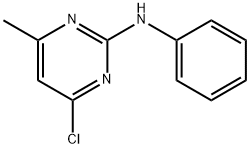
The industrial production of mepanipyrim begins with the synthesis of a substituted pyrimidine core, typically derived from 2-amino-4,6-dimethylpyrimidine. This intermediate undergoes acylation with 4-methylbenzoyl chloride to form a key amide linkage. The reaction is carried out under controlled conditions using organic solvents like dichloromethane and a base such as triethylamine to neutralize by-products and drive the reaction to completion. The resulting compound, mepanipyrim, is then purified through crystallisation or solvent extraction to ensure high chemical purity.
Mechanism of action
Non-systemic with preventative action. Inhibits protein synthesis.
Metabolic pathway
By tomato seedlings, 14C-mepanipyrim is biotransformed via the pathways including elimination of the phenyl group, hydroxylation of the propynyl moiety, and hydroxylation at the phenyl ring to yield several kinds of metabolite, and 2- and 4-[4-methyl-6- (1-propynyl)pyrimidin-2-ylamino]phenols, 1-(2-anilino-6- methylpyrimidin-4-yl)-2-propanol, and 4-methyl-6-(1- propynyl)pyrimidin-2-ylamine are tentatively identified as major metabolites. In soils under laboratory conditions, 14C-mepanipyrim undergoes degradation to give the degradation products and the main pathway is elimination of the phenyl group.
Degradation
Mepanipyrim (1) is stable to hydrolytic degradation in the pH range 4-9 with a DT50 >1 year. It decomposed rapidly in water when exposed to light (DT50 13 days) (PM).
Pesticide Type
Fungicide; Other susbtance


Mepanipyrim Preparation Products And Raw materials
Raw materials
Preparation Products
| Supplier | Tel | Country | ProdList | Advantage | |
|---|---|---|---|---|---|
| J & K SCIENTIFIC LTD. | 18210857532 18210857532 | jkinfo@jkchemical.com | China | 96815 | 76 |
| Syntechem Co.,Ltd | info@syntechem.com | China | 12973 | 57 | |
| Sichuan Kulinan Technology Co., Ltd | 400-1166-196 18981987031 | cdhxsj@163.com | China | 11674 | 57 |
| Chengdu Ai Keda Chemical Technology Co., Ltd. | 4008-755-333 18080918076 | 800078821@qq.com | China | 9706 | 55 |
| Zhengzhou HSH Science & Technology Co., Ltd. | 0371-55932928 18937192232; | 1282296214@qq.com | China | 497 | 55 |
| Nanjing Sunlida Biological Technology Co., Ltd. | 025-57798810 18652991625 | sales@sunlidabio.com | China | 3223 | 55 |
| Shanghai JONLN Reagent Co., Ltd. | 400-0066400 13621662912 | 422131432@qq.com | China | 9970 | 55 |
| Jiangsu Aikon Biopharmaceutical R&D co.,Ltd. | 025-66028182 17714375163 | yftan@aikonchem.com | China | 16674 | 50 |
| Alta Scientific Co., Ltd. | 022-6537-8550 15522853686 | sales@altasci.com.cn | China | 4508 | 55 |
| Shanghai YuanYe Biotechnology Co., Ltd. | 15026964105 | 2881489226@qq.com | China | 89667 | 60 |
