Benazolin
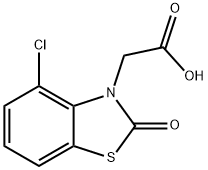
- CAS No.
- 3813-05-6
- Chemical Name:
- Benazolin
- Synonyms
- ben-30;benzar;galtak;leymin;rd7693;tillox;benopan;eunasin;ex10781;galipan
- CBNumber:
- CB4347071
- Molecular Formula:
- C9H6ClNO3S
- Molecular Weight:
- 243.67
- MDL Number:
- MFCD00057102
- MOL File:
- 3813-05-6.mol
- MSDS File:
- SDS
| Product description | Number | Pack Size | Price |
| Benazolin | B119865 | 100mg | $55 |
| BENAZOLIN 95.00% | PST0000012 | 5MG | $502.03 |
| More product size | |||
| Melting point | 192-196°C |
|---|---|
| Boiling point | 468.4±55.0 °C(Predicted) |
| Density | 1.3274 (rough estimate) |
| refractive index | 1.6300 (estimate) |
| Flash point | 100 °C |
| storage temp. | 0-6°C |
| pka | 3.50±0.10(Predicted) |
| color | White, crystalline solid |
| Water Solubility | 0.6g/L(20 ºC) |
| Henry's Law Constant | 4.2×10⁶ mol/(m3Pa) at 25℃, Ebert et al. (2023) |
| InChI | InChI=1S/C9H6ClNO3S/c10-5-2-1-3-6-8(5)11(4-7(12)13)9(14)15-6/h1-3H,4H2,(H,12,13) |
| InChIKey | HYJSGOXICXYZGS-UHFFFAOYSA-N |
| SMILES | S1C2=CC=CC(Cl)=C2N(CC(O)=O)C1=O |
| CAS DataBase Reference | 3813-05-6(CAS DataBase Reference) |
| EWG's Food Scores | 1 |
| FDA UNII | RB02FMB0BR |
| EPA Substance Registry System | Benazolin (3813-05-6) |
SAFETY
Risk and Safety Statements
| Symbol(GHS) |  GHS07 |
|---|---|
| Signal word | Warning |
| Hazard statements | H315-H319-H412 |
| Precautionary statements | P264-P280-P302+P352-P321-P332+P313-P362-P264-P280-P305+P351+P338-P337+P313P-P273-P501 |
| Hazard Codes | Xi;N,N,Xi |
| Risk Statements | 36/38-52/53 |
| Safety Statements | 22-61 |
| RIDADR | UN 3077 |
| RTECS | AF9700000 |
| HS Code | 29342000 |
| Toxicity | LD50 orl-rat: 3000 mg/kg 85ARAE 2,26,77 |
Benazolin price More Price(2)
Benazolin Chemical Properties,Uses,Production
Description
Benazolin is a post-emergence herbicide. It has a moderate aqueous solubility, is semi-volatile with a high potential to leach to groundwater. It is not persistent in soil systems but may possibly be persistent in water. Benazolin has a low mammalian toxicity and is not expected to bioaccumulation. It has a low to moderate toxicity to most aquatic organisms, honeybees and earthworms.
Uses
Benazolin is a selective systemic herbicide developed in the 1960s that has growth-regulatory action in susceptible plants. Structurally, it is a benzothiazolacetic acid and is unrelated to the four major groups of synthetic auxins discussed thus far. Benazolin controls a range of annual broadleaf weeds in alfalfa (Medicago sativa), canola (Brassica spp.), cereals, clover (Trifolium spp.), corn (Zea mays), grassland, and flax (Linum usitatissimum), and it has a relatively low persistence in the environment.
Production Methods
Benazolin is commercially synthesised through a controlled multi-step process that begins with the formation of a benzoxazinone intermediate, which is then reacted with appropriate substituents to introduce herbicidal functionality. A key innovation in the process involves lowering the reaction temperature and adding a catalyst, which significantly reduces the formation of unwanted byproducts and improves safety.
Definition
ChEBI: A member of the class of benzothiazoles that is 4-chloro-1,3-benzothiazol-2(3H)-one which is substituted on the nitrogen by a carboxymethyl group and at position 4 by chlorine. A post-emergence herbicide used (generally as a salt or este ) for the control of annual weeds in wheat and oilseed rape. It is not approved for use with the European Union.
Mechanism of action
Selective, systemic growth-regulation action. It disrupts the normal hormonal balance in susceptible plants by mimicking the action of the natural plant hormone indole-3 acetic acid (IAA). This leads to abnormal growth and eventual death of the plant species.
Safety Profile
Moderately toxic by ingestion. Anherbicide. When heated to decomposition it emits toxicfumes of SOx, Cl-, and NOx.
Metabolism
Because benazolin is not degraded by light and is not readily volatilized, the most important factors affecting its persistence in the environment are microbial breakdown and leaching. However, because the microbial breakdown is so rapid, significant leaching may not occur unless the rainfall within a few days of application is large.
Toxicity evaluation
Benazolin is primarily excreted in the urine as N-[2-chloro-6-(methylsulfinyl)phenyl]glycine and N-[N-[2-chloro-6-(methylthio)phenyl]glycinyl]aniline. Acid-labile conjugates of benazolin acid and N-[2-chloro- 6-(methylthio)phenylglycine] are also formed in small amounts. The acute oral LD50 for rat and mice are >5000 mg/kg and >4000 mg/kg, respectively. See Table 21 for a list of toxicological data for benazolin.
Pesticide Type
Herbicide
Benazolin Preparation Products And Raw materials
Raw materials
1of2
Preparation Products
| Supplier | Tel | Country | ProdList | Advantage | |
|---|---|---|---|---|---|
| Shaanxi Dideu Medichem Co. Ltd | +86-029-81138252 +86-173 9270 1263 | 1057@dideu.com | China | 3955 | 58 |
| CONIER CHEM AND PHARMA LIMITED | sales@conier.com | China | 49906 | 58 | |
| career henan chemical co | +86-0371-86658258 | factory@coreychem.com | China | 29780 | 58 |
| SIMAGCHEM CORP | +86-5922680277 +86-13806087780 | sale@simagchem.com | China | 17339 | 58 |
| Hefei TNJ Chemical Industry Co.,Ltd. | +86-0551-65418671 +86-189 4982 3763 | sales@tnjchem.com | China | 34526 | 58 |
| Henan Alfa Chemical Co., Ltd | +8618339805032 | sale03@alfachem.cn | China | 9817 | 58 |
| LUYUNJIA CHEMISTRY XIAMEN LIMITED | +86-592-5360779 +86-13055435203 | China | 5973 | 58 | |
| Hebei Fengjia New Material Co., Ltd | +86-0311-87836622 +86-18712993135 | sales01@tairunfaz.com | China | 8046 | 58 |
| Hangzhou MolCore BioPharmatech Co.,Ltd. | +86-057181025280; +8617767106207 | sales@molcore.com | China | 49709 | 58 |
| Hebei Chuanghai Biotechnology Co., Ltd | +86-17732866630 | mina@chuanghaibio.com | China | 18112 | 58 |