


NAPROANILIDE
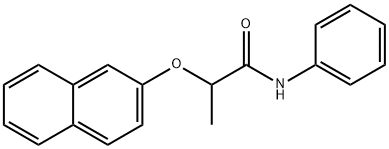
- CAS No.
- 52570-16-8
- Chemical Name:
- NAPROANILIDE
- Synonyms
- mt101;MT-101;uribest;Urigbest;NAPROANILIDE;Naproanilide-D5;naproanilide (jmaf);Naproanilide,10ug/ml;NAPROANILIDE STANDARD;naproanilide (JMAF only)
- CBNumber:
- CB8180559
- Molecular Formula:
- C19H17NO2
- Molecular Weight:
- 291.34
- MDL Number:
- MFCD01310442
- MOL File:
- 52570-16-8.mol
- MSDS File:
- SDS
| Melting point | 128 °C |
|---|---|
| Boiling point | 433.35°C (rough estimate) |
| Density | 1.1552 (rough estimate) |
| refractive index | 1.5000 (estimate) |
| storage temp. | 0-6°C |
| pka | 13.46±0.70(Predicted) |
| Henry's Law Constant | 1.6×10⁵ mol/(m3Pa) at 25℃, Hilal et al. (2008) |
| EWG's Food Scores | 1 |
NAPROANILIDE price More Price(5)
| Manufacturer | Product number | Product description | CAS number | Packaging | Price | Updated | Buy |
|---|---|---|---|---|---|---|---|
| Biosynth | CCA57016 | Naproanilide | 52570-16-8 | 5mg | $873.25 | 2026-06-04 | Buy |
| Biosynth | CCA57016 | Naproanilide | 52570-16-8 | 10mg | $1397.1 | 2026-06-04 | Buy |
| Biosynth | CCA57016 | Naproanilide | 52570-16-8 | 25mg | $2278 | 2026-06-04 | Buy |
| Biosynth | CCA57016 | Naproanilide | 52570-16-8 | 50mg | $3645 | 2026-06-04 | Buy |
| American Custom Chemicals Corporation | CHM0304535 | 2-(2-NAPHTHYLOXY)PROPIONANILIDE 95.00% | 52570-16-8 | 5MG | $503.45 | 2021-12-16 | Buy |
NAPROANILIDE Chemical Properties, Uses, Production
Description
Naproanilide is a rice herbicide. Itself it has no herbicidal activity however its major metabolite 2-(2-naphthoxy)propionic acid does. It is only slightly toxic. Photodegradation appears to be the main degradation pathway in paddy fields. Little is known about the toxicity of this substance to wildlife.
Chemical Properties
Pure product is white crystal, odorless. m.p.128°C, relative density 1.256 (25°C), vapor pressure 66.66Pa (110°C). solubility at 27°C: acetone 171g/L, benzene 36g/L, toluene 42g/L, ethanol 17g/L, water 0.74mg/L. Stable in neutral and weakly acidic solution, unstable in alkaline or hot strongly acidic solution. The The original drug is stable to, but the drug solution is not stable after water. Half-life in soil is 2-7d, disappear in 1 month.
Uses
Naproanilide is used as a herbicide.
Definition
ChEBI: Naproanilide is a member of naphthalenes.
Production Methods
Naproanilide is synthesised through a three-step process starting from 2-chloropropanoic acid, aniline, and 2-naphthol. First, 2-chloropropanoic acid undergoes a nucleophilic substitution with aniline, where the amine group replaces the chlorine atom, forming an amide intermediate. In the second step, this intermediate reacts with 2-naphthol in the presence of a base, such as sodium hydroxide, which activates the phenolic oxygen to act as a nucleophile. This leads to the formation of a naphthyl ether linkage, completing the structure of naproanilide.
Mechanism of action
Stimulates RNA synthesis. Absorbed through stems and roots. No herbicidal activity itself but is rapidly hydrolysed to an active metabolite
Metabolic pathway
In the rice paddy ecosystem, naproanilide is biodegraded by the rice plant and organisms in the paddy field and by soil organisms and is mainly hydrolyzed to 2-(2-naphthoxy)propionic acid (NOP) and its methyl ester (NOPM). In rice plants (Oryza sativa L.) and Sagittaria pygmaea MIQ, naproanilide is metabolized to phytotoxic NOP. In rice plants, NOP subsequently undergoes hydroxylation and rapid conjugation with glucose. Phytotoxic NOP is produced only in a small amount. In S. pygmaea, the amounts of NOP and NOPM are significantly greater than those in rice plants. The difference in metabolites of naproanilide shows a possible mechanism of their herbicidal selectivity. Naproanilide and NOP in aqueous solution are rapidly degraded under sunlight and UV light. The disappearance of naproanilide in the paddy field is largely attributed to photochemical degradation in the surface water.
Pesticide Type
Herbicide
NAPROANILIDE Preparation Products And Raw materials
Raw materials
1of4
Preparation Products
| Supplier | Tel | Country | ProdList | Advantage | |
|---|---|---|---|---|---|
| TianJin Alta Scientific Co., Ltd. | 022-65378550-8551 | contact@altascientific.com | China | 2772 | 58 |
| Alta Scientific Co., Ltd. | 022-6537-8550 15522853686 | sales@altasci.com.cn | China | 4508 | 55 |
| Shanghai YuanYe Biotechnology Co., Ltd. | 15026964105 | 2881489226@qq.com | China | 87240 | 60 |
| Shandong Xiya Chemical Co., Ltd. | 4009903999 13395398332 | sales@xiyashiji.com | China | 20788 | 60 |
| Shandong Ono Chemical Co., Ltd. | 0539-6362799 20) | China | 10007 | 58 | |
| Shenzhen Polymeri Biochemical Technology Co., Ltd. | +86-400-002-6226 | sales@rrkchem.com | China | 57336 | 58 |
| Chongqing Chemdad Co., Ltd | +86-023-6139-8061 +86-86-13650506873 | sales@chemdad.com | China | 39866 | 58 |
| Shanghai Jiegu Biotechnology Co., Ltd. | 021-51698675 | sales@jiejiegroup.com | China | 8198 | 58 |
| career henan chemical co | +86-0371-86658258 | factory@coreychem.com | China | 29780 | 58 |
| ShangHai Anpel Co, Ltd. | 18502138905 | shanpel@anpel.com.cn | China | 9604 | 58 |
View Latest Price from NAPROANILIDE manufacturers
| Image | Update time | Product | Price | Min. Order | Purity | Supply Ability | Manufacturer | |
|---|---|---|---|---|---|---|---|---|
 |
2020-02-13 | naproanilide (JMAF only)
52570-16-8
|
$1.00 | 1KG | Min98% HPLC | Career Henan Chemical Co |
-
- naproanilide (JMAF only)
52570-16-8
- $1.00
- Min98% HPLC
- Career Henan Chemical Co
