|
|
| | PF 02341066 hydrochloride Basic information |
| Product Name: | PF 02341066 hydrochloride | | Synonyms: | PF-02341066 HYDROCHLORIDE;PF-2341066 HYDROCHLORIDE;Crizotinib hydrochloride
(PF-02341066 hydrochloride;PF-2341066 hydrochloride);Crizotinib (hydrochloride);PF 02341066 hydrochloride;PF-02341066 hydrochloride;Crizotinib HCl,PF-02341066 HCl;3-[(1R)-1-(2,6-Dichloro-3-fluorophenyl)ethoxy]-5-[1-(4-piperidinyl)-1H-pyrazol-4-yl]-2-pyridinamine hydrochloride | | CAS: | 1415560-69-8 | | MF: | C21H23Cl3FN5O | | MW: | 486.7976232 | | EINECS: | | | Product Categories: | MET | | Mol File: | 1415560-69-8.mol | 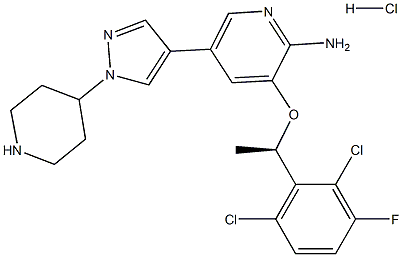 |
| | PF 02341066 hydrochloride Chemical Properties |
| storage temp. | Store at -20°C | | form | Powder | | color | Yellow to brown | | Water Solubility | ≥ 100.4 mg/mL in DMSO, ≥ 101.4 mg/mL in EtOH, ≥ 52.2 mg/mL in Water |
| | PF 02341066 hydrochloride Usage And Synthesis |
| Uses | Crizotinib hydrochloride (PF-02341066 hydrochloride) is an orally bioavailable, selective, and ATP-competitive dual ALK and c-Met inhibitor with IC50s of 20 and 8 nM, respectively. Crizotinib hydrochloride (PF-02341066 hydrochloride) inhibits tyrosine phosphorylation of NPM-ALK and tyrosine phosphorylation of c-Met with IC50s of 24 and 11 nM in cell-based assays, respectively. It is also a ROS proto-oncogene 1 (ROS1) inhibitor. Crizotinib hydrochloride (PF-02341066 hydrochloride) has effective tumor growth inhibition[1][2][3]. | | in vivo | PF-2341066 reveals the ability to cause marked regression of large established tumors (> 600 mm3) in both the 50 mg/kg/day and 75 mg/kg/day treatment cohorts, with a 60% decrease in mean tumor volume over the 43-day administration schedule in the GTL-16 model. In an another study, PF-2341066 displays the ability to completely inhibits GTL-16 tumor growth for >3 months, with only 1 of 12 mice exhibiting a significant increase in tumor growth over the 3-month treatment schedule at 50 mg/kg/day. A significant dose-dependent reduction of CD31-positive endothelial cells is observed at 12.5 mg/kg/day, 25 mg/kg/day, and 50 mg/kg/day in GTL-16 tumors, indicating that inhibition of MVD shows a dose-dependent correlation to antitumor efficacy. PF-2341066 displays a significant dose-dependent reduction of human VEGFA and IL-8 plasma levels in both the GTL-16 and U87MG models. Marked inhibition of phosphorylated c-Met, Akt, Erk, PLCλ1, and STAT5 levels is observed in GTL-16 tumors following p.o. administration of PF-2341066[1].
Treatment of c-MET-amplified GTL-16 xenografts with 50 mg/kg PF-2341066 elicits tumor regression that is associated with a slow reduction in 18F-FDG uptake and decreases expression of the glucose transporter 1, GLUT-1[4]. | | References | [1] Zou HY, et al. An orally available small-molecule inhibitor of c-Met, PF-2341066, exhibits cytoreductive antitumor efficacy through antiproliferative and antiangiogenic mechanisms. Cancer Res. 2007, 67(9), 4408-4417. DOI:10.1158/0008-5472.CAN-06-4443
[2] Christensen JG, et al. Cytoreductive antitumor activity of PF-2341066, a novel inhibitor of anaplastic lymphoma kinase and c-Met, in experimental models of anaplastic large-cell lymphoma. Mol Cancer Ther. 2007, 6(12 Pt 1), 3314-3322. DOI:10.1158/1535-7163.MCT-07-0365
[3] Cui JJ, et al. Structure based drug design of crizotinib (PF-02341066), a potent and selective dual inhibitor of mesenchymal-epithelial transition factor (c-MET) kinase and anaplastic lymphoma kinase (ALK). J Med Chem. 2011 Sep 22;54(18):6342-63. DOI:10.1021/jm2007613
[4] Cullinane C, et al. Differential (18)F-FDG and 3'-deoxy-3'-(18)F-fluorothymidine PET responses to pharmacologic inhibition of the c-MET receptor in preclinical tumor models. J Nucl Med. 2011 Aug;52(8):1261-7 DOI:10.2967/jnumed.110.086967 |
| | PF 02341066 hydrochloride Preparation Products And Raw materials |
|