|
|
| | Chlorfenprop-methyl Basic information |
| Product Name: | Chlorfenprop-methyl | | Synonyms: | METHYL-2-CHLORO-3-(4-CHLOROPHENYL)-PROPIONATE;CHLOROPHENPROP-METHYL;2-chloro-3-(4-chlorophenyl)-methylpropionate;2-chloro-3-(4-chlorophenyl)propionicacidmethylester;2-chloro-3-(4-chlorophenyl)-propionicacimethylester;CHLORFENPROP-METHYL PESTANAL (METHYL2-CH;chlorofenprop-methyl;chlorfenprop-methyl methyl 2-chloro-3-(4-chlorophenyl)propionate | | CAS: | 14437-17-3 | | MF: | C10H10Cl2O2 | | MW: | 233.09 | | EINECS: | 238-413-5 | | Product Categories: | Alpha sort;C;CAlphabetic;CH;Pesticides&Metabolites | | Mol File: | 14437-17-3.mol | 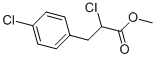 |
| | Chlorfenprop-methyl Chemical Properties |
| Boiling point | 153-156 °C(Press: 11-13 Torr) | | density | 1.2872 (estimate) | | Water Solubility | 40mg/L(20 ºC) | | BRN | 2331933 | | Henry's Law Constant | 4.4×100 mol/(m3Pa) at 25℃, Ebert et al. (2023) | | EPA Substance Registry System | Chlorfenprop-methyl (14437-17-3) |
| Hazard Codes | Xn,N | | Risk Statements | 21/22-50/53 | | Safety Statements | 36/37-60-61 | | RIDADR | UN2810 6.1/PG 3 | | WGK Germany | 3 | | RTECS | UE8840000 | | HS Code | 29163990 |
| | Chlorfenprop-methyl Usage And Synthesis |
| Description | Chorfenprop-methyl is an obsolete herbicide that was mainly used for controlling wild oats in winter cereals. It has a moderate aqueous solubility and is highly volatile. It is highly toxic to aquatic organisms. It is moderately toxic to mammals if ingested and is a recognised irritant. | | Uses | Chlorophenprop-methyl is used in bacterial fermentation products. | | Definition | ChEBI: Chlorfenprop-methyl is a member of monochlorobenzenes. | | Production Methods | The commercial production of chlorfenprop-methyl begins with the preparation of 4-chlorocinnamic acid via a Perkin condensation, where 4-chlorobenzaldehyde is reacted with malonic anhydride in the presence of a base catalyst like pyridine or triethylamine, followed by hydrolysis and decarboxylation to yield the alpha,beta-unsaturated carboxylic acid. This intermediate is then hydrogenated using catalytic hydrogenation with palladium on carbon or Raney nickel in a solvent producing the saturated 3-(4-chlorophenyl)propionic acid. The key alpha-chlorination step involves treating the propionic acid with chlorine gas or N-chlorosuccinimide in an inert solvent under UV irradiation or free-radical initiation, introducing the chlorine at the alpha-position, yielding 2-chloro-3-(4-chlorophenyl)propionic acid. Finally, esterification is performed by reacting the chlorinated acid with methanol in the presence of a strong acid catalyst such as sulphuric acid, or via a Fischer-Speier method under reflux with Dean-Stark azeotropic removal of water, followed by neutralisation, extraction, and distillation to isolate technical-grade chlorfenprop-methyl. | | Mechanism of action | Selective, basic metabolic processes become inactivated during autolysis | | Pesticide Type | Herbicide |
| | Chlorfenprop-methyl Preparation Products And Raw materials |
|